
Resources
Explore a wide range of valuable resources on GCED to deepen your understanding and enhance your research, advocacy, teaching, and learning.
3,777 Results found
 The Elusive and Exclusive Global Citizen Year of publication: 2015 Author: Jill Koyama Corporate author: Mahatma Gandhi Institute of Education for Peace and Sustainable Development (MGIEP) In this paper, the author interrogate the notion of global citizenship, both as an aspiration and an improbable practice, by situating it within contemporary understandings of citizenship and globalization.It is a conceptualization that suffers from the dangers inherent in the term “citizenship” and misconceptions of the terms “global,” and it is rooted in the West’s long engagement in normative undertakings in non-Western countries. The writer refute ideas of the autonomous and agentic global citizen. he encourage a rethinking of global citizenship and global citizenship education (GCE) and offer recommendations for redirecting attention to contemporary global stratifications and issues of human rights to address the issues of social justice and inequality that, due to the problematic definition of global citizenship, are currently inadequately covered in existing GCE curricula.
  Building Citizenship from Universities; University Social Responsibility and Challenges in the XXI century Year of publication: 2011 Author: Eduardo Gasca-Pliego | Julio César Olvera-García Corporate author: Universidad Autónoma del Estado de México The present essay contributes with a reflection on the role universities must take as agents of transformation and consolidation of the democratic model, mainly before the challenge of building full citizens, interested in the need of the physical and social environment, in collective decision making, who think of themselves as participant citizens and not only voters with their own interests in view. Distinguishable is the primordial role of university social responsibility to promote the social management of knowledge for everyone, which has as an end the construction of informed, responsible and participant citizenship, which responds to injustice, non-sustainability, violence and corruption. Rethinking the social function of the university requires defending the values proper to public education, in the sense that every citizen has equal opportunities to develop their capabilities, eliminating obstacles of social and economic nature, as well as the cultural and political that affect and hinder said development. Construir ciudadanía desde las universidades, responsabilidad social universitaria y desafíos ante el siglo XXI Year of publication: 2011 Author: Eduardo Gasca-Pliego | Julio César Olvera-García Corporate author: Universidad Autónoma del Estado de México El presente ensayo aporta una reflexión respecto al rol que deben adquirir las universidades como agentes de transformación y consolidación del modelo democrático, principalmente ante al reto de construir ciudadanos completos, interesados por las necesidades del entorno físico y social, por la toma de decisiones colectivas, que se conciben a sí mismos como ciudadanos partícipes y no únicamente como votantes con miras a satisfacer sus propios intereses. Destaca el papel prioritario de la responsabilidad social universitaria que promueva la gestión social del conocimiento para todos los actores sociales, que tenga como finalidad la construcción de una ciudadanía informada, responsable y participativa, que responda ante la injusticia, la insostenibilidad, la violencia y la corrupción. Repensar la función social de la universidad pública requiere defender los valores propios de la educación pública, en el sentido de que todos los ciudadanos tengan la igualdad de oportunidades para desarrollar sus capacidades, eliminando obstáculos de carácter económico y social, así como los culturales y políticos que afectan e impiden ese desarrollo.
  Citizenship, Identity, and Education: Examining the Public Purposes of Schools in an Age of Globalization Year of publication: 2006 Author: Fernando Reimers Corporate author: UNESCO International Bureau of Education (IBE) One of the purposes of educational institutions is to develop citizenship. In the 21st century, citizenship includes global citizenship. Addressing the challenges of globalization will require making citizenship education and the development of global values an explicit objective of efforts to improve quality throughout the world, critically examining theories and evidence about the effectiveness of various approaches to developing citizenship and global citizenship and supporting activities aligned with this public purpose. In this article, the author does not argue for an exclusive effort to focus schools on civic education, but rather for a balanced effort to elevate educational quality making it more relevant to address global challenges and opportunities, of which civic education and global education are components, much neglected at present. The author also does not suggest making civic education the only purpose of the curriculum or making it a priority to the expense of science, math, arts or physical and health education, but he thinks that helping students develop a sense of purpose, situated within broader civic and global purposes, would also facilitate high level engagement with science, mathematical and artistic pursuits.
  The Contribution of University Education to Instilling the Concept of Citizenship among Students at the Algerian University (vol.17, no.3; Journal of human resources development) Year of publication: 2022 Author: Maarcha Dalila Corporate author: University Mohamed Lamine Debaghine - Setif2 University education endeavors to equip students with the necessary skills and knowledge in scientific research and various disciplines, enabling them to confront the economic, social, and cultural challenges of life. The primary objective of university education is to fulfill societal needs for skilled human resources capable of contributing to societal development and keeping pace with global advancements in education and knowledge. In alignment with this, the University of Algeria aims to instill principles and values of citizenship among its students through its curricula and programs. It aims to foster a sense of belonging and patriotism, as well as to nurture national identity, thereby facilitating the holistic development of students across all dimensions. مساهمة التعليم الجامعي في غرس مفهوم المواطنة لدى الطلبة في الجامعة الجزائرية (vol.17, no.3 مجلة تنمية الملوارد البشرية) Year of publication: 2022 Author: Maarcha Dalila Corporate author: University Mohamed Lamine Debaghine - Setif2 يسعى التعليم الجامعي إلى إعداد الطلاب وتنمية قدراتهم في مجال البحث العلمي، وتكوينهم في مجالات التخصصات المختلفة لتحمل ومواجهة مسؤوليات الحياة الاقتصادية والاجتماعية والثقافية، فالهدف الرئيسي للتعليم الجامعي هو تلبية حاجات المجتمع من الموارد البشرية المؤهلة للقيام بدورها التنموي في المجتمع، وتساير التطورات الحديثة في القطاع أي عولمة التعليم والمعرفة، وتمثلت نتائج الدراسة الحالية في ان البرامج الجامعية المدرسة تسعى إلى زرع مبادئ وقيم المواطنة لدى طلبة الجامعة في ميدان العلوم الاجتماعية تخصص علم النفس وعلوم التربية ، والى تعميق روح الانتماء والولاء للوطن وترسيخ الهوية الوطنية في نفوسهم قصد التنمية المتكاملة لشخصياتهم في جوانبها المختلفة، ويبقى نجاحه مرهون بكفاءات طرائق التدريس ونجاعتها.
 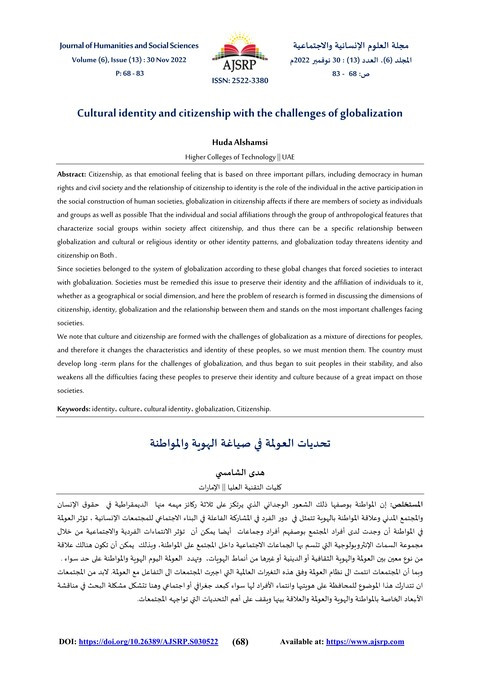 Cultural Identity and Citizenship With the Challenges of Globalization (Journal of Humanities and Social Sciences; Vol.6, No.13) Year of publication: 2022 Author: Huda Alshamsi Corporate author: Arab Institute of Science and Research Publishing (AISRP) Citizenship is the emotional feeling that is based on three important pillars, including democracy in human rights, civil society, and the relationship between citizenship and identity, is manifested in the active role of individuals in social construction within human societies. Globalization affects citizenship when it exists among individuals and groups in society. Individual and social affiliations, characterized by anthropological features within social groups, can also impact citizenship. Thus, there may be a specific relationship between globalization and cultural, religious, or other identity patterns. Today, globalization threatens both identity and citizenship. As societies adapt to the global system through these global changes that force interaction with globalization, it becomes essential for communities to address this issue to preserve their identity and individual belonging, whether geographically or socially. This forms the basis for researching the dimensions related to citizenship, identity, globalization, and their interrelationships, which pose significant challenges for societies. تحديات العولمة في صياغة الهوية والمواطنة (مجلة العلوم الإنسانية والإجتماعية; Vol. 6, No. 13) Year of publication: 2022 Author: Huda Alshamsi Corporate author: Arab Institute of Science and Research Publishing (AISRP) إن المواطنة بوصفها ذلك الشعور الوجداني الذي يرتكز على ثلاثة ركائز مهمه منها الديمقراطية في حقوق الإنسان والمجتمع المدني وعلاقة المواطنة بالهوية تتمثل في دور الفرد في المشاركة الفاعلة في البناء الاجتماعي للمجتمعات الإنسانية ، تؤثر العولمة في المواطنة أن وجدت لدى أفراد المجتمع بوصفهم أفراد وجماعات أيضا يمكن أن تؤثر الانتماءات الفردية والاجتماعية من خلال مجموعة السمات الإنثروبولوجية التي تتسم بها الجماعات الاجتماعية داخل المجتمع على المواطنة، وبذلك يمكن أن تكون هنالك علاقة من نوع معين بين العولمة والهوية الثقافية أو الدينية أو غيرها من أنماط الهويات، وتهدد العولمة اليوم الهوية والمواطنة على حد سواء . وبما أن المجتمعات انتمت الى نظام العولمة وفق هذه التغيرات العالمية التي اجبرت المجتمعات الى التفاعل مع العولمة. لابد من المجتمعات ان تتدارك هذا الموضوع للمحافظة على هويتيها وانتماء الأفراد لها سواء كبعد جغرافي أو اجتماعي وهنا تتشكل مشكلة البحث في مناقشة الأـبعاد الخاصة بالمواطنة والهوية والعولمة والعلاقة بينها ويقف على أهم التحديات التي تواجهه المجتمعات.
  Thoughts on Global Citizenship (Universal) Year of publication: 2017 Author: Nahla Abu Aliwa Corporate author: Arab Council for Childhood and Development (ACCD) This article addresses global citizenship as one of the hot topics the world currently. The researcher highlighted the difference between global citizenship and traditional citizenship. He also touched upon the concept of multiculturalism and its importance in this multicultural world. Emphasis was placed on the Education for Global Citizenship initiative proposed by UNESCO. أفكار حول المواطنة العالمية ( الكوكبية ) Year of publication: 2017 Author: Nahla Abu Aliwa Corporate author: Arab Council for Childhood and Development (ACCD) يتناول هذا المقال المواطنة الكوكبية باعتبارها أحد الموضوعات المطروحة بقوة على الساحة العالمية. قام الباحث بإلقاء الضوء على الفرق بين المواطنة العالمية والمواطنة التقليدية. وأيضا تطرق لمفهوم التعددية الثقافية وأهميته في العالم المتنوع الثقافات. كما تم التركيز على مبادرة التربية من أجل المواطنة العالمية والتي طرحتها منظمة اليونسكو.