
Resources
Explore a wide range of valuable resources on GCED to deepen your understanding and enhance your research, advocacy, teaching, and learning.
3,224 Results found
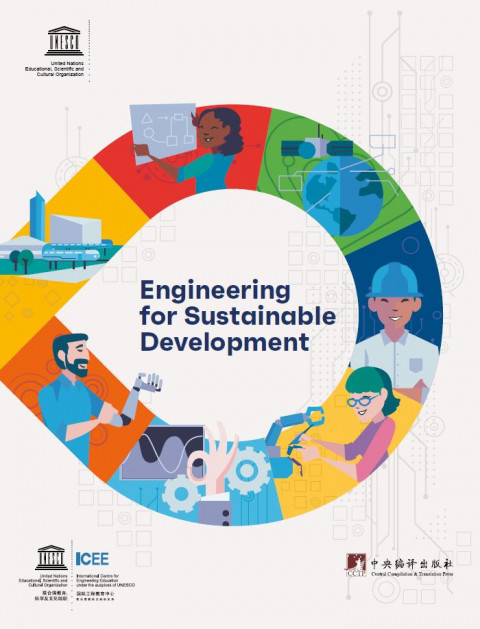 Engineering for Sustainable Development: Delivering on the Sustainable Development Goals Year of publication: 2021 Corporate author: UNESCO | International Centre for Engineering Education (ICEE) The report highlights the crucial role of engineering in achieving each of the 17 SDGs. It shows how equal opportunities for all is key to ensuring an inclusive and gender balanced profession that can better respond to the shortage of engineers for implementing the SDGs. It provides a snapshot of the engineering innovations that are shaping our world, especially emerging technologies such as big data and AI, which are crucial for addressing the pressing challenges facing humankind and the planet. It analyses the transformation of engineering education and capacity-building at the dawn of the Fourth Industrial Revolution that will enable engineers to tackle the challenges ahead. It highlights the global effort needed to address the specific regional disparities, while summarizing the trends of engineering across the different regions of the world.By presenting case studies and approaches, as well as possible solutions, the report reveals why engineering is crucial for sustainable development and why the role of engineers is vital in addressing basic human needs such as alleviating poverty, supplying clean water and energy, responding to natural disasters, constructing resilient infrastructure, and bridging the development divide, among many other actions, leaving no one behind.It is hoped that the report will serve as a reference for governments, engineering organizations, academia and educational institutions, and industry to forge global partnerships and catalyse collaboration in engineering so as to deliver on the SDGs. 工程—支持可持续发展 Year of publication: 2021 Corporate author: UNESCO | International Centre for Engineering Education (ICEE) 报告强调了工程在实现17项可持续发展目标中的关键作用。它表明,人人机会均等是确保一个包容性和性别均衡的职业的关键,能够更好地应对实施可持续发展目标的工程师短缺的问题。它提供了塑造我们世界的工程创新的快照,特别是大数据和人工智能等新兴技术,这些技术对于解决人类和地球面临的紧迫挑战至关重要。它分析了第四次工业革命初期工程教育和能力建设的转变,这将使工程师能够应对未来的挑战。它强调了解决具体地区差异所需的全球努力,同时总结了世界不同地区的工程趋势。通过介绍案例研究和方法以及可能的解决办法,报告揭示了为什么工程对可持续发展至关重要,以及为什么工程师的作用对解决人类的基本需求至关重要,例如减轻贫困、提供清洁水和能源、应对自然灾害,在许多其他行动中,建设有弹性的基础设施和弥合发展鸿沟,不让任何人掉队。希望该报告能为各国政府、工程组织、学术界和教育机构以及工业界建立全球伙伴关系和促进工程领域的合作提供参考,以实现可持续发展目标。
  Asia-Pacific Digital Transformation Report 2024: Digital Innovation for Smarter Climate Action Year of publication: 2024 Corporate author: UN. Economic and Social Commission for Asia and the Pacific (UN. ESCAP) In Asia and the Pacific, the climate crisis intersects with digital transformations through a complex mix of challenges and opportunities, creating a series of vicious but also potentially virtuous cycles. The Asia-Pacific Digital Transformation Report 2024 considers how digital transformations will structurally and irreversibly affect the trajectory of climate change. It presents a digital-growth-climate nexus to better understand the diverse and dynamic picture and considers ways in which the region can follow the most positive trajectory to avert a climate catastrophe. The Report showcases good practices and country examples of digital applications in addressing climate change, in terms of mitigation and adaptation. These can involve the use of artificial intelligence, the Internet of Things, big data, digital twins, geospatial technologies and others, which have been employed in infrastructure, government, mobility, industry and trade, digital data centres, disaster risk reduction, agriculture and biodiversity ecosystems. The Report then explores key drivers of digital transformation for climate change and outlines three future scenarios. It concludes with the key findings of the Report and proposes policy actions aligned with the five actors of the Digital Transformation Index Framework.
 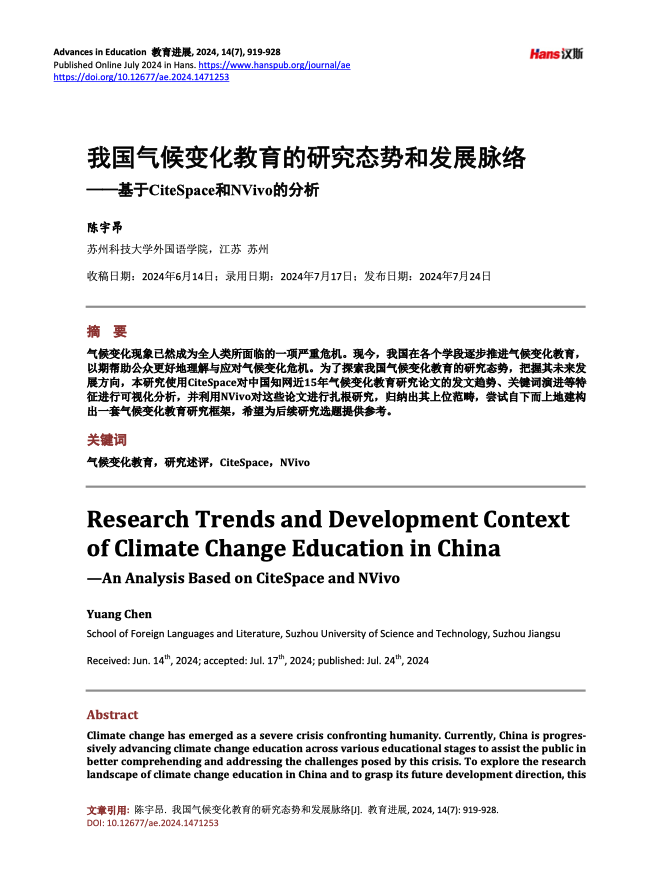 我国气候变化教育的研究态势和发展脉络 : 基于CiteSpace和NVivo的分析 (教育进展 第14卷 第7期) Year of publication: 2024 Author: 陈宇昂 气候变化现象已然成为全人类所面临的一项严重危机。现今,我国在各个学段逐步推进气候变化教育,以期帮助公众更好地理解与应对气候变化危机。为了探索我国气候变化教育的研究态势,把握其未来发展方向,本研究使用CiteSpace对中国知网近15年气候变化教育研究论文的发文趋势、关键词演进等特征进行可视化分析,并利用NVivo对这些论文进行扎根研究,归纳出其上位范畴,尝试自下而上地建构出一套气候变化教育研究框架,希望为后续研究选题提供参考。
  The Impact of a Program Based on Education for Sustainability Principles in Developing Awareness of Climate Change and the Environmental Citizenship Values Among Middle School Students in Slum Areas. (vol.48, no.2; International Journal for Research in Education) Year of publication: 2024 Author: Nermin Awny Mohammad | Ibrahim Ahmed Abdelhady Corporate author: United Arab Emirates University The research aimed to investigate the impact of a program grounded in sustainability education principles on the development of climate change awareness and environmental citizenship values among second-grade middle school students residing in slum areas. The study utilized a quasi-experimental approach. أثر برنامج قائم على مبادئ التربية من أجل الاستدامة في تنمية الوعي بالتغيرات المناخية، وقيم المواطنة البيئية لدى تلاميذ المرحلة المتوسطة بالمناطق العشوائية (vol.48, no.2 المجلة الدولية للأبحاث والتربوية) Year of publication: 2024 Author: Nermin Awny Mohammad | Ibrahim Ahmed Abdelhady Corporate author: United Arab Emirates University هدف البحث إلى الكشف عن أثر برنامج قائم على مبادئ التربية من أجل الاستدامة في تنمية الوعي بالتغيرات المناخية، وقيم المواطنة البيئية لدى تلاميذ الصف الثاني من المرحلة المتوسطة بالمناطق العشوائية، واعتمد البحث على المنهج شبه التجريبي
 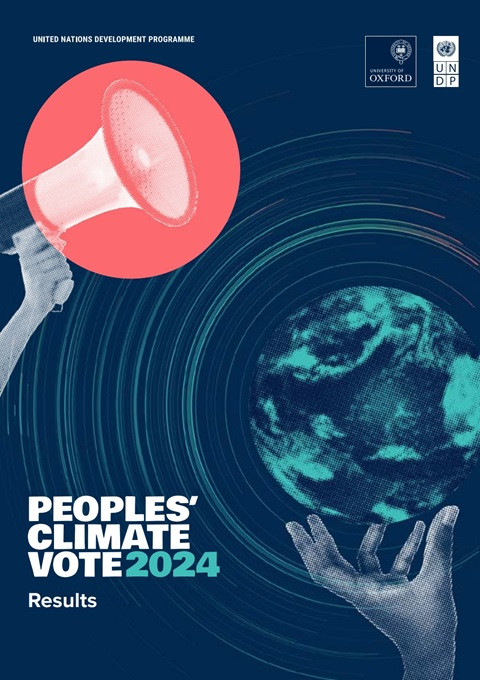 People's Climate Vote 2024 Year of publication: 2024 Author: Cassie Flynn | Silvia Tovar Jardon | Stephen Fisher | Matthew Blayney | Albert Ward | Hunter Smith | Paula Struthoff | Zoë Fillingham Corporate author: United Nations Development Programme (UNDP) | University of Oxford The Peoples’ Climate Vote is the world’s largest standalone public opinion survey on climate change. It serves as a platform for people to express their concerns and needs on climate change to world leaders. This initiative, carried out by UNDP and the University of Oxford, was launched in 2021 with a first poll that surveyed people across 50 countries through adverts in popular mobile gaming apps. The 2024 survey is bigger in terms of scope: 77 countries, representing 87 percent of the world’s population, were asked their views on climate change. The 15 questions in the 2024 edition have never been put to people in any survey before. They asked how people’s day-to-day lives are impacted by climate change, how they feel it is being addressed in their countries and what they would like the world to do about it. The results give the most comprehensive public account yet of how people feel and respond to climate change. The Peoples’ Climate Vote 2024 results come at a crucial time. Leading scientific bodies warn that climate change is accelerating faster than expected. Meanwhile, global GHG emission levels continue to rise, and international tensions and conflicts are similarly on the increase. With more than half of the world’s population potentially voting in 2024, understanding how citizens are thinking about climate change is more important than ever. The survey’s results can help decision makers navigate this challenging context, and beyond. To explore the data and country results in more detail, please visit: https://peoplesclimate.vote/
 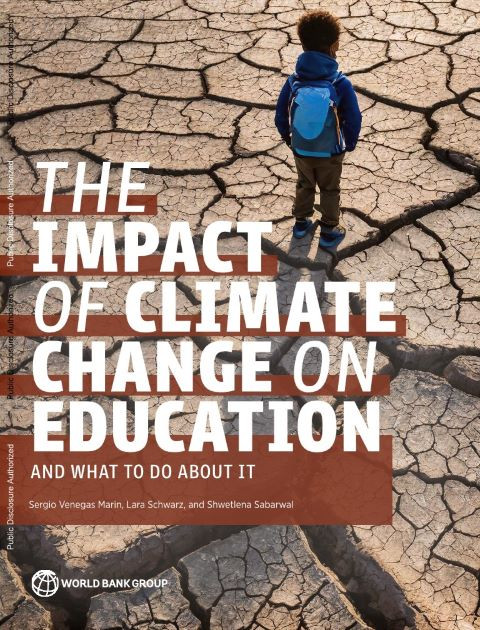 The Impact of Climate Change on Education and What to Do about It Year of publication: 2024 Author: Sergio Venegas Marin | Lara Schwarz | Shwetlena Sabarwal Corporate author: International Bank for Reconstruction and Development | World Bank Education can be the key to ending poverty in a livable planet, but governments must act now to protect it. Climate change is increasing the frequency and intensity of extreme weather events such as cyclones, floods, droughts, heatwaves and wildfires. These extreme weather events are in turn disrupting schooling; precipitating learning losses, dropouts, and long-term impacts. Even if the most drastic climate mitigation strategies were implemented, extreme weather events will continue to have detrimental impacts on education outcomes.
  Leveraging Digitalization for Productivity and Decent Employment: Asia-Pacific Countries with Special Needs Development Report 2024 Year of publication: 2024 Corporate author: UN. Economic and Social Commission for Asia and the Pacific (UN. ESCAP) The Asia-Pacific Countries with Special Needs Development Report is a recurrent ESCAP annual publication that discusses issues of interest for Asia-Pacific least developed countries (LDCs), landlocked developing countries (LLDCs) and small island developing States (SIDS), collectively referred to as countries with special needs (CSN). The Asia-Pacific Countries with Special Needs Development Report 2023: Strengthening Regional Cooperation for Seamless and Sustainable Connectivity examines how regional cooperation on seamless and sustainable connectivity can facilitate a long-term transformation towards a net zero carbon emissions future. Recognising ongoing efforts and existing initiatives and considering the large financing gaps in the countries in special situations, the Report underscores the need to seek synergies between transport, energy, and digital connectivity initiatives in the region.
  Synergy Solutions for a World in Crisis: Tackling Climate and SDG Action Together Year of publication: 2023 Corporate author: UNFCCC | UN. Department of Economic and Social Affairs (UN. DESA) In May 2023 UNDESA and UNFCCC Secretariat co-convened the Expert Group on Climate and SDG Synergy. The Group consists of 14 renowned experts from diverse thematic and geographic backgrounds who were given the task of developing the First Global Report on Climate and SDG Synergies. This report demonstrates that aggressively acting on climate and development in an integrated and synergistic way is an important opportunity to achieve the course correction the UN Secretary- General has called for. It highlights some of the challenges but also the opportunities if the international community is seriously committed to enhancing these synergies and thereby addressing these challenges. The report is designed to provide a broad overview of available data and evidence, insights from experts on the frontlines, and recommendations for enhancing synergistic action across the 2030 Agenda and the SDGs. This first edition will form the basis for future iterations, which will entail a wider scope of sectors, and thematic areas and deep dives on specific issues pertaining to strengthening and operationalizing synergic climate and SDG actions at all levels.