
Resources
Explore a wide range of valuable resources on GCED to deepen your understanding and enhance your research, advocacy, teaching, and learning.
2,199 Results found
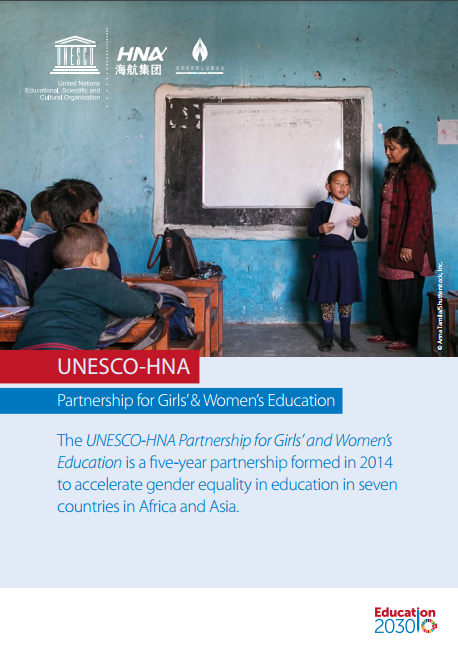 UNESCO-HNA Partnership for Girls' & Women's Education Year of publication: 2017 Corporate author: UNESCO The UNESCO-HNA Partnership for Girls’ and Women’s Education is one component of the “Better Life, Better Future” Global Partnership for Girls’ and Women’s Education launched by UNESCO in 2011. The Global Partnership recognizes that educating girls and women can break the cycle of poverty, foster greater social justice and contribute to the achievement of the Sustainable Development Goals. It aims to expand and improve the quality and relevance of education for girls and women, creating a better life and better future for all members of society for generations to come.
  The United Nations world water development report 2016: water and jobs Year of publication: 2016 Corporate author: UNESCO Three out of four jobs worldwide rely on water. As such, water shortages and lack of access may limit economic growth in the years to come, according to the World Water Development Report 2016. From its collection, through various uses, to its ultimate return to the natural environment, water is a key factor in the development of job opportunities either directly related to its management (supply, infrastructure, wastewater treatment, etc.) or in economic sectors that are heavily water-dependent such as agriculture, fishing, power, industry and health. In its analysis of the economic impact of access to water, the report cites numerous studies that show a positive correlation between investments in the water sector and economic growth. It also highlights the key role of water in the transition to a green economy. Rapport mondial des Nations Unies sur la mise en valeur des ressources en eau 2016: l'eau et l'emploi Year of publication: 2016 Corporate author: Organisation des Nations Unies pour l'éducation, la science et la culture (UNESCO) Three out of four jobs worldwide rely on water. As such, water shortages and lack of access may limit economic growth in the years to come, according to the World Water Development Report 2016. From its collection, through various uses, to its ultimate return to the natural environment, water is a key factor in the development of job opportunities either directly related to its management (supply, infrastructure, wastewater treatment, etc.) or in economic sectors that are heavily water-dependent such as agriculture, fishing, power, industry and health. In its analysis of the economic impact of access to water, the report cites numerous studies that show a positive correlation between investments in the water sector and economic growth. It also highlights the key role of water in the transition to a green economy.
 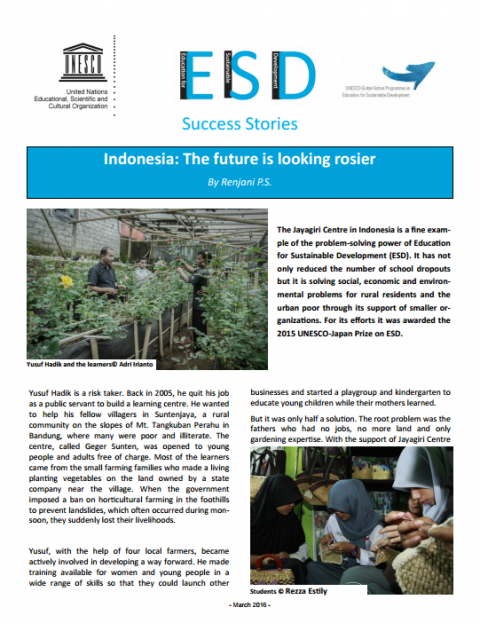 Indonesia: the future is looking rosier Year of publication: 2016 Author: P.S. Renjani Corporate author: UNESCO ESD Success Stories are showcasing compelling stories with a personal/human dimension from all five UNESCO regions (Africa, Arab States, Asia and Pacific, Europe & North America and Latin America & the Caribbean). The stories illustrate the wide diversity of ESD approaches and initiatives taking place in different parts of the world. They show how involvement with ESD has changed the lives of specific individual persons and how they have become more active in their community. Each story centers on one individual or a group of individuals.The Jayagiri Centre in Indonesia teaches environment-friendly business skills. It helps reduce the number of school dropouts and supports rural residents. Indonésie: l'avenir s'annonce plus rose Year of publication: 2016 Author: P.S. Renjani Corporate author: Organisation des Nations Unies pour l'éducation, la science et la culture (UNESCO) ESD Success Stories are showcasing compelling stories with a personal/human dimension from all five UNESCO regions (Africa, Arab States, Asia and Pacific, Europe & North America and Latin America & the Caribbean). The stories illustrate the wide diversity of ESD approaches and initiatives taking place in different parts of the world. They show how involvement with ESD has changed the lives of specific individual persons and how they have become more active in their community. Each story centers on one individual or a group of individuals.The Jayagiri Centre in Indonesia teaches environment-friendly business skills. It helps reduce the number of school dropouts and supports rural residents. Indonesia: hacia un futuro más prometedor Year of publication: 2016 Author: P.S. Renjani Corporate author: Organización de las Naciones Unidas para la Educación, la Ciencia y la Cultura (UNESCO) ESD Success Stories are showcasing compelling stories with a personal/human dimension from all five UNESCO regions (Africa, Arab States, Asia and Pacific, Europe & North America and Latin America & the Caribbean). The stories illustrate the wide diversity of ESD approaches and initiatives taking place in different parts of the world. They show how involvement with ESD has changed the lives of specific individual persons and how they have become more active in their community. Each story centers on one individual or a group of individuals.The Jayagiri Centre in Indonesia teaches environment-friendly business skills. It helps reduce the number of school dropouts and supports rural residents.
 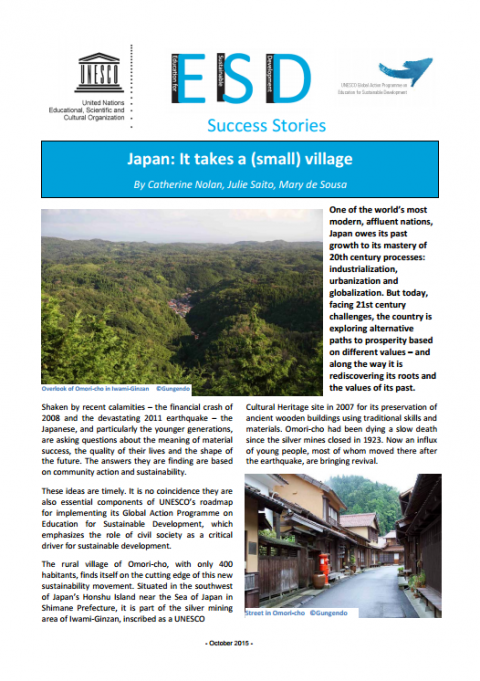 Japan: it takes a (small) village Year of publication: 2015 Author: Catherine Nolan | Julie Saito | Mary de Sousa Corporate author: UNESCO ESD Success Stories are showcasing compelling stories with a personal/human dimension from all five UNESCO regions (Africa, Arab States, Asia and Pacific, Europe & North America and Latin America & the Caribbean). The stories illustrate the wide diversity of ESD approaches and initiatives taking place in different parts of the world. They show how involvement with ESD has changed the lives of specific individual persons and how they have become more active in their community. Each story centers on one individual or a group of individuals.The small village of Omori-cho in Japan explores alternative paths to prosperity based on community action and sustainability. Japon: il suffit d'un (petit) village Year of publication: 2015 Author: Catherine Nolan | Julie Saito | Mary de Sousa Corporate author: Organisation des Nations Unies pour l'éducation, la science et la culture (UNESCO) ESD Success Stories are showcasing compelling stories with a personal/human dimension from all five UNESCO regions (Africa, Arab States, Asia and Pacific, Europe & North America and Latin America & the Caribbean). The stories illustrate the wide diversity of ESD approaches and initiatives taking place in different parts of the world. They show how involvement with ESD has changed the lives of specific individual persons and how they have become more active in their community. Each story centers on one individual or a group of individuals.The small village of Omori-cho in Japan explores alternative paths to prosperity based on community action and sustainability. Japón: se necesita una (pequeña) aldea Year of publication: 2015 Author: Catherine Nolan | Julie Saito | Mary de Sousa Corporate author: Organización de las Naciones Unidas para la Educación, la Ciencia y la Cultura (UNESCO) ESD Success Stories are showcasing compelling stories with a personal/human dimension from all five UNESCO regions (Africa, Arab States, Asia and Pacific, Europe & North America and Latin America & the Caribbean). The stories illustrate the wide diversity of ESD approaches and initiatives taking place in different parts of the world. They show how involvement with ESD has changed the lives of specific individual persons and how they have become more active in their community. Each story centers on one individual or a group of individuals.The small village of Omori-cho in Japan explores alternative paths to prosperity based on community action and sustainability.
  Okayama City: public and private sectors united for ESD Year of publication: 2017 Author: Rika Usami Corporate author: UNESCO ESD Success Stories are showcasing compelling stories with a personal/human dimension from all five UNESCO regions (Africa, Arab States, Asia and Pacific, Europe & North America and Latin America & the Caribbean). The stories illustrate the wide diversity of ESD approaches and initiatives taking place in different parts of the world. They show how involvement with ESD has changed the lives of specific individual persons and how they have become more active in their community. Each story centers on one individual or a group of individuals.Okayama City is known as one of the most comfortable places to live in Japan.The city offers more than an enjoyable lifestyle; it is also a world leader in the promotion of Education for Sustainable Development (ESD).