
Resources
Explore a wide range of valuable resources on GCED to deepen your understanding and enhance your research, advocacy, teaching, and learning.
3,387 Results found
 Estrategias para salir de la modernidad: la necesidad de un giro epistemológico y educativo para superar la crisis Year of publication: 2019 Author: Mauro Rodrigo Avilés Salvador Según el autor: "la crisis de la modernidad ha conllevado una crisis de la educación. Responder a esta crisis, de ninguna manera, puede ser una respuesta única o uniforme. Cada contexto debe responder a las demandas de los cambios requeridos. Si se concibe a la educación como la herramienta clave para una transformación social, no se puede desconocer su papel en la propuesta de nuevos modelos civilizatorios. Un aporte para la superación de la crisis lo constituye la reflexión sobre el símbolo, sobre su presencia en el arte y en la religión, ejes que pueden proponer nuevos elementos para una humanización del futuro." Luego, en el artículo, desde una perspectiva crítica, el autor enfatiza el rol de América Latina como propiciador de un cambio "diferente", desde el ethos cultural que caracteriza lo "latinamericano". Cita a Edgar Morin y habla de la necesidad de una educación pluaral que favorezca la democracia, basada en los Derechos Humanos. Si bien menciona aspectos universales no menciona una ciudadanía planetaria y critica el modelo europeo.
 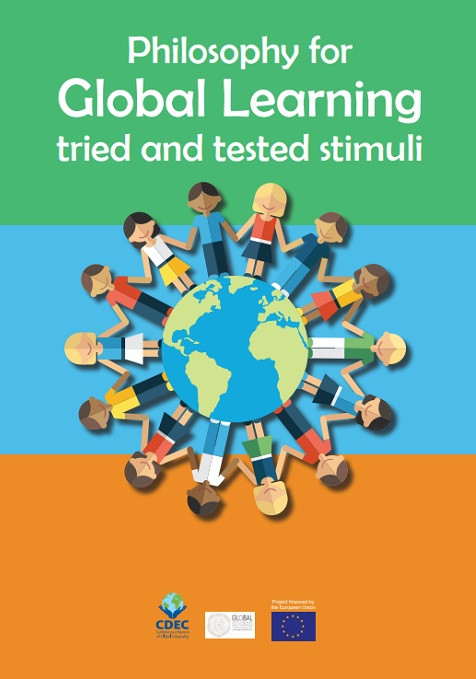 Philosophy for Global Learning: Tried and Tested Stimuli Year of publication: 2018 Corporate author: Cumbria Development Education Centre(CDEC) | European Union (EU) | Global Schools Program Philosophy for Global Learning has been created as a flexible and practical resource for teachers of all levels of experience. It is for those who want to teach global awareness to children through the structure of Philosophy for Children. Philosophy for Global Learning is aimed for use with children in Key Stage 2 but some parts can be used with younger children.
  Preparing teachers to educate for 21st century global citizenship:envisioning and enacting Year of publication: 2014 Author: Linyuan Guo Corporate author: Centennial College The changing educational landscape in the global context and the increasing interconnectedness and interdependence of the world have placed unprecedented demands on teacher education programs in preparing teachers to educate for 21st century global citizenship in K-12 schools. To chart the course of preparing global educators for an interconnected world, the Faculty of Education at the University of Prince Edward Island (UPEI) and UNICEF Canada have collaboratively developed an undergraduate course, entitled Educating for Global Citizenship. It focuses on preparing educators to teach for 21st century global citizenship and has been integrated into UPEI’s teacher preparation program as a compulsory course. This paper is based on a three-year study examining teacher candidates' experiences in learning to educate for global citizenship, the changes of their perceptions on global citizenship education, and the challenges and achievements they experienced in educational practices. Findings from this study indicate the unique opportunities and challenges teachers face in learning to educate for global citizenship and suggest the necessity of integrating global citizenship education in teacher education programs through a holistic approach.
  Green Marketing in the Conformation of a Planetary Citizenship in the Educational Field Latinamerican Year of publication: 2019 Author: Julio Juvenal Aldana Zavala | Félix Colina Ysea The article reviews and analyzes the contribution of green marketing in the formation of a planetary citizenship in the latin american educational systems. A documental and biblographic review methodology was used to gather and structure the information. The content of the documents was analyzed trying to discover the implicit competences for global citizenshipo present in the information. One of the main conclusions is that green marketing offers education the possibility of building competences that favour global thinking in students; thing that should be encouraged from a latin american green education perspective for the global context. Marketing verde en la conformación de una ciudadanía planetaria en el ámbito educativo latinoamericano Year of publication: 2019 Author: Julio Juvenal Aldana Zavala | Félix Colina Ysea El artículo de revisión tuvo por objetivo analizar el aporte del marketing verde en la conformación de una ciudadanía planetaria en el ámbito educativo latinoamericano. Se empleó una metodología de tipo documental con un diseño bibliográfico que permitió estructurar la información recopilada, se aplicó un análisis de contenido con la finalidad de descubrir las competencias implícitas en la información analizada. Entre las principales conclusiones se tiene que el marketing verde ofrece a la educación, la posibilidad de edificar competencias en el estudiante en pro de configurar un pensamiento global, el cual debe ser fomentado desde una educación verde planetaria latinoamericana para el contexto global.
  Epistemology from the South: A Decolonized Vision of the Objectives for Sustainable Development Year of publication: 2016 Author: Javier Collado Ruano Corporate author: Universidade de Sao Paulo The research object of this article is to identify the different epistemological and methodological perspectives that have emerged from the global South. It also addresses the irruption of globalization and cross-border processes of climate change from the called “epistemology of the South” perspective. As a result, it claims the need for cross-cultural bridges between people from all over the world to overcome the paradigmatic crossroads at which we find ourselves as a world-system, with the aim to achieve the Sustainable Development Goals set by the United Nations for the year 2030. Epistemología del Sur: una visión descolonial a los Objetivos de Desarrollo Sostenible Year of publication: 2016 Author: Javier Collado Ruano Corporate author: Universidade de Sao Paulo El objeto de investigación del presente artículo es identificar las diferentes perspectivas epistemológicas y metodológicas que han emergido desde el Sur global. También se aborda la irrupción de la globalización y los procesos transfronterizos del cambio climático desde la denominada “epistemología del sur”. Como resultado, se manifiesta la necesidad de crear puentes transculturales entre los pueblos de todo el mundo para superar la encrucijada paradigmática en la que nos encontramos como sistema-mundo, con la finalidad de alcanzar los Objetivos de Desarrollo Sostenible establecidos por los Naciones Unidas para el año 2030.
 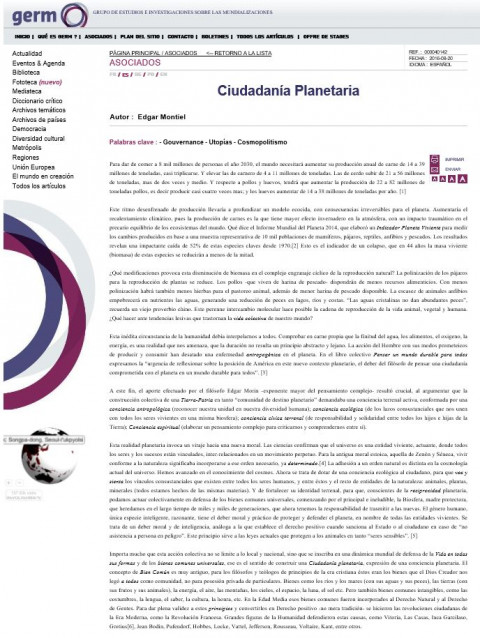 Planetary Citizenship Year of publication: 2016 Author: Edgar Montiel The blog contains and article where many worldiwide problems that humans are facing are described, and it states that it is necessary to modifiy the way in which we live by adopting a practical education that will enable sustainable life in the planet as it would consider environmental sustainability and peaceful international cooperation from diverse perspectives. Ciudadanía Planetaria Year of publication: 2016 Author: Edgar Montiel El blog contiene un artículo donde se describen los problemas actuales que enfrenta la humanidad a escala planetaria y se arguye que se precisas modificar la forma en que vivimos adoptando una educación práctica de vida sostenible que tenga en cuenta el medio ambiente y la cooperación internacional pacífica desde la diversidad.
  Programa de formación continua en educación para la sustentabilidad; Informe Edición 2018 Year of publication: 2018 Corporate author: Universidad de San Andrés El programa(Programa de Educación para la Sustentabilidad) se propuso trabajar en la promoción de la Educación para la Susten-tabilidad en las escuelas, a fin de generar en toda la comunidad educativa una cultu-ra sustentable. Este trabajo se basó en un enfoque holístico orientado al desarrollo de una mirada crítica y transformadora, y en la promoción de la participación ciuda-dana.Nuestro planteo fue que cada participante diseñe una propuesta pedagógica innova-dora en Educación para la Sustentabilidad, que responda a las particularidades de su institución de pertenencia, pero que a la vez pueda ser replicada por otras institu-ciones y actores. De esta forma, se deja capacidad instalada para la planificación e implementación de proyectos educativos orientados a la promoción de la Educación para la Sustentabilidad. Mediante las suce-sivas ediciones del programa, buscamos fortalecer una masa crítica de especialistas en Educación para la Sustentabilidad como apoyo a la calidad del sistema educativo en Argentina, conformando una Comunidad Profesional de Aprendizaje que reconozca a nuestro programa como un espacio de encuentro y referencia.