
Resources
Explore a wide range of valuable resources on GCED to deepen your understanding and enhance your research, advocacy, teaching, and learning.
3,229 Results found
 Innovating Technical and Vocational Education and Training: A Framework for Institutions Year of publication: 2020 Corporate author: UNESCO International Centre for Technical and Vocational Education and Training (UNEVOC) Global developments including the transition to greener economies, the application of digital technologies in the world of work, and the COVID-19 pandemic, amongst others, are changing the way we live and work. These developments are driving technical and vocational education and training (TVET) systems to improve their capacity to identify the future skills demands and to expand access to skills development opportunities. As TVET adapts itself to the impacts of significant social, environmental, and economic disruptions, innovative practices emerge with the potential to rejuvenate the future of skills development. Schools, training centres and colleges have the potential to play a leading role to drive innovation in their local skills and innovation ecosystem.This practical guide provides a systematic, institution-wide, measurable and evidence-based methodology that enables TVET institutions to streamline innovation into their strategic planning, products and services, ecosystem engagement, and teaching and learning processes.
  Putting the Voice of Young People at the Heart of Global Citizenship Education Year of publication: 2014 Author: Douglas Bourn Corporate author: UCL Institute of Education | Erasmus+ This briefing is aimed at policy-makers across Europe who are engaged with, or interested in ensuring that education and international development programmes give consideration to the voices of young people. It also aims to contribute to policy-makers responses to how they are implementing the Sustainable Development Goals.
  The Effect of Integration in Kindergarten in Improving Verbal and Non-Verbal Communication among Children with Autism spectrum Disorder Year of publication: 2023 Author: Bin Fatima Maryam Corporate author: University of Blida 2 This study aimed to identify the effect of integration in kindergartens on improving verbal and non-verbal communication among children with autism spectrum disorder by presenting the development of a group of seven children (3-4) years old who were diagnosed with autism spectrum disorder and then integrating them for a full year in kindergartens. The study, based on the Cars scale for estimating childhood autism, the verbal and non-verbal communication test, and the Brunet-Lèzine test, found that there are statistically significant differences between integration in kindergarten and both verbal and non-verbal communication, the degree of estimation of childhood autism, and the coefficient of the growth. أثر الدمج في رياض الأطفال في تحسين التواصل اللفظي و غير اللفظي لدى الأطفال المصابين باضطراب طيف التوحد Year of publication: 2023 Author: Bin Fatima Maryam Corporate author: University of Blida 2 هدفت هذه الدراسة إلى التعرف على أثر الدمج في رياض الأطفال على تحسين التواصل اللفظي وغير اللفظي لدى الأطفال المصابين باضطراب طيف التوحد بتقديم تطوُر لمجموعة من سبعة أطفال( 3- 4) سنوات تم تشخيصهم باضطراب طيف التوحد ثم دمجهم لمدة عام كامل في رياض الأطفال. و توصلت الدراسة بالاعتماد على مقياس كارز لتقدير التوحد الطفولي ، و اختبار التواصل اللفظي وغير اللفظي ، و اختبار بروني ليزين إلى وجود فروق دالة إحصائيا بين الدمج في رياض الأطفال و كل من التواصل اللفظي وغير اللفظي و درجة تقدير التوحد الطفولي و معامل النمو.
  Ministerial Forum: Global Dialogue on ICT and Education Innovation – Towards Sustainable Development Goal for Education (SDG 4); Proceedings Year of publication: 2019 Corporate author: UNESCO Institute for Information Technologies in Education (IITE) The present publication contains articles based on the outcomes of the Ministerial Forum “Global Dialogue on ICT and Education Innovation – Towards Sustainable Development Goal for Education (SDG 4)”, organized by UNESCO IITE in cooperation with the Ministry of Education and Science of the Russian Federation in Moscow (Russia) on 18-19 March, within the Moscow International Education Fair 2018 (MIEF 2018).The publication covers the flagship topics such as ICT potential for future teachers and future schools, digital pedagogy and OER, collaboration between public and private sectors in the use of ICT in education, digital technologies for quality and equity in education.
 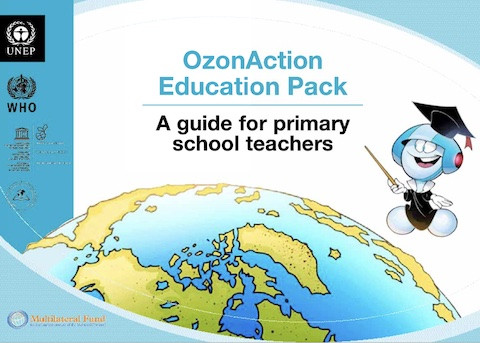 OzonAction Education Pack: A Guide for Primary School Teachers Year of publication: 2006 Author: Fabienne Pierre Corporate author: United Nations Environment Programme (UNEP) This education pack contains an entire teaching and learning programme, based on basic knowledge, practical skills and participation, for students to learn about concrete and simple solutions to protect the ozone layer and safely enjoy the sun.
 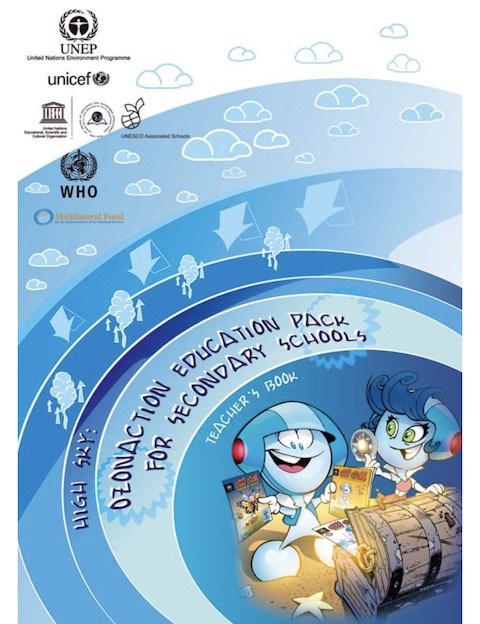 OzonAction Education Pack for Secondary School Teachers: Teacher’s Book Year of publication: 2008 Author: Wayne Talbot Corporate author: United Nations Environment Programme (UNEP) The education pack aims to raise awareness and encourage the active participation of young people in the debate on ozone depletion, its potential effects on them, the place in which they live and the planet. It also offers them a chance to design their own projects for taking action. These materials build upon ideas and activities in our OzonAction Education Pack for Primary Schools and other Ozzy Ozone materials. Education à la Couche d’Ozone: Guide de l’enseignant Year of publication: 2008 Author: Wayne Talbot Corporate author: United Nations Environment Programme (UNEP) Ce pack éducatif vise à sensibiliser les jeunes et à encourager leur participation active au débat sur la réduction de la couche d’ozone, les effets potentiels qu’elle peut avoir sur eux, sur leur lieu de vie et sur la planète. Il leur offre également l’opportunité d’élaborer leur propre projet d’action. Ce matériel pédagogique s’inspire des idées et des activités présentées dans le Pack Educatif pour les écoles primaires et autres productions Ozzy Ozone.
 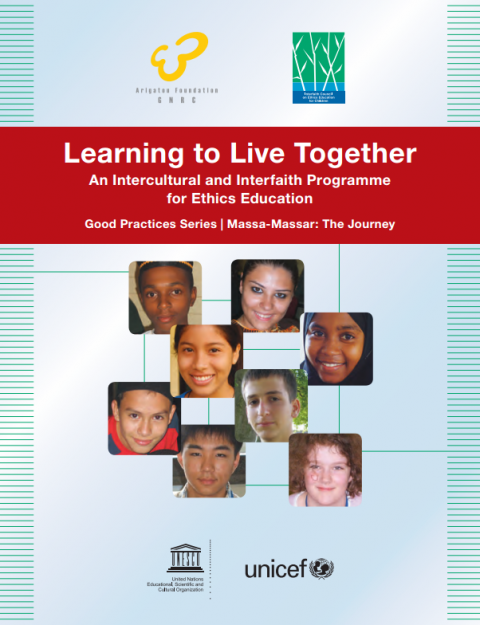 Learning to live together: an intercultural and interfaith programme for ethics education: Good Practices Series; Massa-Massar: The Journey Year of publication: 2012 Corporate author: United Nations Children's Fund (UNICEF) | Interfaith Council on Ethics Education for Children | Arigatou Foundation The Massa-Massar programme creates opportunities for Jews and Palestinians to meet, learn from one another, challenge their prejudices and stereotypes, listen to new narratives and reflect on their relations with others and their role in their societies. Aprender a vivir juntos: Un programa intercultural e interreligioso para la educación ética: Serie de buenas prácticas; Massa-Massar: el viaje Year of publication: 2012 Corporate author: United Nations Children's Fund (UNICEF) | Interfaith Council on Ethics Education for Children | Arigatou Foundation The Massa-Massar programme creates opportunities for Jews and Palestinians to meet, learn from one another, challenge their prejudices and stereotypes, listen to new narratives and reflect on their relations with others and their role in their societies.