
Resources
Explore a wide range of valuable resources on GCED to deepen your understanding and enhance your research, advocacy, teaching, and learning.
3,401 Results found
 How Do We Understand Multiculturalism? Year of publication: 2017 Corporate author: Team of Alternative Speech Project The video reviews the concept of multiculturalism, by addresses the concept of multiculturalism through religion, gender and race. The video also calls for coexistence in the light of pluralism. The video also talks about the customs and traditions that nations have.
  مفهوم التعددية الثقافية- 2 Year of publication: 2017 Author: Abdullah Al-Ghathami يقدم عبدالله الغذامي في هذا المقطع طرحا متوازنا لمفهوم التعددية الثقافية، ويستشهد في ذلك بالولايات المتحدة الامريكية. مقطع الفيديو يطرح بعض التطورات في مفهوم التعددية ويناقش الانصهار والاندماج من أجل نجاح المجتمع المتعدد. The Concept of Multiculturalism - 2 Year of publication: 2017 Author: Abdullah Al-Ghathami In this short video, Abdullah Al-Ghazhami presents a balanced presentation of the concept of multiculturalism. The author use the United States of America as a nation of multiculturalism. The video presents some developments in the concept of pluralism and discusses fusion and integration for the success of a multi-society.
 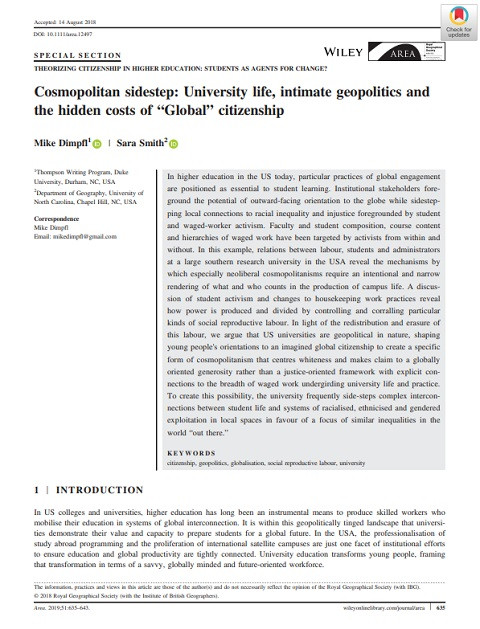 Cosmopolitan Sidestep: University Life, Intimate Geopolitics and the Hidden Costs of “Global” Citizenship (Area; Vol. 51, No. 4) Year of publication: 2018 Author: Mike Dimpfl | Sara Smith Corporate author: Royal Geographical Society | Wiley In higher education in the US today, particular practices of global engagement are positioned as essential to student learning. Institutional stakeholders foreground the potential of outward‐facing orientation to the globe while sidestepping local connections to racial inequality and injustice foregrounded by student and waged‐worker activism. Faculty and student composition, course content and hierarchies of waged work have been targeted by activists from within and without. In this example, relations between labour, students and administrators at a large southern research university in the USA reveal the mechanisms by which especially neoliberal cosmopolitanisms require an intentional and narrow rendering of what and who counts in the production of campus life. A discussion of student activism and changes to housekeeping work practices reveal how power is produced and divided by controlling and corralling particular kinds of social reproductive labour. In light of the redistribution and erasure of this labour, we argue that US universities are geopolitical in nature, shaping young people's orientations to an imagined global citizenship to create a specific form of cosmopolitanism that centres whiteness and makes claim to a globally oriented generosity rather than a justice‐oriented framework with explicit connections to the breadth of waged work undergirding university life and practice. To create this possibility, the university frequently side‐steps complex interconnections between student life and systems of racialised, ethnicised and gendered exploitation in local spaces in favour of a focus of similar inequalities in the world “out there.”
  Global Education for Ontario Learners: Practical Strategies; A Summary of Research Year of publication: 2018 Author: Caroline Manion | Nadya Weber Corporate author: Ontario (Canada). Ministry of Education This summary report flows from the policy outlined in Ontario’s Strategy for K–12 International Education (OME, 2015). The report highlights current knowledge about good and/or promising practices in global education in order to suggest practical strategies for improved teaching, learning, and achievement. The intended audience for this piece includes all education stakeholders – community members, parents, learners, system leaders, school leaders, and educators – as active agents of change in support of an education strategy designed to integrate global perspectives, cultures, and experiences in the curriculum and learning environment. The purpose is to enable students to develop the competencies they will need to thrive as citizens in an increasingly globalized world.
  Manual for Teachers and Educators: To Empower Young People on Sdgs and Migration Year of publication: 2018 Corporate author: Start the Change | European Union (EU) The Start the Change project aims to improve education provision linked to the Sustainable Development Goals (SDGs) in 12 European countries, with a special emphasis on the relationship between migration and global inequality, and contributing to the fulfilment of the 2030 Agenda for Sustainable Development.The first part of the guide (THINK) describes the educational model proposed by Start the Change. Service Learning gives an overview of a pedagogical approach that promotes a new perspective to acquiring global citizenship knowledge, skills and attitudes - not just in the classroom but also through direct experience of working on real issues in the community. MANUAL TO INSPIRE: START THE CHANGE 11 Participative methodologies are the basis of all good global citizenship education, and youth empowerment can be enhanced through peer to peer approaches. The second part of the guide (LEARN) is dedicated to enhancing teachers’ and educators’ knowledge of the contents of the project: the Sustainable Development Goals, inequality and migration issues. Storytelling can be used to develop short film storylines on Start the Change issues. Educational activities can be enriched by using ICT to promote global learning and include voices and experiences from the Global South. The third part of the guide (DO) is dedicated to activities and methodologies to help young people explore these issues and inspire them to take action in their communities.
 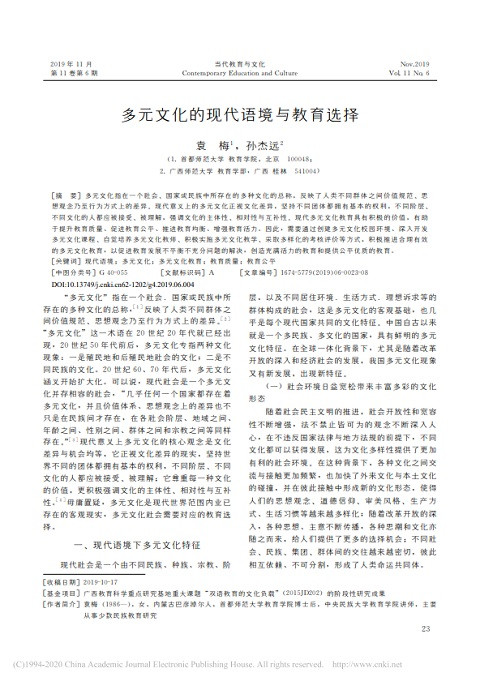 Modern Context and Education Choice of Multi-culture Year of publication: 2019 Author: Yuanmei | Sun Jieyuan Corporate author: Contemporary Education and Culture Multi-culture is a generic term for diverse cultures existing in a society, country or nation, which is a nation that reflexes differences in value standards, thoughts and ideas, and behaviors and actions among varied people. Multi-culture, in modern context, is to face cultural differences hold that different groups of people have basic rights and that people with different classes and cultures should all be accepted and understood, and highlight the main role, relatively and complementary of all quality, education fairness, a balanced education as well as educational dynamism. Therefore, we should create multicultural teachers. Besides, we should implement multicultural courses and positively foster more multicultural teaching, adopt diverse assessment and evaluation methods and promote appropriate and efficient multicultural education, thus addressing the problems of unbalanced and inadequate educational development, creation more dynamic education environment and delivering more fair and quality education. 多元文化的现代语境与教育选择 Year of publication: 2019 Author: Yuanmei | Sun Jieyuan Corporate author: Contemporary Education and Culture 多元文化指在一个社会、国家或民族中所存在的多种文化的总称,反映了人类不同群体之间价值规范、思 想观念乃至行为方式上的差异。现代意义上的多元文化正视文化差异,坚持不同团体都拥有基本的权利,不 同 阶 层、 不同文化的人都应被接受、被理解,强调文化的主体性、相对性与互补性。现代多元文化教育具有积极的价值,有助 于提升教育质量、促进教育公平、推进教育均衡、增强教育活力。因此,需要通过创建多元文化校园环境、深入开发 多元文化课程、自觉培养多元文化教师、积极实施多元文化教学、采取多样化的考核评价等方式,积极推进合理有效 的多元文化教育,以促进教育发展不平衡不充分问题的解决,创造充满活力的教育和提供公平优质的教育。
  Global Rights, Nobel Goals: Refugees, Migration, the Sustainable Development Goals and Youth; Resource Pack Year of publication: 2016 Author: Valerie Duffy | Leo Gilmartin | Grace McManus | Dermot O’Brien Corporate author: National Youth Council of Ireland (NYCI) This resource pack explores the terms around migration (asylum seeker, refugee, internally displace peoples etc), the reasons that people choose or are forced to migrate and makes connections with the SDGs. It also includes a great selection of activities for young people at different ages and stages.
  한국사회 인종차별을 말하다: 2018. 7. 20 ~ 21 인종차별 보고대회 자료집 Year of publication: 2018 Corporate author: UN인종차별철폐협약 한국심의대응 시민사회 공동사무국 | 서울지방변호사회 2018년 7월 20일부터 21일까지 개최되었던 토론회 인종차별보고대회의 자료집으로 1966년 UN총회 결의로 선포된 인종차별철폐협약(The Committee on the Elimination of Racial Discrimination, CERD)과 관련하여 경과보고와 현재까지 남아 있는 한국사회 내의 인종차별의 원인과 현황을 다루고 있다. 1부 : 한국사회와 인종차별을 말하다 - 한국사회와 인종차별 역사와 배경2부 : 현실을 말하다 - 국가는 인종차별 강화에 어떻게 기여하고 있는가?3부 : 인종차별의 선긋기는 어디에서 교차되는가?4부 : 미래를 말하다 - 미래를 향한 제언