
Resources
Explore a wide range of valuable resources on GCED to deepen your understanding and enhance your research, advocacy, teaching, and learning.
3,451 Results found
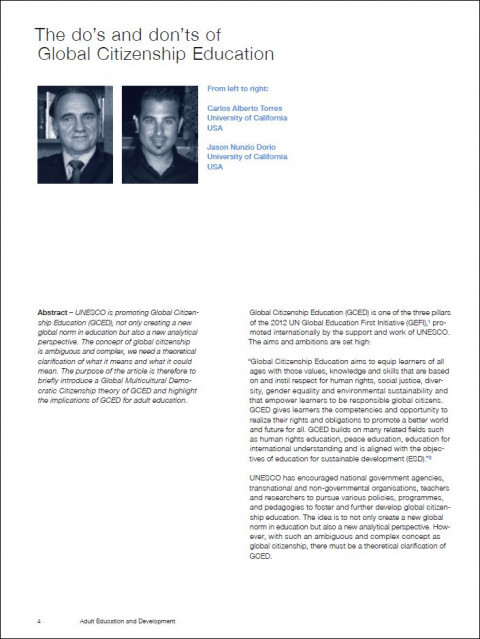 Les choses à faire et à éviter dans le domaine de l’éducation à la citoyenneté mondiale Year of publication: 2015 Author: Carlos Alberto Torres | Jason Nunzio Dorio Corporate author: Éducation des Adultes et Développement L’UNESCO promeut l’éducation à la citoyenneté mondiale (ECM), en créant non seulement une nouvelle norme mondiale dans l’éducation, mais aussi un nouvel angle analytique. Le concept de la citoyenneté mondiale est ambigu et complexe. Aussi convient-il de mettre au point au plan théorique ce qu’il veut dire et ce qu’il pourrait vouloir dire. Par conséquent, cet article a pour objectif de présenter rapidement une théorie de l’ECM portant sur la citoyenneté mondiale multiculturelle et démocratique, et de mettre en lumière ce qu’implique l’ECM pour l’éducation des adultes.
 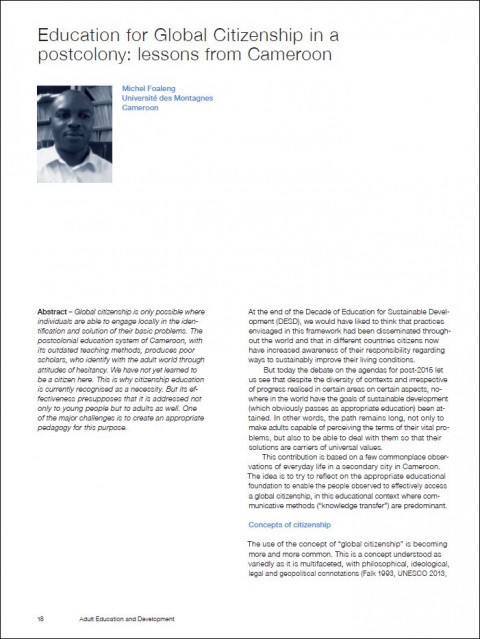 Education for Global Citizenship in a Postcolony: Lessons from Cameroon Year of publication: 2015 Author: Michael Foaleng Corporate author: Éducation des Adultes et Développement Global citizenship is only possible where individuals are able to engage locally in the identification and solution of their basic problems. The postcolonial education system of Cameroon, with its outdated teaching methods, produces poor scholars, who identify with the adult world through attitudes of hesitancy. We have not yet learned to be a citizen here. This is why citizenship education is currently recognised as a necessity. But its effectiveness presupposes that it is addressed not only to young people but to adults as well. One of the major challenges is to create an appropriate pedagogy for this purpose. Educación para la ciudadanía mundial en una nación postcolonial: lecciones de Camerún Year of publication: 2015 Author: Michael Foaleng Corporate author: Éducation des Adultes et Développement La ciudadanía mundial solo puede ejercerse allí donde las personas son capaces de participar a nivel local en la identifi cación y la solución de sus problemas básicos. El sistema postcolonial de educación de Camerún, cuyos métodos pedagógicos están obsoletos, forma estudiantes deficientes, que se identifi can con el mundo de los adultos mediante actitudes de vacilación. Aún no hemos aprendido a ser ciudadanos en este país. Por eso en la actualidad se reconoce la necesidad de impartir educación para la ciudadanía. Sin embargo, para que resulte efi caz es preciso que no solo esté orientada a los jóvenes, sino también a los adultos. Uno de los principales desafíos consiste en crear una pedagogía adecuada para alcanzar este objetivo. Éducation à la citoyenneté mondiale à l’ère postcoloniale : leçons du Cameroun Year of publication: 2015 Author: Michael Foaleng Corporate author: Éducation des Adultes et Développement Une citoyenneté mondiale n’est possible que là où localement les individus sont capables de s’engager dans l’identification et la résolution de leurs problèmes élémentaires. Le système éducatif du Cameroun postcolonial, avec ses méthodes pédagogiques désuètes, produit des déchets scolaires, qui se reconnaissent dans le monde des adultes par des attitudes attentistes. On n’a pas encore appris ici à être citoyen. C’est pourquoi l’éducation à la citoyenneté est actuellement reconnue comme une nécessité. Mais son efficacité présuppose qu’elle s’adresse non seulement aux jeunes, mais aussi adultes. L’un des défis majeurs reste alors d’imaginer une pédagogie appropriée à cet effet.
 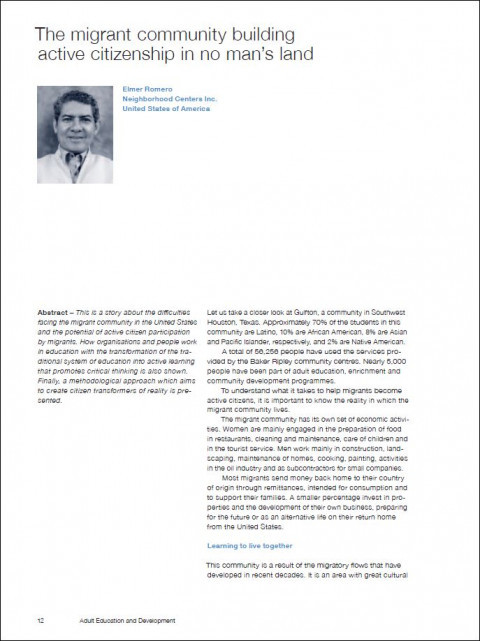 The Migrant Community Building Active Citizenship in No Man’s Land Year of publication: 2015 Author: Elmer Romero Corporate author: Éducation des Adultes et Développement This is a story about the difficulties facing the migrant community in the United States and the potential of active citizen participation by migrants. How organisations and people work in education with the transformation of the traditional system of education into active learning that promotes critical thinking is also shown. Finally, a methodological approach which aims to create citizen transformers of reality is presented. La comunidad migrante como constructora de la ciudadanía activa en tierra de nadie Year of publication: 2015 Author: Elmer Romero Corporate author: Éducation des Adultes et Développement Esta es una historia sobre las dificultades que afronta la comunidad migrante en Estados Unidos, y el potencial de participación ciudadana activa que poseen las y los migrantes. Asimismo, en esta nota se expone el papel de las entidades y personas que trabajan en el área educativa con respecto a la transformación del tradicional sistema de educación hacia un aprendizaje activo que propicie el pensamiento crítico. Por último, se da a conocer un abordaje metodológico que tiene como fin último formar a ciudadanos transformadores de la realidad. Une communauté de migrants promotrice de la citoyenneté active dans le no man’s land Year of publication: 2015 Author: Elmer Romero Corporate author: Éducation des Adultes et Développement Cet article décrit les diffi cultés auxquelles sont confrontés les migrants aux États- Unis, et le potentiel que recèle la participation citoyenne active de cette communauté. Il montre également le travail réalisé par les organisations et les personnes impliquées dans le domaine de l’éducation pour transformer le système éducatif traditionnel en un apprentissage actif, promoteur de pensée critique. Pour fi nir, il propose une approche méthodologique visant à former des citoyens capables de changer l’ordre établi.
 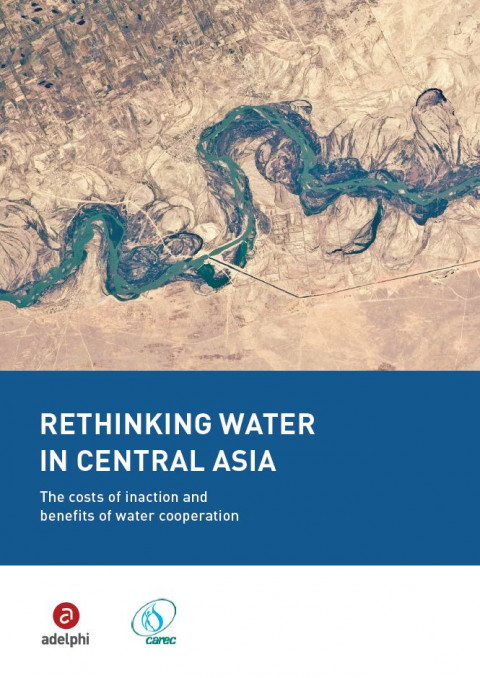 Rethinking Water in Central Asia: The Costs of Inaction and Benefits of Water Cooperation Year of publication: 2017 Author: Benjamin Pohl | Annika Kramer | William Hull | Sabine Blumstein | Iskandar Abdullaev | Jusipbek Kazbekov | Tais Reznikova | Ekaterina Strikeleva | Eduard Interwies | Stefan Görlitz Corporate author: adelphi | Central Asia Regional Economic Cooperation (CAREC) A joint study conducted by CAREC and adelphi within the framework of the Switzerland’s Blue Peace Central Asia Initiative is published. The publication demonstrates the cost of inaction and benefits of cooperation in the field of water management between the countries of the region.entral Asia is witnessing intense competition over water resources and their use for irrigation and hydropower generation. Despite general political commitment to cooperation, water policies in Central Asia are largely driven by uncoordinated and partly contradicting national strategies. This limited water cooperation, however, entails significant costs and major risks for the future development of the region.“Rethinking Water in Central Asia” analyses these “costs of inaction” – defined here as the difference between the current, limited cooperation and the benefits that would result from full cooperation. Even if only parts of these costs are taken into account, they amount to more than US$ 4.5 billion per year for the whole region and are significant for each of the five countries studied. Due to deteriorating infrastructure, environmental degradation and demographic and economic pressures, these costs will increase if water management remains as it currently is.By raising awareness of these costs of inaction, and by setting out a variety of pathways towards eliminating them in the future, the present report seeks to encourage and support Central Asian policy-makers in strengthening regional water cooperation and improved water governance. The costs of inaction mirror the potential benefits of water cooperation, and their scale hence demonstrates the scale of the benefits and opportunities that better water management and closer cooperation can deliver for Central Asia. Переосмысление водного вопроса в Центральной Азии: Цена бездействия и преимущества водного сотрудничества Year of publication: 2017 Author: Benjamin Pohl | Annika Kramer | William Hull | Sabine Blumstein | Iskandar Abdullaev | Jusipbek Kazbekov | Tais Reznikova | Ekaterina Strikeleva | Eduard Interwies | Stefan Görlitz Corporate author: adelphi | Central Asia Regional Economic Cooperation (CAREC) Исследование «Переосмысление водной проблематики в центральноазиатском контексте: ущерб от бездействия и преимущества водного сотрудничества», проведенное РЭЦЦА совместно с немецким консультационным бюро «adelphi» при поддержке Швейцарского агентства по развитию и сотрудничеству.В работе представлен всесторонний анализ так называемой «цены бездействия» – разницы между преимуществами текущего ограниченного сотрудничества в сфере управления водными ресурсами и вероятными преимуществами полноценного всестороннего сотрудничества. С учетом лишь некоторых соответствующих затрат, общий ущерб из-за недостаточного уровня взаимодействия может составить более $4,5 млрд для стран региона. Таким образом, данный отчет ставит своей целью повысить осведомленность о высокой цене бездействия и представить рекомендации для лиц, принимающих решения по расширению регионального сотрудничества по водным вопросам и улучшению системы управления водными ресурсами.Авторы настоящего отчета надеются, что представленный анализ потерь вследствие бездействия и ряда возможных путей их предотвращения послужит полезным источником информации для лиц, принимающих решения в сфере водного сотрудничества в регионе Центральной Азии, а также будет содействовать совершенствованию системы управления водными ресурсами. Потери от бездействия коррелируют с потенциальными выгодами от сотрудничества, масштаб которых отражает объем преимуществ и возможностей в результате повышения качества управления водными ресурсами и более тесного сотрудничества в данной области.
 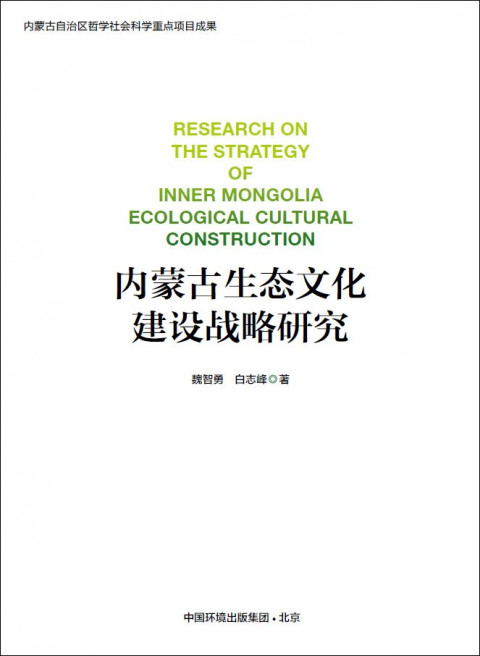 内蒙古生态文化建设战略研究 Year of publication: 2019 Author: WEI Zhiyong | BAI Zhifeng Corporate author: China Environment Publishing Group 《内蒙古生态文化建设战略研究》是由魏智勇教授和白志峰主任主持完成的内蒙 古哲学社会科学重点项目的最终研究成果。在认真分析研究国内外生态文化建设文献资料的基础上,深入系统地论证了内蒙古加强生态文化的必要性和重要性,较为全面地分析了内蒙古生态文化建设的现 状,明确了内蒙古生态文化建设的优劣条件、机遇和挑战,提出了内蒙古生态文化建 设的指导思想、目标、原则、重点任务,探索了一些切实可行的保障措施,希望对于 推动内蒙古生态文明和生态文化建设起到重要的理论指导作用。