
Resources
Explore a wide range of valuable resources on GCED to deepen your understanding and enhance your research, advocacy, teaching, and learning.
3,451 Results found
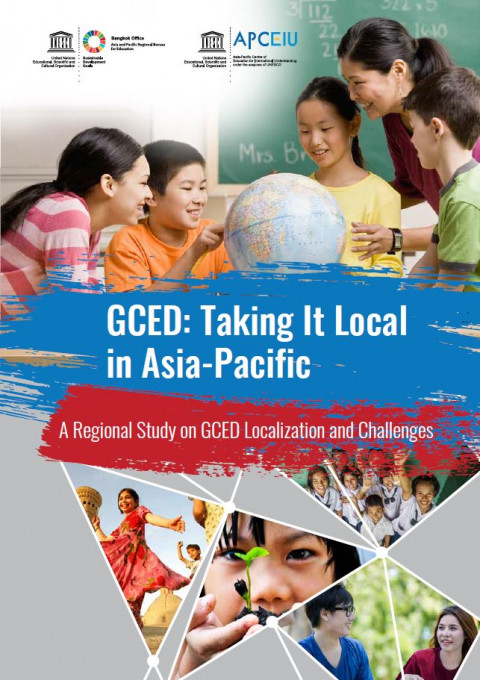 GCED: Taking It Local in Asia-Pacific; A Regional Study on GCED Localization and Challenges Year of publication: 2019 Corporate author: UNESCO Bangkok Global Citizenship Education (GCED) is often interpreted in theoretical ways, which may make GCED difficult for laypeople to understand from a local perspective. However, notions of GCED are deeply rooted in the cultures of the Asia-Pacific region and are very much related to daily life experiences.In the “Asia-Pacific Regional GCED Network 2018 Jakarta Meeting Final Report”, “Contextualize GCED in Asia-Pacific while keeping in mind the global view” has been identified as one of the actions needed for facilitating GCED implementation. Thus, this study attempts to link the concept of GCED with localized ideologies by showing some examples of the way GCED is understood in different cultural contexts in the Asia and Pacific region.
  Understanding the Impact of Global Citizenship Education - Using a Theory of Change Approach: An IDEAS Report Year of publication: 2017 Corporate author: International Development Education Association Scotland (IDEAS) This report provides an overview of the range of impacts IDEAS members are working towards and discusses how best to approach their assessment. It focuses, in particular, on how global citizenship education affects teachers and pupils and how this relates to attainment. The Theory of Change that it is based around offers a forward-looking framework that will over time enable us to make the evidence for global citizenship education more accessible, approachable and coherent.
  학교교육을 통한 세계시민교육 안착방안 Year of publication: 2017 Author: 신혜진 | 이춘희 | 류성남 | 장은경 Corporate author: 서울특별시교육청 교육연구정보원 | 서울교육정책연구소 이 연구는 세계시민교육이 학교교육을 통해 어떻게 운영되고 있는지 실태를 분석하여 세계시민교육이 학교교육에서 안착할 수 있는 방안을 모색해 보고자 하였다. 특히 세계시민교육이 학교에서 효과적으로 안착되기 위하여 교원의 역할이 중요하기에 교원을 대상으로 연구를 수행하였다. 최초로 서울시 전체 교원을 대상으로 연구하며 학교현장에서 세계시민교육이 단위학교 차원에서 어떻게 운영되고 있는지의 현황에 대한 이해를 높이고자 하였다. 이를 위하여 먼저 선행연구 및 주요정책문건 분석을 통한 세계시민교육의 주요 개념 및 정의를 고찰하였다. 다음으로 세계시민교육의 단위학교 적용 사례를 살펴보고 세계시민교육에 대한 교원인식, 교내 활용정도, 교원연수 등을 중심으로 세계시민교육의 학교활용현황을 분석하였다. 마지막으로 세계시민교육이 학교 내에서 안착할 수 있는 방안을 제안한다. 서울특별시교육청교육연구정보원이(가) 창작한 [정책-17-06] 학교교육을 통한 세계시민교육 안착방안 저작물은 "공공누리 제4유형(출처표시-상업적 이용금지-변경금지)" 조건에 따라 이용 할 수 있습니다.
 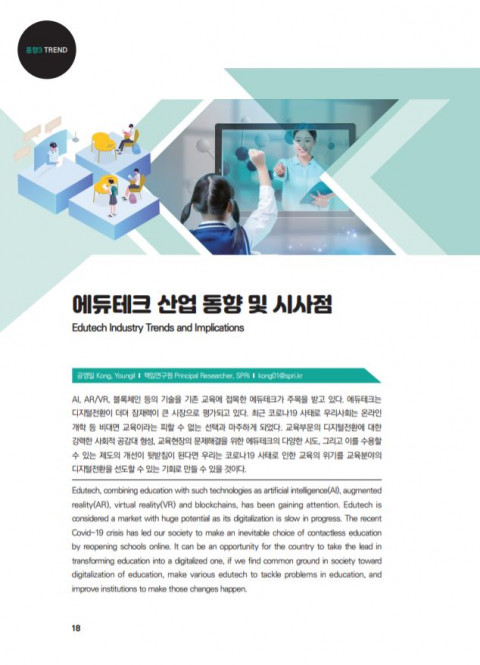 Edutech Industry Trends and Implications Year of publication: 2020 Author: Youngil Gong Corporate author: Software Policy & Research Institute Edutech, combining education with such technologies as artificial intelligence(AI), augmented reality(AR), virtual reality(VR) and blockchains, has been gaining attention. Edutech is considered a market with huge potential as its digitalization is slow in progress. The recent Covid-19 crisis has led our society to make an inevitable choice of contactless education by reopening schools online. It can be an opportunity for the country to take the lead in transforming education into a digitalized one, if we find common ground in society toward digitalization of education, make various edutech to tackle problems in education, and improve institutions to make those changes happen. 에듀테크 산업 동향 및 시사점 Year of publication: 2020 Author: 공영일 Corporate author: 소프트웨어정책연구소 AI, AR/VR, 블록체인 등의 기술을 기존 교육에 접목한 에듀테크가 주목을 받고 있다. 에듀테크는 디지털전환이 더뎌 잠재력이 큰 시장으로 평가되고 있다. 최근 코로나19 사태로 우리 사회는 온라인 개학 등 비대면 교육이라는 피할 수 없는 선택과 마주하게 되었다. 교육부문의 디지털전환에 대한 강력한 사회적 공감대 형성, 교육현장의 문제해결을 위한 에듀테크의 다양한 시도, 그리고 이를 수용할 수 있는 제도의 개선이 뒷받침된다면 우리는 코로나19 사태로 인한 교육의 위기를 교육 분야의 디지털전환을 선도할 수 있는 기회가 될 것이다.
  학교 현장 적용을 위한 평화교육 정책 연구 Year of publication: 2020 Author: 이대훈 Corporate author: 서울특별시교육청 교육연구정보원 | 서울교육정책연구소 본 연구는 서울특별시교육청의 학교 평화교육 도입 및 시행을 위한 평화교육 개념 및 정책 방향을 설정하는 토대 연구이다. 이를 통해서 변화하는 한반도 현실에 적합한 평화교육 정책 모색하면서, 학교 현장의 필요에 적합한 평화교육의 내용 및 활성화 방법과 평화교육과 교과 교육과정과의 연계의 방향을 찾고자 한다. 본 연구에서 다루는 평화교육의 초점은 ‘평화역량’ 개념의 교육적 적용, 즉 평화역량 중심의 평화교육을 위한 정의와 프로그램이다. 이를 위해 국내외 주요 평화교육으로부터의 시사점, 서울특별시교육청의 평화교육 비전 설정 및 주제와 이행단계 설정, 교육 현장의 욕구 및 필요를 반영한 평화교육의 통합적 운영 방안을 제시한다. 서울특별시교육청교육연구정보원이(가) 창작한 [서교연2019-25]2019 위탁연구(학교 현장 적용을 위한 평화교육 정책 연구) 최종보고서 저작물은 "공공누리 제4유형(출처표시-상업적 이용금지-변경금지)" 조건에 따라 이용 할 수 있습니다.
 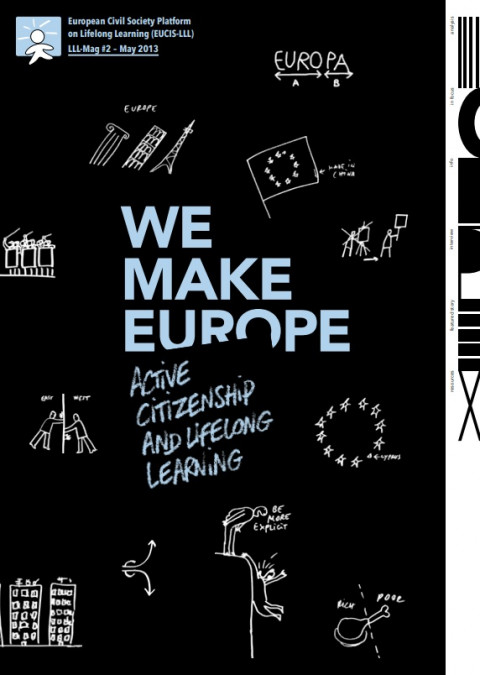 We Make Europe: Active Citizenship and Lifelong Learner Year of publication: 2013 Corporate author: European Civil Society Platform on Lifelong Learning (EUCIS-LLL) This material captures some of the sparks of civic engagement and aimed to contribute to the debates that took place in the context of the European Year of Citizens 2013. Its purpose was to bring together various perspectives and experiences in order to show the wealth and dynamism as well as the limitations and pitfalls of what is active European citizenship nowadays.
  Children's Global Thinking: Research Investigating the Engagement of Seven-to-Nine-Year Old Children with Critical Literacy and Global Citizenship Education Year of publication: 2014 Author: Rowan Oberman | Fiona O’Shea | Beth Hickey | Claire Joyce Corporate author: Education for a Just World Partnership | St. Patrick's College | Trócaire | Centre for Human Rights and Citizenship Education (CHRCE) The focus of this research is two-fold. Firstly, it investigates how children aged seven to nine years conceptualise global and justice issues. Secondly, it explores children’s engagement with critical literacy strategies as part of a global citizenship education programme. This research project is undertaken with the intention of providing an empirical basis to support the development of pedagogy integrating global citizenship education into different curriculum areas.
  Des histoires du passé: Le féminisme dans les manuels d’histoire et d’éducation à la citoyenneté selon des élèves québécois de quatrième secondaire (Revue des sciences de l'éducation de McGill; Vol. 52, No. 2) Year of publication: 2017 Author: Marie-Hélène Brunet Corporate author: McGill University. Faculty of Education L’article s’intéresse à la manière dont les élèves traitent les contenus liés au féminisme dans les manuels d’histoire. Un questionnaire a été distribué à 575 élèves québécois de quatrième secondaire afin d’identifier leurs conceptions du manuel et du féminisme. Neuf élèves ont ensuite été rencontrés en entrevue afin d’évaluer leur compréhension de l’agentivité des femmes de même que leur réaction à des récits contradictoires. Les résultats montrent l’importance de prendre en compte les représentations des élèves afin d’évaluer le processus de médiation. Une très forte proportion des élèves (88 %) considère le manuel comme le reflet d’une vérité objective. Ils ressentent un inconfort devant la tâche et tentent d’amoindrir les différences entre les récits en sélectionnant les éléments correspondant à leurs conceptions initiales. Une majorité des élèves rencontrés différencient, de façon variable, les textes en fonction de l’agentivité.
 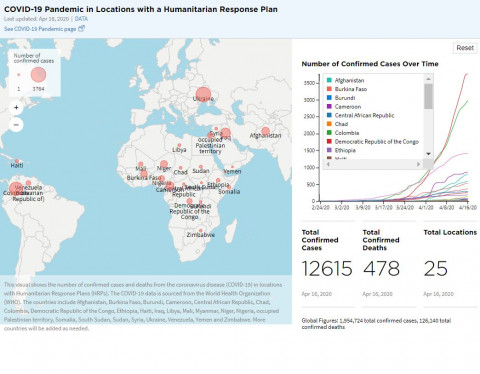 COVID-19 Pandemic in Locations with a Humanitarian Response Plans Year of publication: 2020 Corporate author: United Nations Office for the Coordination of Humanitarian Affairs (OCHA) This visual shows the number of confirmed cases and deaths from the coronavirus disease (COVID-19) in locations with Humanitarian Response Plans (HRPs). The COVID-19 data is sourced from the World Health Organization (WHO). The countries include Afghanistan, Burkina Faso, Burundi, Cameroon, Сentral African Republic, Chad, Colombia, Democratic Republic of the Congo, Ethiopia, Haiti, Iraq, Libya, Mali, Myanmar, Niger, Nigeria, occupied Palestinian territory, Somalia, South Sudan, Sudan, Syria, Ukraine, Venezuela, Yemen and Zimbabwe. More countries will be added as needed.