
Resources
Explore a wide range of valuable resources on GCED to deepen your understanding and enhance your research, advocacy, teaching, and learning.
3,454 Results found
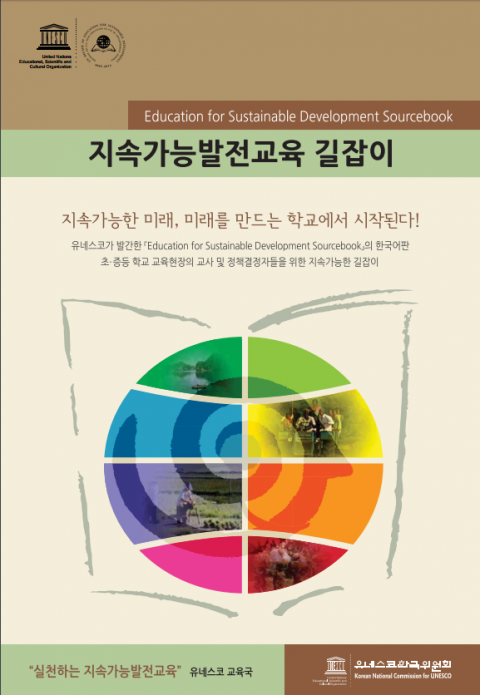 Education for Sustainable Devleopment: Sourcebook Year of publication: 2013 Corporate author: UNESCO The target audiences for the Education for Sustainable Development Sourcebook are primary and secondary teachers and mid-level decision-makers, who have responsibility for primary and secondary education. Another primary audience is teacher educators who work with pre-service and in-service primary and secondary school teachers. The purpose of the publication is to describe ways in which education for sustainable development (ESD) can be integrated into primary and secondary schooling. This collection of briefs is designed to complement other ESD materials published by UNESCO. The topics for the briefs were selected in consultation with UNESCO Field Offices and Institutes. The briefs for primary and secondary teachers are specifically written for professional educators who work in formal education settings. The briefs for teachers as well as those for decision-makers address “gaps” in the UNESCO ESD literature.
  من أجل التنمية المستدامة الأمم المتحدة للتعليم للنصف الثاني من العقد استراتيجية اليونسكو Year of publication: 2010 Corporate author: منظمة الأمم المتحدة للتربية والعلم والثقافة (UNESCO) The UNESCO Strategy for the Second Half of the United Nations (UN) Decade of Education for Sustainable Development (DESD) draws on the findings and lessons learnt from the first phase of the DESD monitoring and evaluation (M&E) process (as reflected in the 2009 DESD M&E report Learning for a Sustainable World: Review of Contexts and Structures for Education for Sustainable Development. It also builds on the UNESCO World Conference on ESD and the Bonn Declaration as well as on the outcomes of other key international ESD meetings. The Bonn Declaration gives particular emphasis to the importance of education for the global development agenda and underlines the essential contribution of ESD to shaping the purpose, content and quality of all education. The UNESCO strategy will be implemented in line with the International Implementation Scheme (IIS), which, along with the Bonn Declaration, will provide the global strategic framework for UNESCO and its DESD partners during the second half of the Decade. The Strategy takes into account key DESD regional challenges and opportunities. It is also shaped by the shared vision of education emerging from the four 2008-2009 UNESCO international education conferences: one of education systems that encourage equity and inclusion, quality learning, flexibility and innovation. While UNESCO puts highest emphasis on achieving Education for All (EFA), the Organization’s actions in education extend beyond this, to pay explicit attention to inclusion, social cohesion and social justice, to lifelong learning and to the crucial role of higher education and research. The overall goal of the UNESCO Strategy for the Second Half of the DESD is to support Member States and other stakeholders in addressing global sustainable development challenges at regional, national and global level through ESD, thus addressing the challenges of learning for bringing about a more sustainable world. Стратегии ЮНЕСКО на вторую половину Десятилетия образования в интересах устойчивого развития Организации Объединенных Наций Year of publication: 2010 Corporate author: Организация Объединенных Наций по вопросам образования, науки и культуры (UNESCO) The UNESCO Strategy for the Second Half of the United Nations (UN) Decade of Education for Sustainable Development (DESD) draws on the findings and lessons learnt from the first phase of the DESD monitoring and evaluation (M&E) process (as reflected in the 2009 DESD M&E report Learning for a Sustainable World: Review of Contexts and Structures for Education for Sustainable Development. It also builds on the UNESCO World Conference on ESD and the Bonn Declaration as well as on the outcomes of other key international ESD meetings. The Bonn Declaration gives particular emphasis to the importance of education for the global development agenda and underlines the essential contribution of ESD to shaping the purpose, content and quality of all education. The UNESCO strategy will be implemented in line with the International Implementation Scheme (IIS), which, along with the Bonn Declaration, will provide the global strategic framework for UNESCO and its DESD partners during the second half of the Decade. The Strategy takes into account key DESD regional challenges and opportunities. It is also shaped by the shared vision of education emerging from the four 2008-2009 UNESCO international education conferences: one of education systems that encourage equity and inclusion, quality learning, flexibility and innovation. While UNESCO puts highest emphasis on achieving Education for All (EFA), the Organization’s actions in education extend beyond this, to pay explicit attention to inclusion, social cohesion and social justice, to lifelong learning and to the crucial role of higher education and research. The overall goal of the UNESCO Strategy for the Second Half of the DESD is to support Member States and other stakeholders in addressing global sustainable development challenges at regional, national and global level through ESD, thus addressing the challenges of learning for bringing about a more sustainable world. Estrategia de la UNESCO para la segunda mitad del decenio de las Naciones Unidas de la educación para el desarrollo sostenible Year of publication: 2010 Corporate author: Organización de las Naciones Unidas para la Educación, la Ciencia y la Cultura (UNESCO) The UNESCO Strategy for the Second Half of the United Nations (UN) Decade of Education for Sustainable Development (DESD) draws on the findings and lessons learnt from the first phase of the DESD monitoring and evaluation (M&E) process (as reflected in the 2009 DESD M&E report Learning for a Sustainable World: Review of Contexts and Structures for Education for Sustainable Development. It also builds on the UNESCO World Conference on ESD and the Bonn Declaration as well as on the outcomes of other key international ESD meetings. The Bonn Declaration gives particular emphasis to the importance of education for the global development agenda and underlines the essential contribution of ESD to shaping the purpose, content and quality of all education. The UNESCO strategy will be implemented in line with the International Implementation Scheme (IIS), which, along with the Bonn Declaration, will provide the global strategic framework for UNESCO and its DESD partners during the second half of the Decade. The Strategy takes into account key DESD regional challenges and opportunities. It is also shaped by the shared vision of education emerging from the four 2008-2009 UNESCO international education conferences: one of education systems that encourage equity and inclusion, quality learning, flexibility and innovation. While UNESCO puts highest emphasis on achieving Education for All (EFA), the Organization’s actions in education extend beyond this, to pay explicit attention to inclusion, social cohesion and social justice, to lifelong learning and to the crucial role of higher education and research. The overall goal of the UNESCO Strategy for the Second Half of the DESD is to support Member States and other stakeholders in addressing global sustainable development challenges at regional, national and global level through ESD, thus addressing the challenges of learning for bringing about a more sustainable world. Le rôle de l'UNESCO pour la décennie des Nations Unies pour l'éducation au service du développement durable (2005-2014): visions et défis Year of publication: 2006 Corporate author: Organisation des Nations Unies pour l'éducation, la science et la culture (UNESCO) This document elaborates on UNESCO's role in guiding the Decade of Education for Sustainable Development (DESD), its vision and challenges for the DESD.
 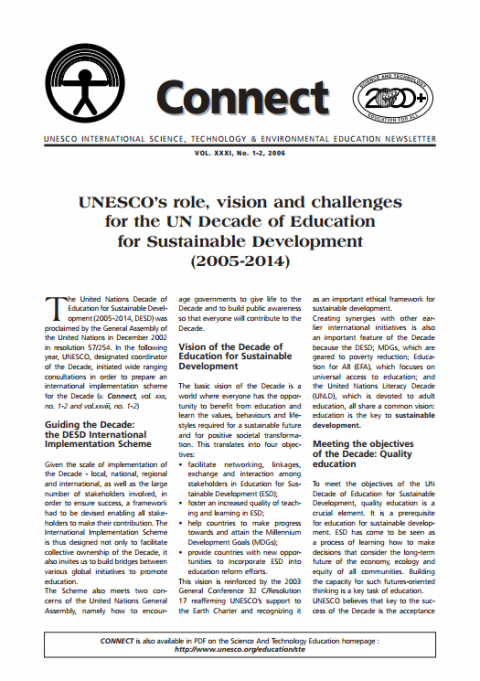 UNESCO's role, vision and challenges for the UN decade of education for sustainable development (2005-2014) Year of publication: 2006 Corporate author: UNESCO This document elaborates on UNESCO's role in guiding the Decade of Education for Sustainable Development (DESD), its vision and challenges for the DESD. Media as partners in education for sustainable development: a training and resource kit Year of publication: 2008 Author: Eleanor Bird | Richard Lutz | Christine Warwick Corporate author: UNESCO Media as Partners in Education for Sustainable Development addresses issues that are being discussed on the social, economic and environmental fronts. It does not pretend to know all the answers, but draws on existing experience and recommends resources for further inquiry and research. It encourages the media to engage in public participation and to debate improvements that can lead to sustainable development. It also seeks to contribute to media awareness and understanding of sustainability, as outlined by the Agenda 21 Plan of Action for all nations endorsed at the 1992 Earth Summit in Rio de Janeiro. Education and national sustainable development strategies Year of publication: 2009 Corporate author: UNESCO Since the Rio Earth Summit in 1992 countries around the world have been developing and implementing National Sustainable Development Strategies (NSDS). Sustainable Development competes with many deeply entrenched values and therefore progress has been slow. Tensions between long term and short term thinking, and between economic growth and social and environmental sustainability, are not easy to resolve. The NSDS process has gained impetus following the 2002 World Summit on Sustainable Development, where it was agreed that countries need to take immediate steps to elaborate and formulate NSDS systems that can continuously improve. The UN Guidance Document describes an NSDS as a comprehensive, adaptable, continuous and long term undertaking that helps a country to achieve economic prosperity and higher levels of social welfare, while at the same time preserving the environment. An NSDS is not just something that can be put together in a document and be promulgated. Development of an NSDS requires multi-stakeholder participation, partnerships, country ownership, shared vision with a commitment to continuous improvement, capacity development and the ability to build on existing knowledge and processes and a clear focus on outcomes. Education is a central dimension of achieving sustainable development, and needs to be incorporated into the NSDS process. Learning is central to the process of NSDS development and implementation. Éducation et stratégies nationales de développement durable Year of publication: 2009 Corporate author: Organisation des Nations Unies pour l'éducation, la science et la culture (UNESCO) Depuis le Sommet de la Terre de Rio en 1992, les pays du monde entier élaborent et mettent en œuvre des Stratégies Nationales de Développement Durable (SNDD). Le développement durable est en concurrence avec de nombreuses valeurs profondément enracinées et les progrès ont donc été lents. Les tensions entre la pensée à long terme et à court terme et entre la croissance économique et la durabilité sociale et environnementale ne sont pas faciles à résoudre. Le processus des SNDD a pris de l'ampleur à la suite du Sommet mondial sur le développement durable de 2002, où il a été convenu que les pays devaient prendre des mesures immédiates pour élaborer et formuler des systèmes de SNDD susceptibles d'être continuellement améliorés. Le Document d'orientation des Nations Unies décrit une SNDD comme une entreprise globale, adaptable, continue et à long terme qui aide un pays à atteindre une prospérité économique et des niveaux supérieurs de bien-être social tout en préservant l'environnement. Une SNDD n'est pas seulement quelque chose qui peut être rassemblée dans un document et être promulguée. Le développement d'une SNDD requiert la participation de plusieurs parties prenantes, des partenariats, l'appropriation par les pays, une vision partagée avec un engagement à l'amélioration continue, le renforcement des capacités et la capacité de s'appuyer sur les connaissances et les processus existants. L'éducation est une dimension centrale de la réalisation du développement durable et doit être intégrée au processus des SNDD. L'apprentissage est au cœur du processus de développement et de mise en œuvre de la SNDD. Education for sustainable development and the millennium development goals Year of publication: 2009 Corporate author: UNESCO The Millennium Development Goals (MDGs) provide a universal framework for development, agreed to by all UN Member States in 2000. They provide a means for developing countries and development partners to work together in pursuit of a sustainable future. Education for Sustainable Development (ESD) can contribute to the achievement of all the MDGs. It can help governments and development partners to ensure that capacity exists for achieving the MDGs. ESD provides learning goals that help to achieve the MDGs.