
Resources
Explore a wide range of valuable resources on GCED to deepen your understanding and enhance your research, advocacy, teaching, and learning.
2,197 Results found
 Manual for Developing Intercultural Competencies: Story Circles Year of publication: 2020 Author: Darla K. Deardorff Corporate author: UNESCO This book presents a structured yet flexible methodology for developing intercultural competence in a variety of contexts, both formal and informal. Piloted around the world by UNESCO, this methodology has proven to be effective in a range of different contexts and focused on a variety of different issues. It, therefore, can be considered an important resource for anyone concerned with effectively managing the growing cultural diversity within our societies to ensure inclusive and sustainable development.The book serves as a tool to develop those competences, presenting an innovative adaptation of what could be considered an ancient tradition of storytelling found in many cultures. Through engaging in the methodology, participants develop key elements of intercultural competence, including greater self-awareness, openness, respect, reflexivity, empathy, increased awareness of others, and in the end, greater cultural humility.This book will be of great interest to intercultural trainers, policy makers, development practitioners, educators, community organizers, civil society leaders, university lecturers, and students – all who are interested in developing intercultural competence as a means to understand and appreciate difference, develop relationships with those across difference, engage in intercultural dialogue, and bridge societal divides. Manuel de développement des compétences interculturelles: les cercles d’histoires Year of publication: 2020 Author: Darla K. Deardorff Corporate author: UNESCO Le présent ouvrage propose une méthode structurée mais flexible de développement des compétences interculturelles qui pourra être utilisée dans les contextes les plus divers, formels ou informels. Mise en oeuvre à titre expérimental par l’UNESCO dans plusieurs pays du monde, cette méthode, qui aborde une grande diversité de thèmes, a apporté la preuve de son efficacité dans des situations très variées. Elle constitue donc un outil capital pour tous ceux qui ont à coeur d’appréhender efficacement la diversité culturelle grandissante qui est devenue la marque de nos sociétés, et ce afin de parvenir à un développement inclusif et durable.Ce manuel consacre l’adaptation innovante d’une tradition très ancienne, celle du récit, que l’on retrouve dans un très grand nombre de cultures. À l’aide de cette méthode, les participants apprennent à renforcer certains aspects clés des compétences interculturelles comme la conscience de soi, l’ouverture d’esprit, le respect, la réflexivité, l’empathie, la conscience d’autrui, en manifestant, en fin de compte, une plus grande humilité culturelle.Cette publication présente un grand intérêt pour les formateurs interculturels, les dirigeants politiques, les praticiens du développement, les éducateurs, les responsables des communautés et de la société civile, les universitaires et les étudiants – pour tous ceux qui s’intéressent au développement des compétences interculturelles comme moyen de comprendre et d’apprécier la différence, d’approfondir les relations indépendamment des différences, de participer au dialogue interculturel et de surmonter tout ce qui divise les sociétés. 培养跨文化能力手册 : 故事圈 Year of publication: 2020 Author: Darla K. Deardorff Corporate author: UNESCO 该文件详细介绍了用以培养跨文化能力的“故事圈”的方法,包括其使用的工具,操作方法等,同时包括了大量培训资源、案例素材与辅助材料。
 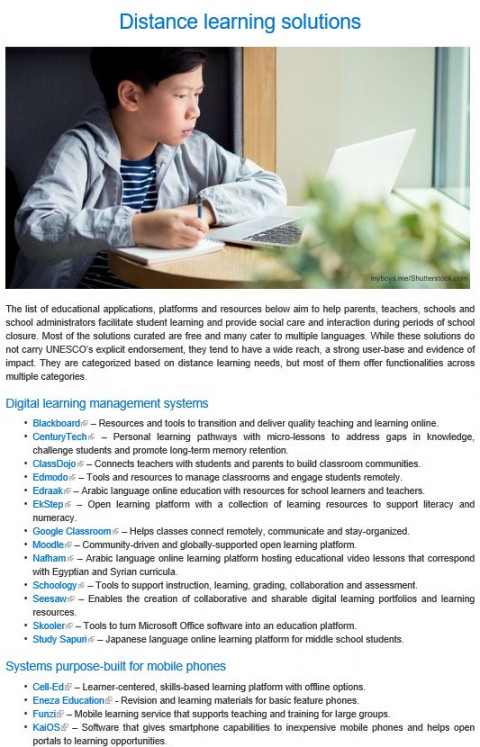 Distance Learning Solutions Year of publication: 2020 Corporate author: UNESCO The list of educational applications, platforms and resources below aim to help parents, teachers, schools and school administrators facilitate student learning and provide social care and interaction during periods of school closure. Most of the solutions curated are free and many cater to multiple languages. While these solutions do not carry UNESCO’s explicit endorsement, they tend to have a wide reach, a strong user-base and evidence of impact. They are categorized based on distance learning needs, but most of them offer functionalities across multiple categories. Solutions d’apprentissage à distance Year of publication: 2020 Corporate author: UNESCO La liste d’applications et de plates-formes éducatives ci-dessous vise à aider parents, enseignants, établissements et responsables pédagogiques à faciliter l’apprentissage des élèves et à assurer des interactions et des services sociaux pendant la fermeture des écoles. La plupart des solutions sont gratuites et plusieurs sont multilingues. Bien qu’elles ne soient pas explicitement soutenues par l’UNESCO, ces solutions ont généralement une large portée, de nombreux utilisateurs et une efficacité avérée. Elles sont classées par type de besoin pédagogique mais la plupart présente des fonctionnalités relevant de plusieurs catégories.
  Tools for Planning and Monitoring Programmes of Multilingual Education in Asia Year of publication: 2020 Corporate author: UNESCO | UNESCO Bangkok This booklet provides some tools that programme personnel may use in the M&E of their multilingual education (MLE) programmes. This booklet complements the five booklets of UNESCO’s MTB MLE Resource Kit – Including the Excluded: Promoting Multilingual Education (2018).
  Country Commitments to Gender Equality in Education Year of publication: 2018 Author: Erica Murphy Corporate author: UNESCO The international community has committed through legal and political frameworks to achieving gender equality in all spheres, including education. These frameworks include obligations to protect and secure women and girls' right to education through the elimination of discriminatory barriers, whether they exist in law or in everyday life, and to undertake positive measures to bring about equality, including in access of, within, and through education.This paper firstly sets out the legal and political frameworks on gender equality in education to which states have committed and then describes how they have committed.In the second section, the content of states’ commitments to achieve gender equality in education is explained, including the normative content of relevant provisions found in international and regional human rights treaties and the 2030 Agenda for Sustainable Development. This section also includes a classification of states according to what legal commitments to women and girls’ right to education they have made.The final section details how states can be held accountable for failure to meet their legal commitments to gender equality in education, including what mechanisms are available and examples of how these mechanisms have been used to hold states accountable.This paper is also background paper prepared for the 2018 Global education monitoring report gender review: Meeting our commitments to gender equality in education.
 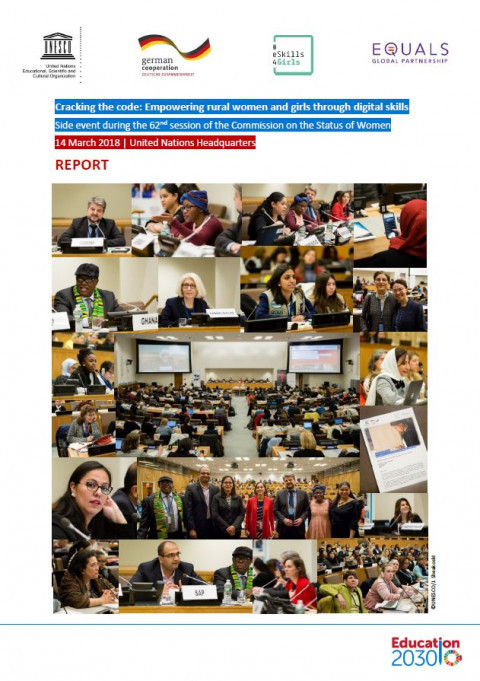 Cracking the Code: Empowering Rural Women and Girls through Digital Skills; Side Event during the 62nd Session of the Commission on the Status of Women, 14 March 2018, United Nations Headquarters: Report Year of publication: 2018 Corporate author: UNESCO | Germany. Federal Ministry for Economic Cooperation and Development (BMZ) UNESCO and the German Federal Ministry of Economic Cooperation and Development (BMZ) co-organised the side event ‘Cracking the code: Empowering rural women and girls through digital skills’ on 14 March 2018, United Nations Headquarters in New York, on the margins of the 62nd session of the CSW. More than 500 participants participated in the event while a broad global audience followed the discussions through live webcast.This report provides an overview of the discussions and examples of government, civil society organizations, and private sector initiatives to close the gender digital gap and empower rural girls and women to be ICT users, creators and innovators through gender-responsive digital skills training as well as science, technology, engineering and mathematics (STEM) education more broadly.
  Sustainability Education Principal Training Manual Year of publication: 2012 Corporate author: UNESCO | Beijing Sustainable Development Education Association | China National Council for Sustainable Development Education Secretariat This article is devoted to explaining the application of sustainable development in China. 可持续发展教育校长培训手册 Year of publication: 2012 Corporate author: 联合国教科文组织 (UNESCO) | Beijing Sustainable Development Education Association | China National Council for Sustainable Development Education Secretariat 文章旨在解释可持续发展在中国的应用