
Resources
Explore a wide range of valuable resources on GCED to deepen your understanding and enhance your research, advocacy, teaching, and learning.
1,402 Results found
 Comprendre les enjeux du numérique en éducation - Apports de la recherche Year of publication: 2022 Corporate author: France. Ministère de l'Éducation Nationale et de la Jeunesse Panorama de quelques apports de la recherche sur les enjeux du numérique en éducation (contexte socio-économique et culturel, parentalité et vie familiale, pratiques des jeunes, enseignement et apprentissages, intelligence artificielle, impact de la crise sanitaire) : infographie bilingue et livret.L’étude du numérique en éducation prend en compte le numérique comme « fait social total» et va des interfaces aux interactions, des pratiques aux représentations. C’est un champ de recherche qui recouvre une grande diversité d’objets : dispositifs technologiques utilisés (équipements, services, environnements de travail, ressources), évolution des pratiques professionnelles, pluralité des écosystèmes et des interactions entre acteurs (institutions, communauté éducative, collectivités, monde associatif, industriels…), etc. – et d’approches, disciplinaires ou pluridisciplinaires : psychologie, neurosciences, informatique et sciences du numérique, sciences de l’information et de la communication, sciences de l’éducation, sociologie, didactique, anthropologie, sociolinguistique, ingénierie des connaissances, etc. Dans un contexte international où l’éducation au numérique correspond à une demande sociale, celle-ci tend à une évolution des compétences portée par des référentiels communs mais avec des traductions dans les programmes officiels variables selon les pays. Overview of some research contributions on the challenges of digital education (socio-economic and cultural context, parenthood and family life, youth practices, teaching and learning, artificial intelligence, impact of the health crisis): bilingual infographic and booklet.The study of digital technology in education takes into account digital technology as a "total social fact", from interfaces to interactions, from practices to representations. This field of research covers a wide range of subjects: technological devices used (equipment, services, work environments, resources), changes in professional practices, the plurality of ecosystems and interactions between players (institutions, the educational community, local authorities, associations, industry, etc.), etc., as well as disciplinary and multidisciplinary approaches: psychology, neuroscience, social sciences, etc. - and disciplinary or multidisciplinary approaches: psychology, neuroscience, computer and digital sciences, information and communication sciences, educational sciences, sociology, didactics, anthropology, sociolinguistics, knowledge engineering, etc. In an international context where digital education corresponds to a social demand, the trend is towards an evolution of skills supported by common reference frameworks, but with translations into official programs that vary from country to country.
  Lumni Corporate author: Institut national de l'audiovisuel (INA) | France Télévisions Lumni est l’offre de tous les acteurs de l’audiovisuel public français au service de l’éducation pour les élèves et les enseignants. Cette offre donne accès à la culture, au savoir et à la connaissance pour tous les enfants de 3 à 20 ans et couvre l’ensemble des disciplines scolaires de la maternelle à la terminale. Tous les programmes sont indexés par niveau, matière et thématique.Avec plus de 12 000 vidéos, audios, jeux, dossiers, ce catalogue propose :• aux élèves, seuls ou accompagnés, de développer leur culture générale, de prolonger leurs cours, de comprendre le monde en apprenant autrement et de devenir des citoyens éclairés capables de décrypter l’actualité ;• aux enseignants, d’enrichir et de préparer leurs cours ;Avec une proposition éditoriale adaptée à chaque univers, Lumni enrichit régulièrement son offre avec des séries webnatives, des cours, des jeux, des quiz, ainsi que des programmes et des opérations à forte valeur éducative. Lumni is the educational offering for students and teachers from all French public broadcasters. This offer provides access to culture, knowledge and learning for all children aged 3 to 20, and covers all school subjects from kindergarten to the end of secondary school. All programs are indexed by level, subject and theme.With more than 12,000 videos, audios, games and dossiers, this catalog offers:• students, alone or accompanied, to develop their general knowledge, extend their lessons, understand the world by learning differently, and become enlightened citizens capable of deciphering current events;• teachers, to enrich and prepare their lessons;With an editorial proposal adapted to each universe, Lumni regularly enriches its offer with webnative series, courses, games, quizzes, as well as programs and operations with high educational value.
 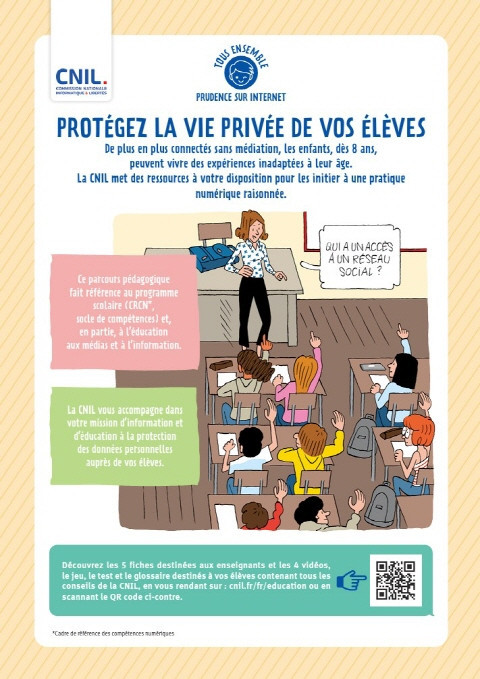 Protégez la vie privée de vos élèves Year of publication: 2022 Corporate author: Commission nationale de l'informatique et des libertés (CNIL) La CNIL propose ce dossier pédagogique pour accompagner les enseignants dans leur mission d’information et d’éducation à la protection des données personnelles auprès de leurs élèves. Sous la forme d’un livret, découvrez cinq fiches adaptées au programme scolaire des cycles 2 et 3 (6 à 10 ans). Chacune présente le déroulé d’une séance de travail en classe en plusieurs temps dont un consacré au jeu. The CNIL offers this educational pack to support teachers in their mission to inform and educate their students about personal data protection. In the form of a booklet, discover five fact sheets adapted to the school curriculum for cycles 2 and 3 (ages 6 to 10). Each one outlines a class work session in several stages, one of which is devoted to games.
  International News, Reading Notes : From Restricted Citizenship to Citizenship Education (Nathanaël Wallenhorst et Éric Mutabazi (dir.), Le Bord de l’eau, 2021, 230 p.) Year of publication: 2021 Author: Jean-Pierre Véran Corporate author: Revue internationale d’éducation de Sèvres For readers of the Revue Internationale d’éducation de Sèvres, it should first be emphasized that this work raises the question of citizenship in the era of globalization. And, as an example, we will give chapter 2, which answers the question posed by its title: "How ethnicity prevented the realization of a community of citizens in Rwanda? It should also be emphasized that the thinkers called upon, from Kant to Arendt via Gramsci, have in common that they have considered the question of citizenship in very diverse historical and national contexts, but on a scale exceeding the national borders.We will also underline the second merit of this collective work of eleven researchers. It first paints a picture of the impeded citizenship of our present time before proposing an overcoming of these various impediments through cosmopolitical and existential citizenship. Actualité internationale, Notes de lecture: D’une citoyenneté empêchée à une éducation citoyenne (Nathanaël Wallenhorst et Éric Mutabazi (dir.), Le Bord de l’eau, 2021, 230 p.) Year of publication: 2021 Author: Jean-Pierre Véran Corporate author: Revue internationale d’éducation de Sèvres Pour les lecteurs de la Revue internationale d’éducation de Sèvres, on soulignera d’abord que cet ouvrage pose la question de la citoyenneté à l’ère de la mondialisation. Et, à titre d’exemple, on donnera le chapitre 2, qui répond à la question posée par son titre : « Comment l’ethnicité a empêché la réalisation d’une communauté de citoyens au Rwanda ? » On soulignera aussi que les penseurs à qui il est fait appel, de Kant à Arendt en passant par Gramsci, ont en commun d’avoir pensé la question de la citoyenneté dans des contextes historiques et nationaux très divers, mais à une échelle dépassant les frontières nationales.2On soulignera également un second mérite de ce travail collectif de onze chercheurs. Il dresse d’abord un tableau de la citoyenneté empêchée de notre temps présent avant de proposer un dépassement de ces empêchements divers au travers d’une citoyenneté cosmopolitique et existentielle.
  Les clichés du gaming, comment chasser le racisme ou le patriarcat des jeux vidéos ? Year of publication: 2024 Corporate author: France Inter Produit phare de l’industrie culturelle, le jeu vidéo a, au même titre que le cinéma, une dimension politique et sociale. Certains titres, ont été jugés comme étant racistes. Alors, comment décoloniser le jeu vidéo ?A flagship product of the cultural industry, video games have, like cinema, a political and social dimension. Some titles, like Resident Evil 5, have been deemed racist. So how do we decolonize video games?
  être citoyen numérique, ça te dit ? Year of publication: 2022 Corporate author: TRALALERE Vinz est très excité, il a été sélectionné pour participer au concours du meilleur citoyen numérique ! En effet, dans les vidéos qu’il a déjà réalisées, il respecte, sans le savoir, la Charte pour l’éducation à la culture et à la citoyenneté numériques. Une belle occasion pour Vinz de nous expliquer les notions de charte et de citoyenneté numérique. Vinz is very excited - he's been selected to take part in the best digital citizen competition! In fact, in the videos he's already made, he unknowingly respects the Charter for Education in Digital Culture and Citizenship. This is a great opportunity for Vinz to explain the concepts of the Charter and of digital citizenship.
 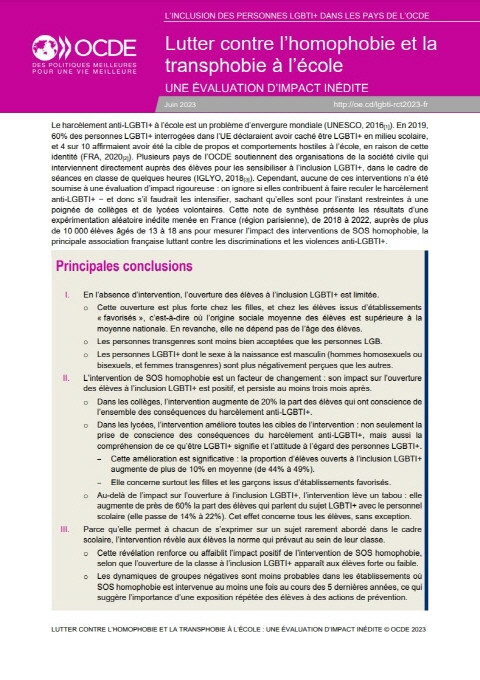 Lutter contre l’homophobie et la transphobie à l’école Year of publication: 2023 Corporate author: Organisation de coopération et de développement économiques (OCDE) Cette note de synthèse présente les résultats d’une expérimentation inédite que l’OCDE a menée en France (région parisienne), de 2018 à 2022, auprès de plus de 10 000 élèves âgés de 13 à 18 ans pour mesurer l’impact des interventions de SOS homophobie, la principale association française luttant contre les discriminations et les violences anti-LGBTI+. This briefing note presents the results of an unprecedented experiment that the OECD conducted in France (Paris region), from 2018 to 2022, with more than 10,000 pupils aged 13 to 18, to measure the impact of interventions by SOS homophobie, the leading French association fighting anti-LGBTI+ discrimination and violence.
  The ABCs of Artificial Intelligence: A Lesson in Geopolitics Year of publication: 2024 Author: Angèle Le Névé Corporate author: Association Relative à la Télévision Européenne (ARTE) As artificial intelligence becomes more and more a part of our daily lives, what are its political and geopolitical repercussions? Asma Mhalla, a specialist in political issues surrounding technology, explains the basics of AI and how it is used by industry and governments to promote their ideas. Le B.A.-BA de l'intelligence artificielle: Une leçon de géopolitique Year of publication: 2024 Author: Angèle Le Névé Corporate author: Association Relative à la Télévision Européenne (ARTE) Alors que l'intelligence artificielle prend de plus en plus de place dans notre quotidien, quelles sont ses répercussions politiques et géopolitiques ? Asma Mhalla, spécialiste des enjeux politiques de la Tech explique les bases de l'IA et comment elle est utilisée par les industriels et les États pour véhiculer leurs idées.