
Resources
Explore a wide range of valuable resources on GCED to deepen your understanding and enhance your research, advocacy, teaching, and learning.
882 Results found
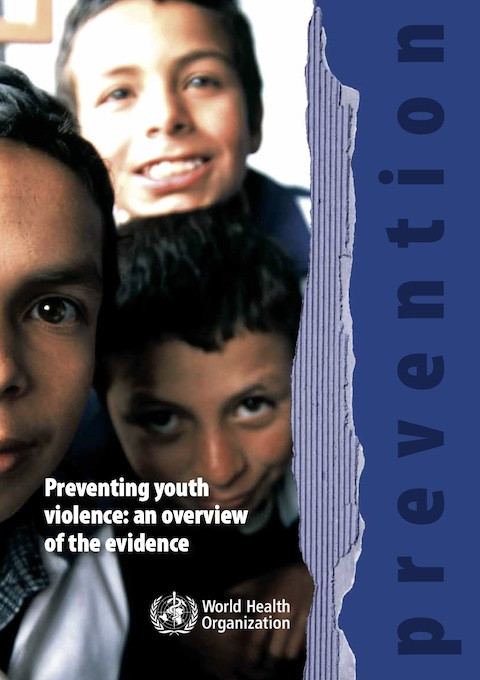 Preventing Youth Violence: An Overview of the Evidence Year of publication: 2015 Corporate author: World Health Organization (WHO) Every year about 200.000 adolescents and young people between the ages of 10 and 29 die, which places homicide in fourth place in the world as cause of death in young population. Several million adolescents and young people suffer from acts of violence, and trauma that require urgent medical and psychological treatment. The emotional imprints that youth volence leaves on its survivors and their loved ones are often profound. Youth violence destroys lives and its consequences have very high economic costs, both for society and for the families of young people. The goal of this manual is to provide a scientific framework that allows us to understand why some people have a greater tendency to be involved in acts of youth violence and how to prevent it. La prevención de la violencia juvenil: Panorama general de la evidencia Year of publication: 2015 Corporate author: World Health Organization (WHO) Cada año mueren unos 200.000 adolescentes y jovenes entre los 10 y los 29 años de edad, lo cual coloca al homicidio en cuarto lugar en el mundo como causa demuerte en la población joven. Varios millones de adolescentes y jovenes sufren por actos de violencia, traumatismos que exijen tratamiento medico y psicologico urgente. Las huellas emocionales que la violencia juvenil deja en sus sobrevivientes y en los seres queridos de estos suelen ser profundas. La violencia juvenil destroza vidas y sus consecuencias tienen costos economicos muy altos,tanto para la sociedad como para las familias de los jovenes. El objetivo de este manual es ayudar a los formuladores de politicas y planificadores en todas partes a contrarrestar la violencia juvenil mediante estrategias respaldadas por la evidencia. El manual proporciona un marco cientifico que permite entender por qué algunas personas tiene una mayor tendencia a verse involucradas en actos de violencia juvenil y cómo prevenirla.
 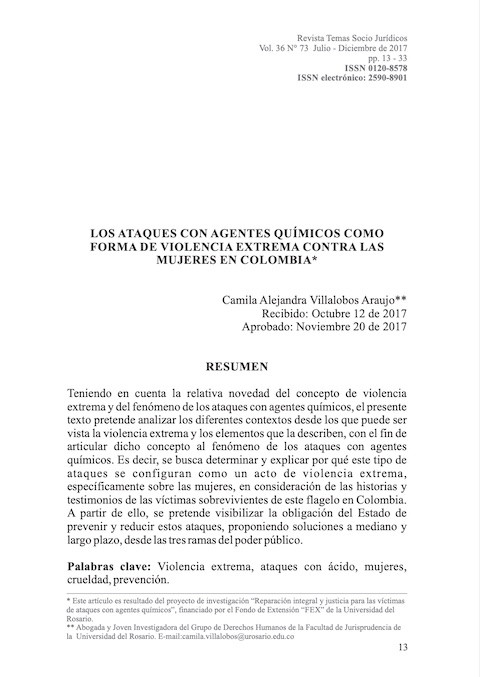 Attacks With Chemical Agents as a Form of Extreme Violence Against Women in Colombia (Revista Temas Socio Jurídicos; Vol. 36 No. 73) Year of publication: 2017 Author: Camila Alejandra Villalobos Araujo Corporate author: Universidad Autónoma de Bucaramanga (UNAB) This text aims to analyse different contexts from which the extreme violence can be seen and the elements that describe it, in order to articulate this concept to the phenomenon of acid attacks. In other words, the text seeks to determine and explain why such attacks are configured as an act of extreme violence, specifically to women, taking into account the stories and testimonies of surviving victims in Colombia. From it, the text seeks to make visible the obligation of the State to prevent and reduce these attacks, proposing solutions in the medium and long term, from the legislative, judicial and executive power. Los ataques con agentes químicos como forma de violencia extrema contra las mujeres en Colombia (Revista Temas Socio Jurídicos; Vol. 36 No. 73) Year of publication: 2017 Author: Camila Alejandra Villalobos Araujo Corporate author: Universidad Autónoma de Bucaramanga (UNAB) Este texto pretende analizar los diferentes contextos desde los que puede ser vista la violencia extrema y los elementos que la describen, con el fin de articular dicho concepto al fenómeno de los ataques con agentes químicos. Es decir, se busca determinar y explicar por qué este tipo de ataques se configuran como un acto de violencia extrema, específicamente sobre las mujeres, en consideración de las historias y testimonios de las víctimas sobrevivientes de este flagelo en Colombia. A partir de ello, se pretende visibilizar la obligación del Estado de prevenir y reducir estos ataques, proponiendo soluciones a mediano y largo plazo, desde las tres ramas del poder público.
  Formalism, Tribalism, and Nationalism in the Protection of Children’s Rights in Kazakhstan Year of publication: 2020 Author: Aigerim Musabalinova Corporate author: Central Asian Bureau for Analytical Reporting (CABAR) | Institute for War and Peace Reporting (IWPR) Aigerim Musabalinova, an expert on children’s rights tries to find an answer to the question of how the social and cultural aspect of the country affects the well-being of children and the observance of their rights and interests, in an article for CABAR.asia. Формализм, трайбализм и национализм в вопросах защиты прав детей в Казахстане Year of publication: 2020 Author: Aigerim Musabalinova Corporate author: Central Asian Bureau for Analytical Reporting (CABAR) | Institute for War and Peace Reporting (IWPR) Айгерим Мусабалинова, казахстанский эксперт по правам ребенка в статье для CABAR.asia пробует найти ответ на вопрос как социальный и культурный аспект страны влияет на благополучие детей и соблюдение их прав и интересов.
  Борьба с семейным насилием в Кыргызстане: Защищены ли Жертвы? Year of publication: 2020 Author: Anna Zubenko Corporate author: Central Asian Bureau for Analytical Reporting (CABAR) | Institute for War and Peace Reporting (IWPR) В данной статье автор анализирует некоторые результаты реформ судебно-правовой системы, благодаря которым в Кыргызстане появился ряд новых кодексов, была направлена прежде всего на гуманизацию законодательства и декриминализацию отдельных видов преступлений. Семейное насилие, в рамках изменения законодательства напротив, было криминализовано – его включили в Кодекс о проступках, являющийся частью уголовного законодательства. Однако по мнению автора де-факто привлекать к ответственности виновников стало сложнее.
 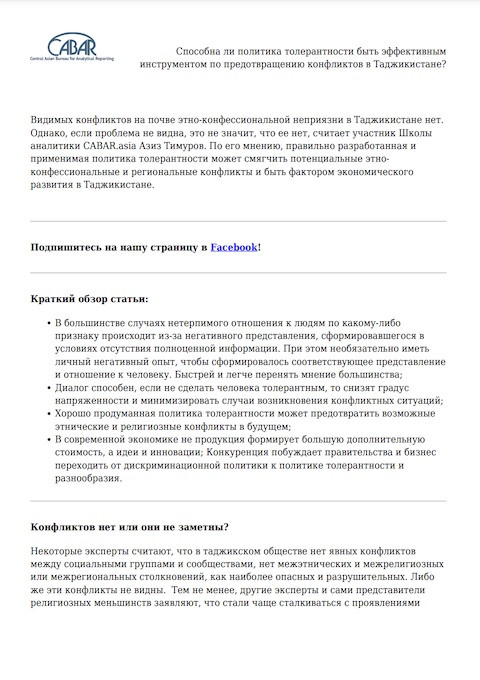 Can Tolerance Policy Be an Effective Tool for Conflict Prevention in Tajikistan? Year of publication: 2020 Author: Aziz Timurov Corporate author: Central Asian Bureau for Analytical Reporting (CABAR) | Institute for War and Peace Reporting (IWPR) There are no visible conflicts on the basis of ethnic-religious hostility in Tajikistan. However, if the problem is not visible, this does not mean that it does not exist, said Aziz Timurov, participant of the CABAR.asia School of Analytics. In his opinion, a well-developed and applicable tolerance policy can mitigate potential ethnic-religious and regional conflicts and be a factor in economic development in Tajikistan. Способна ли политика толерантности быть эффективным инструментом по предотвращению конфликтов в Таджикистане? Year of publication: 2020 Author: Aziz Timurov Corporate author: Central Asian Bureau for Analytical Reporting (CABAR) | Institute for War and Peace Reporting (IWPR) Видимых конфликтов на почве этно-конфессиональной неприязни в Таджикистане нет. Однако, если проблема не видна, это не значит, что ее нет, считает участник Школы аналитики CABAR.asia Азиз Тимуров. По его мнению, правильно разработанная и применимая политика толерантности может смягчить потенциальные этно-конфессиональные и региональные конфликты и быть фактором экономического развития в Таджикистане.
  التنمر الإلكتروني بين المراهقين: دراسة مطبَّقة على عينة من طلبة المرحلة المتوسطة المستخدمين للعبة الفورتنايت Year of publication: 2019 Author: Moudi Al-Anzi Corporate author: Qassim University استهدفت الدراسة التعرف على الأسباب الشخصية للتنمر الالكتروني ومعرفة دور المناخ الأسري والمدرسي في التنمر الالكتروني. استخدمت لعبة الفورتنايت كمثال للتعرف على التنمر الذي يحصل من خلال الألعاب الالكترونية. استخدمت الاستبانة لجمع البيانات.