
Resources
Explore a wide range of valuable resources on GCED to deepen your understanding and enhance your research, advocacy, teaching, and learning.
3,790 Results found
 Identité, empreinte génétique et citoyenneté: réflexions philosophiques Year of publication: 2010 Author: Marie-Hélène Parizeau Corporate author: Sociologie et sociétés Dans quelle mesure la biométrie, et plus spécifiquement l’empreinte génétique, dans un contexte de globalisation, de flux migratoires, et de chasse au terrorisme, vient-elle modifier le rapport de l’individu à sa citoyenneté ?Pour tenter de répondre à cette question, nous rappellerons quelques aspects théoriques de la citoyenneté. L’historique des mesures d’encartement liées à l’avènement de la citoyenneté y sera aussi rapidement présenté. Nous évoquerons ensuite le contexte actuel de l’usage de la biométrie à des fins d’identification et les motifs invoqués par la Communauté européenne et les États-Unis. Nous examinerons plus attentivement le cas précis de l’empreinte génétique avec les exemples du Canada et des États-Unis. Finalement, l’empreinte génétique et l’identité personnelle seront mises en relation à partir du concept d’identité narrative de Paul Ricoeur. Nous montrerons comment les critères ethno-raciaux utilisés par la biométrie ; concomitamment avec l’idéologie du multiculturalisme ; construisent une nouvelle narration occidentale de l’Autre, qui l’exclut de la sphère de la citoyenneté.
  Umstrittene Geschichte: Ansichten zum Holocaust unter Muslimen im internationalen Vergleich The article relates a qualitative study carried out alongside an educational project for multiplicators. It is an experimental encounter programme between Israeli Jews and Palestinians from Israel, dealing together with the history and the memory of the Holocaust, and also with the Israeli-Palestinian conflict and the Nakba. The programme can be considered an experience located at the intersection of Peace Education and Holocaust Education; it lasted over a year and included a study trip to Berlin. The research is based on three series of interviews with the participants, including during the study-trip to Berlin. The findings point to questions of identity-building during the process, recognizing victims’ experiences rather than victims’ identities, processes of inclusion and distancing, and dilemmas faced by the participants when dealing together with the history and the memory of the Holocaust. The contribution shows possible objectives and limits of such a project, as well as the necessary conditions for the emergence of a culture of mutual recognition, without negating the asymmetrical character of the prevailing situation, nor comparing sufferings, nor equating historical facts. It shows that focusing on perpetrators and bystanders, rather than only on victims, can bring common insights for both sides. (By the author)
  Las actividades nazis en la Argentina: reflexiones en torno a un texto de estudio para EGB 3 y Polimodal This article approaches the question of teaching history through students´ books or school manuals. Recognizing the importance of the role of history as a builder of collective memory, the study analyses specifically the proposal of a manual (designed by the authors of this article) created for teachers and students about the Holocaust problematic and its treatment in Argentinean classrooms. Based on the material elaborated by CEANA (Comisión para el Esclarecimiento de las Actividades Nazis en la Argentina / Commission for the clarification of the Nazi activities in Argentina,) the Manual gives a new meaning to the Shoah´s history and memory and offers a new proposal of transference of this knowledge in the classroom to make it possible to teach a living and critical history that is in a permanent relationship with the present. (By the author)
 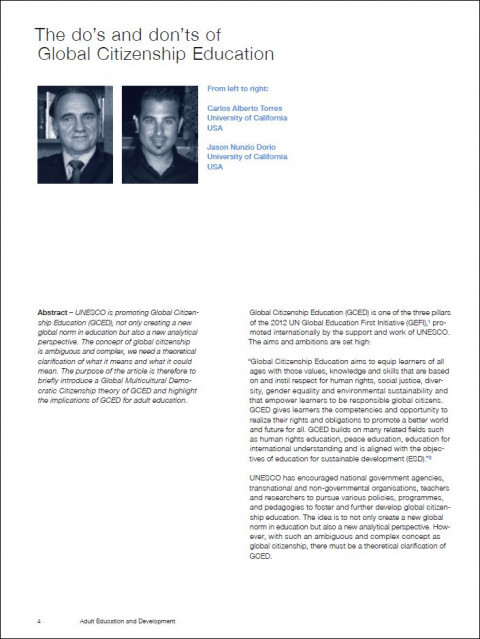 The Do's and Don’ts of Global Citizenship Education Year of publication: 2015 Author: Carlos Alberto Torres | Jason Nunzio Dorio Corporate author: Éducation des Adultes et Développement UNESCO is promoting Global Citizenship Education (GCED), not only creating a new global norm in education but also a new analytical perspective. The concept of global citizenship is ambiguous and complex, we need a theoretical clarification of what it means and what it could mean. The purpose of the article is therefore to briefly introduce a Global Multicultural Democratic Citizenship theory of GCED and highlight the implications of GCED for adult education. Qué hacer y qué evitar en la educación para la ciudadanía mundial Year of publication: 2015 Author: Carlos Alberto Torres | Jason Nunzio Dorio Corporate author: Éducation des Adultes et Développement La UNESCO está promoviendo la educación para la ciudadanía mundial (ECM), no solo creando una nueva normativa mundial sobre educación, sino introduciendo además una nueva perspectiva de análisis. Como el concepto de ciudadanía mundial es ambiguo y complejo, se requiere una aclaración teórica de lo que signifi ca y de lo que podría denotar. El objetivo de este artículo es, por tanto, exponer brevemente una teoría de ECM basada en una ciudadanía mundial democrática y multicultural, y subrayar las implicaciones de la ECM para la educación de adultos. Les choses à faire et à éviter dans le domaine de l’éducation à la citoyenneté mondiale Year of publication: 2015 Author: Carlos Alberto Torres | Jason Nunzio Dorio Corporate author: Éducation des Adultes et Développement L’UNESCO promeut l’éducation à la citoyenneté mondiale (ECM), en créant non seulement une nouvelle norme mondiale dans l’éducation, mais aussi un nouvel angle analytique. Le concept de la citoyenneté mondiale est ambigu et complexe. Aussi convient-il de mettre au point au plan théorique ce qu’il veut dire et ce qu’il pourrait vouloir dire. Par conséquent, cet article a pour objectif de présenter rapidement une théorie de l’ECM portant sur la citoyenneté mondiale multiculturelle et démocratique, et de mettre en lumière ce qu’implique l’ECM pour l’éducation des adultes.
 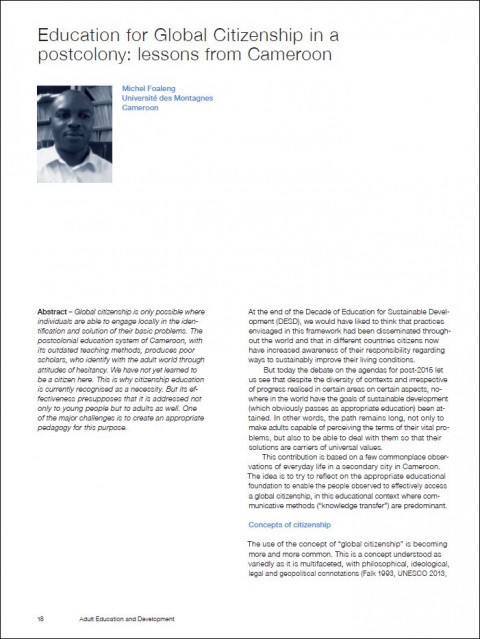 Education for Global Citizenship in a Postcolony: Lessons from Cameroon Year of publication: 2015 Author: Michael Foaleng Corporate author: Éducation des Adultes et Développement Global citizenship is only possible where individuals are able to engage locally in the identification and solution of their basic problems. The postcolonial education system of Cameroon, with its outdated teaching methods, produces poor scholars, who identify with the adult world through attitudes of hesitancy. We have not yet learned to be a citizen here. This is why citizenship education is currently recognised as a necessity. But its effectiveness presupposes that it is addressed not only to young people but to adults as well. One of the major challenges is to create an appropriate pedagogy for this purpose. Educación para la ciudadanía mundial en una nación postcolonial: lecciones de Camerún Year of publication: 2015 Author: Michael Foaleng Corporate author: Éducation des Adultes et Développement La ciudadanía mundial solo puede ejercerse allí donde las personas son capaces de participar a nivel local en la identifi cación y la solución de sus problemas básicos. El sistema postcolonial de educación de Camerún, cuyos métodos pedagógicos están obsoletos, forma estudiantes deficientes, que se identifi can con el mundo de los adultos mediante actitudes de vacilación. Aún no hemos aprendido a ser ciudadanos en este país. Por eso en la actualidad se reconoce la necesidad de impartir educación para la ciudadanía. Sin embargo, para que resulte efi caz es preciso que no solo esté orientada a los jóvenes, sino también a los adultos. Uno de los principales desafíos consiste en crear una pedagogía adecuada para alcanzar este objetivo. Éducation à la citoyenneté mondiale à l’ère postcoloniale : leçons du Cameroun Year of publication: 2015 Author: Michael Foaleng Corporate author: Éducation des Adultes et Développement Une citoyenneté mondiale n’est possible que là où localement les individus sont capables de s’engager dans l’identification et la résolution de leurs problèmes élémentaires. Le système éducatif du Cameroun postcolonial, avec ses méthodes pédagogiques désuètes, produit des déchets scolaires, qui se reconnaissent dans le monde des adultes par des attitudes attentistes. On n’a pas encore appris ici à être citoyen. C’est pourquoi l’éducation à la citoyenneté est actuellement reconnue comme une nécessité. Mais son efficacité présuppose qu’elle s’adresse non seulement aux jeunes, mais aussi adultes. L’un des défis majeurs reste alors d’imaginer une pédagogie appropriée à cet effet.
  The Migrant Community Building Active Citizenship in No Man’s Land Year of publication: 2015 Author: Elmer Romero Corporate author: Éducation des Adultes et Développement This is a story about the difficulties facing the migrant community in the United States and the potential of active citizen participation by migrants. How organisations and people work in education with the transformation of the traditional system of education into active learning that promotes critical thinking is also shown. Finally, a methodological approach which aims to create citizen transformers of reality is presented.