
Resources
Explore a wide range of valuable resources on GCED to deepen your understanding and enhance your research, advocacy, teaching, and learning.
3,229 Results found
 Progress on the Sustainable Development Goals: The Gender Snapshot 2020 Year of publication: 2020 Corporate author: United Nations Entity for Gender Equality and the Empowerment of Women (UN Women) This document brings together the latest available evidence on gender equality across all 17 Goals, underscoring the progress made, but also taking stock of areas where progress has been disrupted, as a result of COVID-19.
 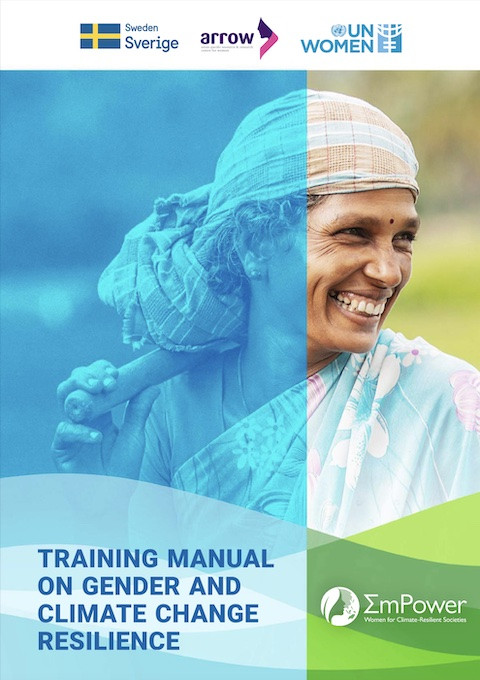 Training Manual on Gender and Climate Change Resilience Year of publication: 2021 Author: Dharmistha Chauhan Corporate author: Asian-Pacific Resource & Research Centre for Women (ARROW) | United Nations Entity for Gender Equality and the Empowerment of Women (UN Women) This Training Manual on Gender and Climate Change Resilience is designed for use by Civil Society Organizations (CSOs) in Asia working with communities on gender, climate change resilience and disaster risk reduction. The manual aims to strengthen the capacities of CSOs to mainstream gender in their practices and to actively advocate for gender mainstreaming in policies, programmes, projects and legislation. The long-term objective is to promote climate resilience action on the ground with a gender equality perspective in the forefront.
  Gender and Climate Change: Training Handbook Year of publication: 2018 Author: Višnja Baćanović | Jasmina Murić Corporate author: United Nations Entity for Gender Equality and the Empowerment of Women (UN Women) | Government of Serbia | United Nations Development Programme (UNDP) This handbook aims to improve the understanding of gender aspects in climate change. It is intended for experts and interested public, and is organized as a training program for male and female representatives of institutions and state administration, so that it may can be used as a source for practical training, as well as a guide for the introduction of gender perspective in programs and projects.The manual is organized according to thematic units of training and includes basic concepts, gender roles and stereotypes; key gender aspects of climate change; legal and strategic frameworks; and the introduction of gender perspectives in policies and programs in the field of climate change.
 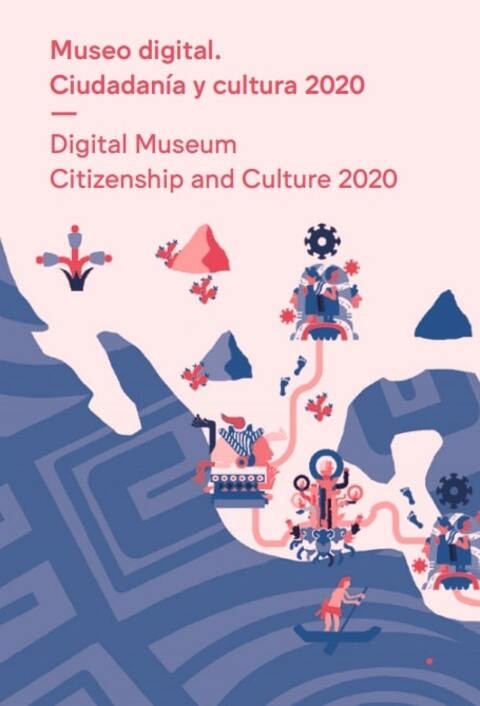 Digital Museum: Citizenship and Culture 2020 Year of publication: 2022 Corporate author: National Autonomous University of Mexico (UNAM) Conversations about digitality and museums were transformed, as a result of the COVID-19 pandemic, towards actions and topics related to the creation of content with perspectives of building a digital citizenship where activism, free access and the exercise of cultural rights They are confronted with the paradoxes of the privatization of knowledge, job insecurity, 2.0 exploitation systems and the emergence of asymmetrical time horizons. This publication expands on the conferences, dialogues, workshops and case studies presented at the homonymous meeting held in November 2020. Museo digital: Ciudadanía y cultura 2020 Year of publication: 2022 Corporate author: National Autonomous University of Mexico (UNAM) Las conversaciones sobre digitalidad y museos se transformaron, a raíz de la pandemia por COVID-19, hacia acciones y temas relativos a la creación de contenidos con perspectivas de construcción de una ciudadanía digital donde el activismo, el acceso libre y el ejercicio de derechos culturales se confrontan con las paradojas de la privatización de saberes, la precarización laboral, los sistemas de explotación 2.0 y la emergencia de horizontes temporales asimétricos. Esta publicación expande las conferencias, diálogos, talleres y estudios de caso presentados en el encuentro homónimo celebrado en noviembre de 2020.
  SDG4 이행 촉진을 위한 지표 연구 Year of publication: 2025 Author: 박근영 | 주형미 | 문무경 | 오예진 | 류기락 | 조혜승 | 변종임 | Sunmi Ji | 이슬비 | 박기웅 | 안해정 | 서무계 Corporate author: Korean National Commission for UNESCO 지속가능발전목표(SDGs) 이행의 전환점을 맞아 국내 교육의 현황과 과제를 SDG4 지표를 통해 진단하고 향후 방향을 탐색한 연구 보고서 <목차> 발간사 ‘SDG4 이행 촉진을 위한 지표 연구’ 보고서를 발간하며 서론 현 시점의 SDG4 이행 수준 점검과 개선 방향 탐색의 당위성 SDG 4.1 공평하고 양질의 초·중등 교육 이수 보장에 대한 한국 현황 및 향후 과제 SDG 4.2 영유아 교육과 보육 지표 검토와 향후 과제 SDG 4.3 고등교육의 수월성과 형평성 논의 및 향후 과제 SDG 4.4 고용을 위한 스킬: SDG 4.4의 이행 현황과 과제 SDG 4.5 교육 형평성 실현을 위한 SDG 4.5 지표 검토와 이행 현황 분석 SDG 4.6 한국의 SDG 4.6 이행 현행과 과제: 성인 문해력 SDG 4.7 더불어 살기 위한 학습을 향하여: 세계시민교육 및 지속가능발전교육 이행 현황과 모니터링 개선 방안 탐색 SDG 4.a SDG 4.a.1과 한국 디지털 교육 이행 현황: 접근성, 사용도, 스킬 SDG 4.b 공적개발원조(ODA) 장학금 확대 SDG 4.c 자격을 갖춘 교사의 공급 관련 이행 현황 및 개선 방안 결론 엄격한 현실 인식에 기반한 다음 목표로의 이행 준비
 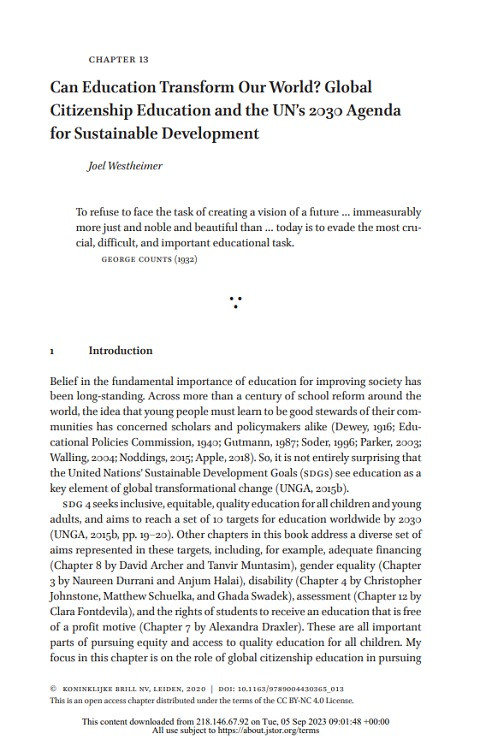 “Can Education Transform Our World?: Global Citizenship Education and the UN’s 2030 Agenda for Sustainable Development” Year of publication: 2020 Author: Joel Westheimer Corporate author: Brill This book chapter is taken from the book Grading Goal Four: Tensions, Threats, and Opportunities in the Sustainable Development Goal on Quality Education, which aims to support the immplementation of Sustainable Development Goal 4 by exploreing various tensions, threats, and opportunities. This chapter specifically focuses on the role of eucation in fostering global citizenship and how educational systems and policies can be improved to facilitate creating a sustainable society and contribute to the 2030 SDG Agenda.
  Leave No One Behind Year of publication: 2016 Corporate author: Global Goals At the heart of the Sustainable Development Goals is a commitment to leave no one behind. That’s because, although we have made huge progress towards a better world, too many people have been left behind because of who they are or where they live.
  Global citizenship education: citizenship education for globalizing societies Year of publication: 2015 Author: Werner Wintersteiner | Heidi Grobbauer | Gertraud Diendorfer | Susanne Reitmair-Juárez Corporate author: Austrian Commission for UNESCO This text reflects the work we have been doing for many years in the area of Global Citizenship Education (GCED) in Austria. Two endeavors particularly stand out: first, the continuing Masters programme GCED at the Alps-Adriatic University (Alpen-Adria Universität) in Klagenfurt, which is a specialized course of study for educationalists, teacher trainers, NGO associates and teachers (participants may either graduate with a certificate after two years or an MA degree after three years respectively), and second, our cooperation with the Austrian UNESCO Associated Schools Project Network. This was the originally intended audience for the German version of this brochure, which constitutes the programmatic basis for our training programs. We understand GCED as a concept that is located at the interface between civic education, global education and peace education, as well as education for sustainable development and intercultural learning. Our approach is characterized by these four features:* theoretical grounding and a particular focus on terminology in order to foster competence of judgment regarding political concepts* investigating the historical dimension of GCED in depth in order to account for colonialism and neocolonialism* socio-critical orientation in order to set us apart from strands of GCED that ultimately perpetuate concepts of Western hegemony* didactic implementation that is systematic and based on appropriate theoretical work in order to avoid pragmatismWith this English edition (the section specific to the Austrian context was omitted) we wish to initiate a dialog with colleagues in the whole world and hope to engage in lively exchange. Education à la citoyenneté mondiale: éducation à la citoyenneté pour les sociétés de mondialisation Year of publication: 2015 Author: Werner Wintersteiner | Heidi Grobbauer | Gertraud Diendorfer | Susanne Reitmair-Juárez Corporate author: Austrian Commission for UNESCO Ce texte reflète le travail que nous faisons depuis de nombreuses années dans le domaine de l'éducation à la citoyenneté mondiale (ECM) en Autriche. Deux projets se démarquent particulièrement: d'abord, le programme de maîtrise ECM à l'Université alpine-adriatique de Klagenfurt, qui est un cours spécialisé pour les pédagogues, les formateurs d'enseignants, les associés des ONG et les enseignants (les participants peuvent soit être diplômés Avec un certificat après deux ans ou un MA après trois ans respectivement), et deuxièmement, notre coopération avec le Réseau autrichien du projet des écoles associées de l'UNESCO. Il s'agissait du public initialement destiné à la version allemande de cette brochure, qui constitue la base programmatique de nos programmes de formation. Nous considérons l'ECM comme un concept situé à l'interface entre éducation civique, éducation globale et éducation à la paix, ainsi que l'éducation pour le développement durable et l'apprentissage interculturel. Notre approche se caractérise par ces quatre caractéristiques: fondement théorique et un accent particulier sur la terminologie afin de favoriser la compétence de jugement sur les concepts politiques étudier la dimension historique de l'ECM en profondeur afin de rendre compte du colonialisme et néocolonialisme orientation socio-critique afin Nous distinguent des filières de l'ECM qui, en fin de compte, perpétuent les concepts d'une mise en œuvre didactique de l'hégémonie occidentale systématique et basée sur un travail théorique approprié pour éviter le pragmatisme. Avec cette édition en anglais (la section spécifique au contexte autrichien a été omis), nous souhaitons initier un dialogue avec des collègues dans le monde entier et espérer engager des échanges animés.