
Resources
Explore a wide range of valuable resources on GCED to deepen your understanding and enhance your research, advocacy, teaching, and learning.
3,448 Results found
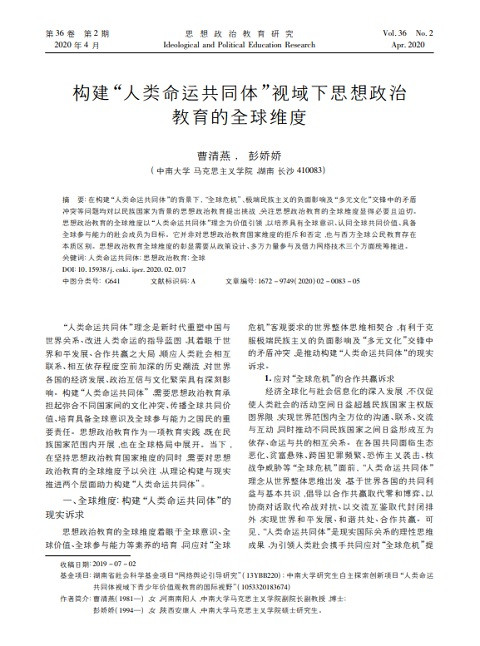 构建“人类命运共同体”视域下思想政治 教育的全球维度 (思想政治教育研究; Vol. 36, No. 2) Year of publication: 2020 Author: Cao Qingyan | Peng Jiaojiao Corporate author: Harbin University of Science and Technology 在构建“人类命运共同体”的背景下,“全球危机”、极端民族主义的负面影响及“多元文化”交锋中的矛盾 冲突等问题均对以民族国家为背景的思想政治教育提出挑战,关注思想政治教育的全球维度显得必要且迫切。 思想政治教育的全球维度以“人类命运共同体”理念为价值引领,以培养具有全球意识、认同全球共同价值、具备 全球参与能力的社会成员为目标。它并非对思想政治教育国家维度的拒斥和否定,也与西方全球公民教育存在 本质区别。思想政治教育全球维度的彰显需要从政策设计、多方力量参与及借力网络技术三个方面统筹推进。
 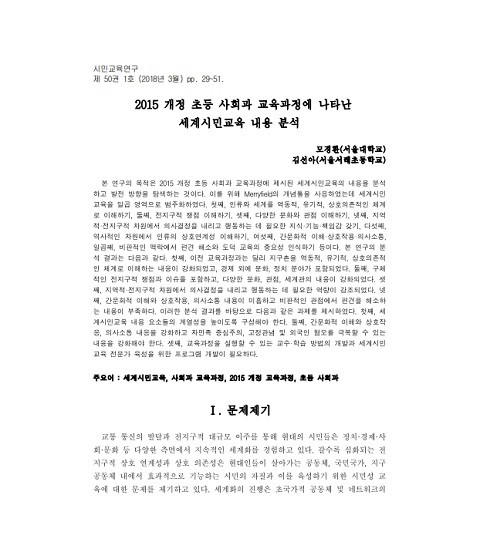 A Critical Analysis of Global Citizenship in 2015 Revised Elementary Social Studies Curriculum (Theory and Research in Citizenship Education; Vol. 50, No. 1) Year of publication: 2018 Author: Kyunghwan Mo | Sunah Kim Corporate author: Korea Association of Social Education The purpose of this study was to examine how global citizenship is reflected in the 2015 revised social studies curriculum. The study used the conceptual framework of Merryfield(1998) to analyze the national curriculum. The results of the analysis are as follows. First, in terms of understanding of the world as interdependent systems, contents on politics and culture as well as economy increased. Second, more global issues and problems were included. Third, contents on sustainable development increased. Fourth, the scope of diversity expanded. Fifth, interconnectedness of humans through time was inadequately reflected in the current social studies curriculum. Sixth, contents on values and attitudes, and actions were strengtened. Sixth, contents of cross-cultural understanding, interaction, and communication are not adequately included. The elementary social studies curriculum should strengthen cross-cultural understanding and interaction and prejudice reduction. Also, more instructional methods for global citizenship education should be developed and teacher education programs should be overhauled. 2015 개정 초등 사회과 교육과정에 나타난 세계시민교육 내용 분석 (시민교육연구; Vol. 50, No. 1) Year of publication: 2018 Author: 모경환 | 김선아 Corporate author: 한국사회과교육학회 본 연구의 목적은 2015 개정 초등 사회과 교육과정에 제시된 세계시민교육의 내용을 분석하고 발전 방향을 탐색하는 것이다. 이를 위해 Merryfield의 개념틀을 사용하였는데 세계시민교육을 일곱 영역으로 범주화하였다. 첫째, 인류와 세계를 역동적, 유기적, 상호의존적인 체계로 이해하기, 둘째, 전지구적 쟁점 이해하기, 셋째, 다양한 문화와 관점 이해하기, 넷째, 지역적·전지구적 차원에서 의사결정을 내리고 행동하는 데 필요한 지식·기능·책임감 갖기, 다섯째, 역사적인 차원에서 인류의 상호연계성 이해하기, 여섯째, 간문화적 이해·상호작용·의사소통, 일곱째, 비판적인 맥락에서 편견 해소와 도덕 교육의 중요성 인식하기 등이다. 본 연구의 분석 결과는 다음과 같다. 첫째, 이전 교육과정과는 달리 지구촌을 역동적, 유기적, 상호의존적인 체계로 이해하는 내용이 강화되었고, 경제 외에 문화, 정치 분야가 포함되었다. 둘째, 구체적인 전지구적 쟁점과 이슈를 포함하고, 다양한 문화, 관점, 세계관의 내용이 강화되었다. 셋째, 지역적·전지구적 차원에서 의사결정을 내리고 행동하는 데 필요한 역량이 강조되었다. 넷째, 간문화적 이해와 상호작용, 의사소통 내용이 미흡하고 비판적인 관점에서 편견을 해소하는 내용이 부족하다. 이러한 분석 결과를 바탕으로 다음과 같은 과제를 제시하였다. 첫째, 세계시민교육 내용 요소들의 계열성을 높이도록 구성해야 한다. 둘째, 간문화적 이해와 상호작용, 의사소통 내용을 강화하고 자민족 중심주의, 고정관념 및 외국인 혐오를 극복할 수 있는 내용을 강화해야 한다. 셋째, 교육과정을 실행할 수 있는 교수·학습 방법의 개발과 세계시민교육 전문가 육성을 위한 프로그램 개발이 필요하다.
  Sustainable Foundations: A Guide for Teaching the Sustainable Development Goals Year of publication: 2018 Author: Keana Rellinger | Grace Van Mil Corporate author: Manitoba Council for International Cooperation (MCIC) This guide is designed for educators or anyone who would like to teach young people about the United Nations Sustainable Development Goals. The Sustainable Development Goals — also known as the SDGs or the Global Goals —cover a wide range of sustainability issues; highlighting local, national and international priority areas to end poverty and hunger, improve health and education, make cities more sustainable and combat climate change. This guide will provide you with clear information, educational resources and other supports to help you in your efforts to educate and engage young people so that they support the Sustainable Development Goals and are inspired to turn their support into action. This guide will also explore how you can incorporate the different topics covered by each goal into your lessons across multiple subjects. Fondations durables: Un Guide d’enseignement des objectifs de développement durable Year of publication: 2018 Author: Keana Rellinger | Grace Van Mil Corporate author: Manitoba Council for International Cooperation (MCIC) Ce guide est conçu pour les éducateurs ou toute personne qui aimerait enseigner aux jeunes les objectifs de développement durable des Nations Unies. Les objectifs de développement durable – également connus sous l’acronyme ODD ou les objectifs mondiaux – couvrent un large éventail de questions relatives à la durabilité, et mettent en lumière les zones de priorité internationale pour mettre fin à la pauvreté et à la faim, améliorer la santé et l’éducation, rendre les villes plus durables et combattre le changement climatique. Ce guide vous donne des informations claires, des ressources pédagogiques et d’autres soutiens pour appuyer vos efforts d’éducation et de motivation des jeunes pour qu’ils appuient les objectifs de développement durable et se sentent inspirés à transformer leur appui en action. Ce guide explore aussi comment vous pouvez incorporer à vos cours les divers sujets couverts par chaque objectif dans de multiples matières.
 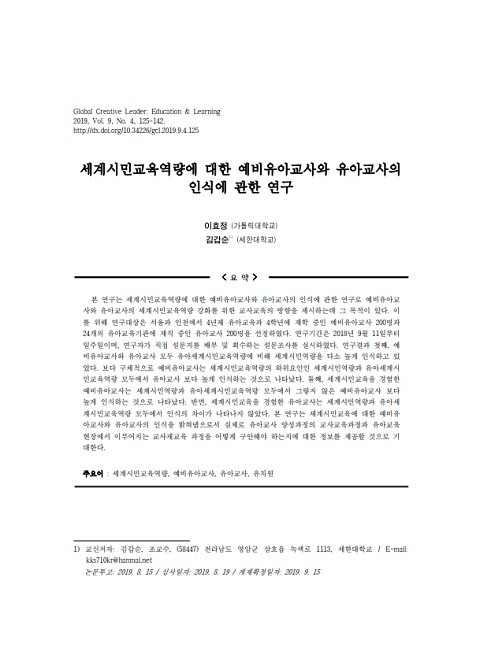 세계시민교육역량에 대한 예비유아교사와 유아교사의 인식에 관한 연구 (Global Creative Leader: Education & Learning; Vol. 9, No. 4) Year of publication: 2019 Author: 이효정 | 김갑순 Corporate author: 숭실대학교 영재교육연구소 본 연구는 세계시민교육역량에 대한 예비유아교사와 유아교사의 인식에 관한 연구로 예비유아교사와 유아교사의 세계시민교육역량 강화를 위한 교사교육의 방향을 제시하는데 그 목적이 있다. 이를 위해 연구대상은 서울과 인천에서 4년제 유아교육과 4학년에 재학 중인 예비유아교사 200명과 24개의 유아교육기관에 재직 중인 유아교사 200명을 선정하였다. 연구기간은 2018년 9월 11일부터 일주일이며, 연구자가 직접 설문지를 배부 및 회수하는 설문조사를 실시하였다. 연구결과 첫째, 예비유아교사와 유아교사 모두 유아세계시민교육역량에 비해 세계시민역량을 다소 높게 인식하고 있었다. 보다 구체적으로 예비유아교사는 세계시민교육역량의 하위요인인 세계시민역량과 유아세계시민교육역량 모두에서 유아교사 보다 높게 인식하는 것으로 나타났다. 둘째, 세계시민교육을 경험한 예비유아교사는 세계시민역량과 유아세계시민교육역량 모두에서 그렇지 않은 예비유아교사 보다 높게 인식하는 것으로 나타났다. 반면, 세계시민교육을 경험한 유아교사는 세계시민역량과 유아세계시민교육역량 모두에서 인식의 차이가 나타나지 않았다. 본 연구는 세계시민교육에 대한 예비유아교사와 유아교사의 인식을 밝혀냄으로서 실제로 유아교사 양성과정의 교사교육과정과 유아교육현장에서 이루어지는 교사재교육 과정을 어떻게 구안해야 하는지에 대한 정보를 제공할 것으로 기대한다.
  从教书匠到燃灯者: 教师公民教育自觉的蒙昧与唤醒 (当代教育论坛; No. 296) Year of publication: 2020 Author: Hu Chaoxia | Tang Songlin Corporate author: Hunan Academy of Educational Science 从课程角度来看,目前我国学校公民教育存在两个不充分:公民学科教 育以公民认知代替完整的公民教育,路径开发不充分;其他各类课程协同的公民教育同 向聚焦不足,路径拓展不充分。从教师角度思考其原因,是“教书匠”的职业定位蒙昧了其 现代教育背景下职能的自觉,拘囿了其教育视域的拓展。教师要以公民教育自觉,为社会 和谐与公民幸福而教,拓展公民教育的场域,结成学习共同体,向自然、向社会、向生活开 发,搭建全景、多层交错衔接式育公民的大世界;拓展学科教学视域,在学科课程资源中 发掘或显或隐的公民教育课程资源,构建全员、全课程育公民的大格局。
  Treaties on Teachers for Global Citizenship Education (Korean Journal of Teacher Education; Vol. 31, No. special) Year of publication: 2015 Author: Kioh Jeong Corporate author: Korea National University of Education This article examines the nature of Global Citizenship Education (GCE) and the qualification of the teacher for the GCE. GCE means post-modern education beyond modern public education. In the latter, teachers used to have been affiliated with nation-building mission, professional service to learners, and sometimes teacher unionism. These affiliations are typically of modern nationalism and industrialism. Teachers for GCE stand on different ground for their professional practice: global civil right to teach, global civil right to learn, and finally peoples’ fundamental right for development. Their sight extends beyond national territory up to global world and cyber space. They overcome modernity to practice transformative pedagogy accommodating multi-cultural dimensions. The image can be summarized as a model global citizen who serves highly for the benefit of mankind, which characterizes Korean educational ideal as provided by the foundation law of education Korea. 세계시민교육을 위한 교사론 (교원교육; Vol. 31, 특별호) Year of publication: 2015 Author: Kioh Jeong Corporate author: Korea National University of Education 세계시민교육은 국경과 국가와 결부된 근대적 성격의 교육을 넘어선 포스트모던 교육을 지 향한다. 이 논문은 이러한 세계시민교육을 담당하고 발전시켜갈 교사들의 성격이나 교사관에 대한 논의를 전개한다. 세계시민교육을 담당할 교사들의 성격은 성직자관 전문직관 노동자관으 로 요약되는 기존 교직관의 틀을 벗어난다. 세계시민교사로 요약된 이러한 교사상은 세계시민권으로서 가르칠 권리와 세계시민권으로서의 학습권에 기초한 교육을 보편적 인권으로서 개발 에의 권리에 입각한 모든 인류의 발전과 성장을 지향하는 교사를 필요로 한다. 이러한 교사는 세속적인 교육을 견지하며, 영토를 넘어 전 지구생태계와 사이버세계에 시야를 넓히고, 근대성을 벗어나 포스트모던 패러다임에 입각한 변혁적 교수법과 다문화교육을 지향한다. 이러한 교사상을 선도적 세계시민으로서의 교사라고 요약할 수 있다. 선도적 세계시민으로서의 교사상은 우리 한국교육이 지향해온 교육이념인 홍익인간의 인간상과 일치한다. 홍익인간의 이념은 한국 교육이 세계시민교육논의에 적극 참여하는 배경의 하나를 이루고 있다. Perception on Global Citizenship Education Competence between Pre-service Teachers and In-service Teachers in Kindergarten (Global Creative Leader: Education & Learning; Vol. 9, No. 4) Year of publication: 2019 Author: Hyojeong Lee | Kabsoon Kim Corporate author: Soongsil University. Research Institute for Gifted & Talented Education The purpose of this study was to establish the direction of teacher education based on global citizenship education competence studying the perception of pre-service teachers and in-service teachers on global citizenship education competence. The 2018 survey was conducted for a week beginning September 11. The respondents who were 200 pre-service teachers and 200 in-service teachers were selected from Seoul and Incheon. The researcher distributed and collected the questionnaire directly. The results of the study were as follows. First, pre-service teachers showed higher cognition than in-service teacher in both global citizenship competence and early childhood global citizenship competence. Second, among pre-service teachers, ones who had experienced global citizenship education showed higher cognition level in both categories than others. On the other hand, in-service teachers who had experienced global citizenship education did not show any difference of cognition in both global citizenship competence and early childhood global citizenship competence. This study was expected to reveal the perceptions of pre-service teachers and when training teachers, the data provided more specific details for early childhood educator curriculums about global citizenship education.