
Resources
Explore a wide range of valuable resources on GCED to deepen your understanding and enhance your research, advocacy, teaching, and learning.
3,448 Results found
 Basic Elements of Forgiveness and Reconciliation Theory Year of publication: 2018 Author: Leonel Narváez Gómez Corporate author: Fundación para la Reconciliación This text presents the theoretical bases for forgiveness and reconciliation that support the pedagogy and actions of the Foundation for Reconcilation. Elementos básicos de la teoría del Perdón y la Reconciliación Year of publication: 2018 Author: Leonel Narváez Gómez Corporate author: Fundación para la Reconciliación En este texto se presentan las bases teóricas para el perdón y la reconciliación que sustentan la pedagogía y acciones de la Fundación para la Reconcliación.
  Initial Teacher Education in Citizenship in Latin America: A Comparative Analysis of Six Countries Year of publication: 2017 Corporate author: UNESCO Santiago This document reports on a study of initial teacher education in citizenship education in Latin America undertaken as an initiative of the OREALC-UNESCO Regional Strategy on Teacher Policies. Its purpose is to examine citizenship education in the teacher education curricula of six countries in the region –Argentina, Chile, Colombia, Guatemala, Mexico and Peru – researching the general contents of the programs, their organization, and the topics covered, and analyzing teacher preparation in this crucial dimension of the formative experience provided. La formación inicial docente en educación para la ciudadanía en América Latina: Análisis comparado de seis casos nacionales Year of publication: 2017 Corporate author: UNESCO Santiago El presente informe da cuenta de un estudio impulsado por la Estrategia Regional sobre Políticas Docentes de OREALC-UNESCO, acerca de la Formación Inicial Docente en educación para la ciudadanía en América Latina. Su propósito es examinar la presencia de la educación ciudadana en el currículum de la formación de docentes de seis países de la Región –Argentina, Chile, Colombia, Guatemala, México y Perú-, interrogando acerca de qué contenidos, organizados en qué forma, y cubriendo qué temáticas, caracterizan la preparación de maestros y maestras en esta crucial dimensión de la experiencia formativa que provee la escolaridad.
  Assurer à tous une éducation équitable, inclusive et de qualité: Objectif de développement durable 4 au Canada Year of publication: 2020 Corporate author: Council of Ministers of Education, Canada (CMEC) Ce rapport fournit un cadre pour communiquer l’information aux échelons pancanadien et international au sujet du travail en cours au Canada sur la réalisation de l’ODD 4. Il tire parti des données et des indicateurs liés à l’ODD 4 et inclut, dans la mesure du possible, les données provinciales et territoriales.
  The Impact of Short-term Study Abroad on Global Citizenship Identity and Engagement (Journal of Global Citizenship & Equity Education; Vol. 7, No. 1) Year of publication: 2020 Author: Paul Sherman | Brianna Cofield | Neve Connolly Corporate author: Centennial College Higher education has increasingly realized the importance of engaging students in global citizenship learning opportunities to be more globally informed, prepared, responsible, and competent. Study abroad in higher education is rapidly becoming recognized as an effective experiential learning platform for fostering intercultural exchanges. This article reports on research that examined study abroad as a learning platform for integrating classroom-acquired knowledge with real-world experience. The study explored the value of short-term study abroad in the facilitation of students’ global awareness and knowledge, their identification as global citizens and endorsement of prosocial values associated with global citizenship, and their participation as globally engaged citizens. Participation in study abroad was found to significantly strengthen one’s affiliation with global citizenship, endorsement of prosocial values and motivation to engage in global citizenship activities. Our findings have implications for the design and implementation of global citizenship education curricula in higher education.
 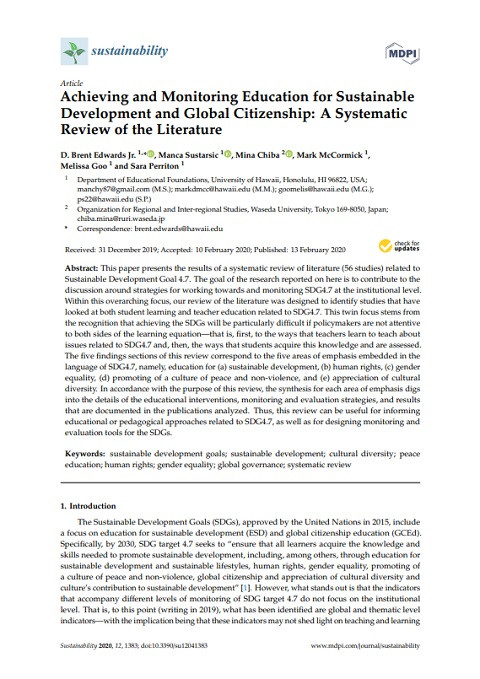 Achieving and Monitoring Education for Sustainable Development and Global Citizenship: A Systematic Review of the Literature (Sustainability 2020; Vol. 12, No. 4) Year of publication: 2020 Author: Brent Edwards | Manca Sustarsic | Mina Chiba | Mark McCormick | Melissa Goo | Sara Perriton Corporate author: Multidisciplinary Digital Publishing Institute (MDPI) This paper presents the results of a systematic review of literature (56 studies) related to Sustainable Development Goal 4.7. The goal of the research reported on here is to contribute to the discussion around strategies for working towards and monitoring SDG4.7 at the institutional level. Within this overarching focus, our review of the literature was designed to identify studies that have looked at both student learning and teacher education related to SDG4.7. This twin focus stems from the recognition that achieving the SDGs will be particularly difficult if policymakers are not attentive to both sides of the learning equation—that is, first, to the ways that teachers learn to teach about issues related to SDG4.7 and, then, the ways that students acquire this knowledge and are assessed. The five findings sections of this review correspond to the five areas of emphasis embedded in the language of SDG4.7, namely, education for (a) sustainable development, (b) human rights, (c) gender equality, (d) promoting of a culture of peace and non-violence, and (e) appreciation of cultural diversity. In accordance with the purpose of this review, the synthesis for each area of emphasis digs into the details of the educational interventions, monitoring and evaluation strategies, and results that are documented in the publications analyzed. Thus, this review can be useful for informing educational or pedagogical approaches related to SDG4.7, as well as for designing monitoring and evaluation tools for the SDGs.
 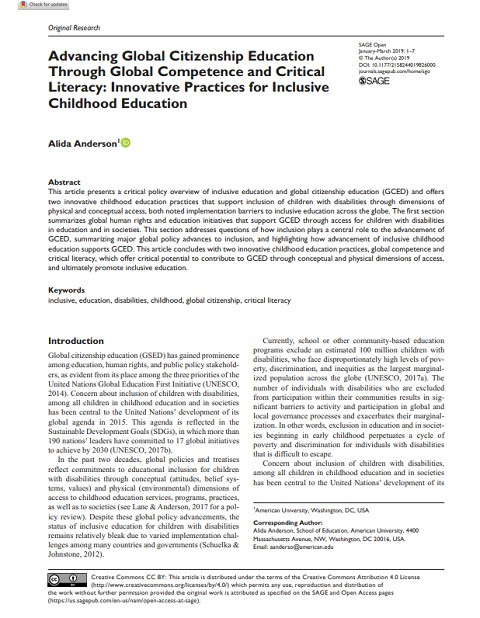 Advancing Global Citizenship Education Through Global Competence and Critical Literacy: Innovative Practices for Inclusive Childhood Education (SAGE Open; Vol. 9, No. 1) Year of publication: 2019 Author: Alida Anderson Corporate author: SAGE Publications This article presents a critical policy overview of inclusive education and global citizenship education (GCED) and offers two innovative childhood education practices that support inclusion of children with disabilities through dimensions of physical and conceptual access, both noted implementation barriers to inclusive education across the globe. The first section summarizes global human rights and education initiatives that support GCED through access for children with disabilities in education and in societies. This section addresses questions of how inclusion plays a central role to the advancement of GCED, summarizing major global policy advances to inclusion, and highlighting how advancement of inclusive childhood education supports GCED. This article concludes with two innovative childhood education practices, global competence and critical literacy, which offer critical potential to contribute to GCED through conceptual and physical dimensions of access, and ultimately promote inclusive education. Ensuring Inclusive and Equitable Quality Education: Sustainable Development Goal 4 in Canada Year of publication: 2020 Corporate author: Council of Ministers of Education, Canada (CMEC) This report provides a framework to share information at the pan-Canadian and international levels on work underway in Canada to achieve SDG 4. The report builds on SDG 4 data and indicators and includes, where possible, provincial and territorial data.
 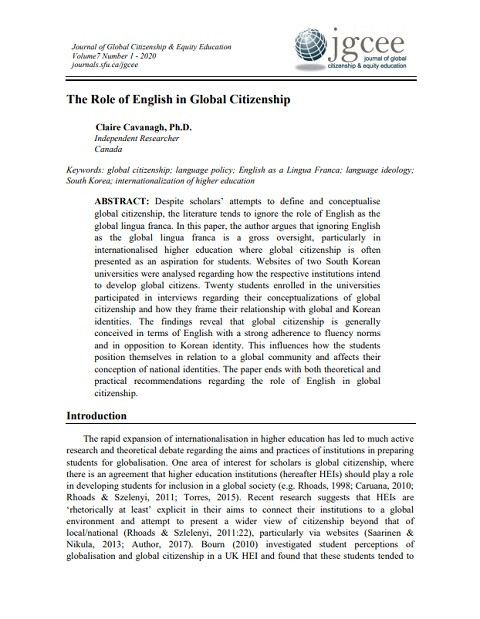 The Role of English in Global Citizenship (Journal of Global Citizenship & Equity Education; Vol. 7, No. 1) Year of publication: 2020 Author: Claire Cavanagh Corporate author: Centennial College Despite scholars’ attempts to define and conceptualise global citizenship, the literature tends to ignore the role of English as the global lingua franca. In this paper, the author argues that ignoring English as the global lingua franca is a gross oversight, particularly in internationalised higher education where global citizenship is often presented as an aspiration for students. Websites of two South Korean universities were analysed regarding how the respective institutions intend to develop global citizens. Twenty students enrolled in the universities participated in interviews regarding their conceptualizations of global citizenship and how they frame their relationship with global and Korean identities. The findings reveal that global citizenship is generally conceived in terms of English with a strong adherence to fluency norms and in opposition to Korean identity. This influences how the students position themselves in relation to a global community and affects their conception of national identities. The paper ends with both theoretical and practical recommendations regarding the role of English in global citizenship.