
Resources
Explore a wide range of valuable resources on GCED to deepen your understanding and enhance your research, advocacy, teaching, and learning.
2,197 Results found
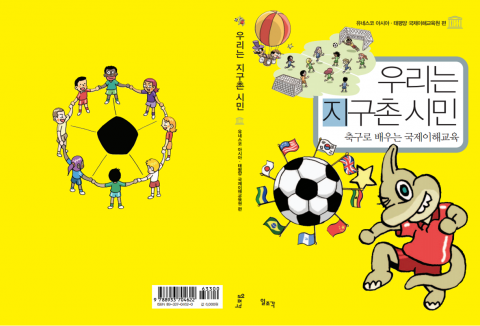 우리는 지구촌 시민: 축구로 배우는 국제이해교육 Year of publication: 2004 Corporate author: 유네스코 아시아태평양 국제이해교육원 『우리는 지구촌 시민—축구로 배우는 국제이해교육』은 세계화 시대에 우리 학생들이 세계 이웃의 다른 모습을 이해하고, 함께 살아가는 가치관을 깨우칠 수 있도록 도움을 주기 위하여 만들어진 교재입니다.세계적인 석학들과 교육 전문가들로 구성된 유네스코 21세기 세계교육위원회는 「들로르 보고서」에서 ‘함께 살기 위한 교육’을 21세기 교육의 핵심 과제로 제시하였습니다. 점차 증가하고 있는 여러가지 갈등 문제를 교육을 통하여 해결해 나가기 위한 시도인 것입니다. 이러한 세계적인 흐름 속에서 우리나라도 이에 발맞추어 제 7차 교육과정에서 '국제이해교육'을 창의적 재량학습 과목의 하나로 채택하였습니다. 이제는 국제이해교육의 하나의 독립된 학습 과목으로 자리잡을 수 있게 되었고, 이에 걸맞은 전문 교재와 교육 자료들이 필요하게 되었습니다. 하지만 안타깝게도 이러한 시대적인 요구를 만족시켜 줄만한 교재나 교육 자료는 그다지 많지 않습니다. 또한 '국제이해교육'이라는 제목을 통해서도 알 수 있듯이, 그 범위가 아주 넓어 어디서부터 어떻게 시작해야 할 지 막막한 기분이 드는 것도 사실입니다.유네스코 아시아태평양 국제이해교육원은 이러한 교육 현장의 요구에 부응하기 위해 『우리는 지구촌 시민—축구로 배우는 국제이해교육』을 발간하게 되었습니다. 유네스코 아시아태평양 국제이해교육원은 아시아·태평양 지역의 45개 나라들과 함께 '국제이해교육'을 강화하고 발전시킬 책임을 완수하기 위해 학교와 시민사회에서 다양한 활동을 이어오고 있습니다. 이러한 활동의 일환으로 우리 교육원은 다양한 분야의 전문가들과 함께 국제이해교육의 교육과정을 연구하는 동시에, 교원들에 대한 연수와 교육자료 개발에 온 힘을 쏟고 있습니다. 이번에 발간된 『우리는 지구촌 시민—축구로 배우는 국제이해교육』은 일곱 개의 장으로 구성되어 있으며, 각 장은 학생들이 세계 여러 나라의 저마다 다른 문화에 대한 이해를 통해서 문화간 이해, 인권, 평화, 세계화, 지속가능한 발전 등의 범세계적인 가치관을 배울 수 있도록 짜여졌습니다. 학생들이 일상 생활에서 쉽게 접할 수 있는 '축구'라는 작고 친근한 소재를 통해 '나와 다른 모습에 대한 이해'와 '함께 만들어가는 세상'을 체험하고 배울 수 있도록 꾸몄으며, 각 단원마다 다양한 <함께해보기>를 수록하여 학생들이 직접 참여함으로써 자신들이 가지고 있던 편견과 선입견을 발견하고 스스로 깨우쳐 나갈 수 있도록 구성하였습니다. 이 교재를 통하여 학생들이 편견에서 벗어나 세계의 친구들과 함께 살아갈 수 있는 올바른 가치관과 태도를 배울 수 있게 되기를 바랍니다.
 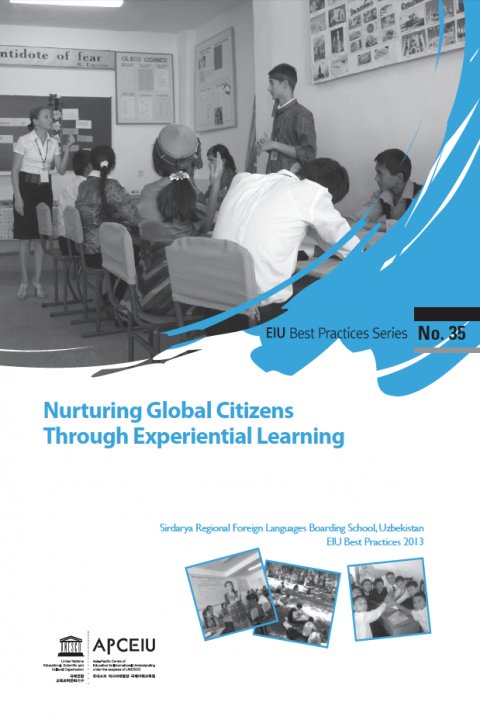 EIU Best Practice Series No. 35: Nurturing global citizens through experiential learning Year of publication: 2013 Author: Ildar Yusupov | Feruza Ahmedova Corporate author: APCEIU The following case is set in Uzbekistan where evidently diverse social groups live in harmony despite their differences. Among the schools in the country, the Sirdarya Regional Foreign Languages Boarding School in Gulistan City is arguably an exceptionally unique school due to the close engagement of parents with the boarding school’s EIU-themed activities. Activities range from extra-curricular activities including artwork and sports, to classroom-based activities such as role plays and international awareness events. Each activity is carefully designed to arouse the interest of the students in EIU-related themes such as tolerance, understanding and sustainable development. In the process, the students become highly motivated to take leading roles as responsible global citizens in creating a more peaceful world. Nourrir les citoyens du monde par l'apprentissage expérientiel (ECI Série des Meilleures Pratiques no.35) Year of publication: 2013 Author: Ildar Yusupov | Feruza Ahmedova Corporate author: Centre Asie-Pacifique d'éducation pour la compréhension internationale (APCEIU) Le cas suivant est réglé en Ouzbékistan où les groupes sociaux évidemment diverses vivent en harmonie malgré leurs différences. Parmi les écoles du pays, les langues régionales Sirdarya étrangères pensionnat de Gulistan ville est sans doute une école exceptionnellement unique en raison de la collaboration étroite des parents avec les activités ECI-thème de l'école d'embarquement. Les activités vont des activités extra-scolaires, y compris art et du sport, aux activités en salle de classe tels que des jeux de rôle et des activités de sensibilisation internationales. Chaque activité est soigneusement conçu pour susciter l'intérêt des étudiants dans les thèmes ECI-connexes tels que la tolérance, la compréhension et le développement durable. Dans le processus, les étudiants deviennent très motivés à prendre des rôles de premier plan en tant que citoyens du monde responsables dans la création d'un monde plus pacifique.
 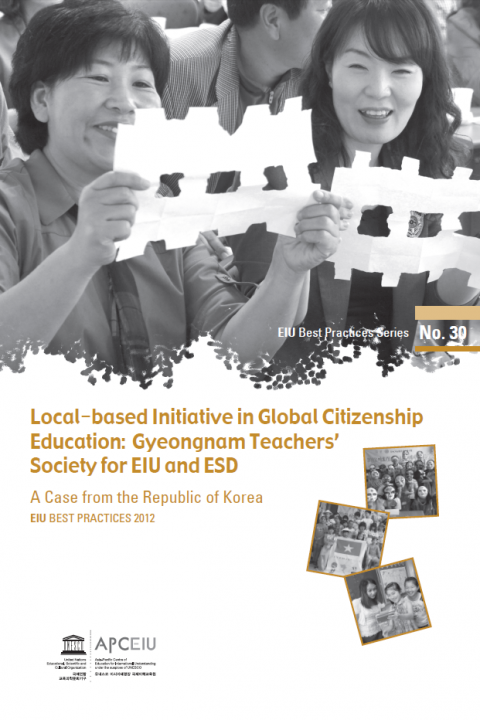 EIU Best Practice Series No.30: Local-based initiative in global citizenship education: Gyeongnam teachers’ society for EIU and ESD Year of publication: 2012 Author: Byeongseob Choi Corporate author: APCEIU Issue No. 30 introduces a case in the Republic of Korea on the local-based initiatives of school teachers to promote EIU and ESD in their local community. The case illustrates the taken steps and efforts made by the respective teachers when elaborating innovative approaches to promote EIU and ESD, led by the intention to create a more open and locally relevant educational setting for students as well as teachers in response to the growing globalization. Especially the Gyeongnam Province, where the teachers are based, is experiencing a rapid demographic change due to the high influx of foreigners, which calls upon the educators to prepare their students to effectively cope with these changes and become global citizens. Local à base initiative en matière d'éducation à la citoyenneté mondiale: la société des enseignants Gyeongnam pour ECI et EDD (ECI Série des Meilleures Pratiques no.30) Year of publication: 2012 Author: Byeongseob Choi Corporate author: Centre Asie-Pacifique d'éducation pour la compréhension internationale (APCEIU) Question n ° 30 introduit un cas en République de Corée sur les initiatives locales à base des enseignants des écoles pour promouvoir ECI et EDD dans leur communauté locale. Ce cas illustre les étapes et les efforts déployés par les enseignants respectifs lors de l'élaboration d'approches novatrices pour promouvoir ECI et EDD, menés par l'intention de créer un cadre éducatif plus ouvert et pertinent au niveau local pour les étudiants ainsi que les enseignants en réponse à la mondialisation croissante prises. En particulier, la province de Gyeongnam, où les enseignants sont basés, connaît une évolution démographique rapide en raison de l'afflux massif d'étrangers, qui invite les éducateurs à préparer leurs élèves à faire face efficacement à ces changements et à devenir des citoyens du monde.
 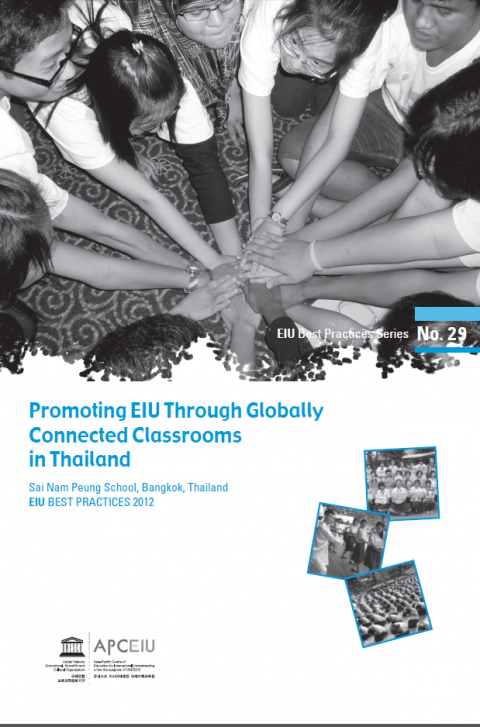 EIU Best Practice Series No. 29: Promoting EIU through globally connected classrooms in Thailand Year of publication: 2012 Author: Ajarn Kanchaphat Chaoplaina Corporate author: APCEIU This issue presents a multilateral project in Thailand, which interconnected students from Thailand, United Kingdom, Korea, Indonesia, Malaysia, Taiwan, and Vietnam to share their values and thoughts on EIU issues. Through the portals of connection, students from different regions were able to collaborate in doing group works and activities, which were focused on sharing ideas on students’ interest and every day experiences. This case highlights the specific practice that encouraged students to actively learn from one another and understand the cultural diversity, which optimized the outcome of the students’ capacity in communication skills, language skills, and personal development as global citizens. In addition to strengthening the network among participating schools, the impact of the multilateral project extended to teachers while they were engaged in exchanging pedagogical methods and knowledge to support and inspire each other. Promouvoir ECI travers les salles de classe branchés sur le monde en Thaïlande (ECI Série des Meilleures Pratiques no.29) Year of publication: 2012 Author: Ajarn Kanchaphat Chaoplaina Corporate author: Centre Asie-Pacifique d'éducation pour la compréhension internationale (APCEIU) Cette question présente un projet multilatéral en Thaïlande, qui interconnectée étudiants en provenance de Thaïlande, Royaume-Uni, la Corée, l'Indonésie, la Malaisie, Taïwan et le Vietnam pour partager leurs valeurs et leurs réflexions sur les questions ECI. A travers les portails de connexion, les étudiants de différentes régions ont été en mesure de collaborer à faire des travaux et des activités de groupe, qui ont été axées sur le partage des idées sur l'intérêt des élèves et expériences quotidiennes. Ce cas met en lumière la pratique spécifique qui a encouragé les élèves à apprendre activement les uns des autres et de comprendre la diversité culturelle, qui a optimisé le résultat de la capacité des étudiants en techniques de communication, les compétences linguistiques et le développement personnel en tant que citoyens. En plus de renforcer le réseau entre les écoles participantes, l'impact du projet multilatéral étendu aux enseignants alors qu'ils étaient engagés dans l'échange de méthodes et de connaissances pédagogiques pour soutenir et inspirer les uns des autres.
 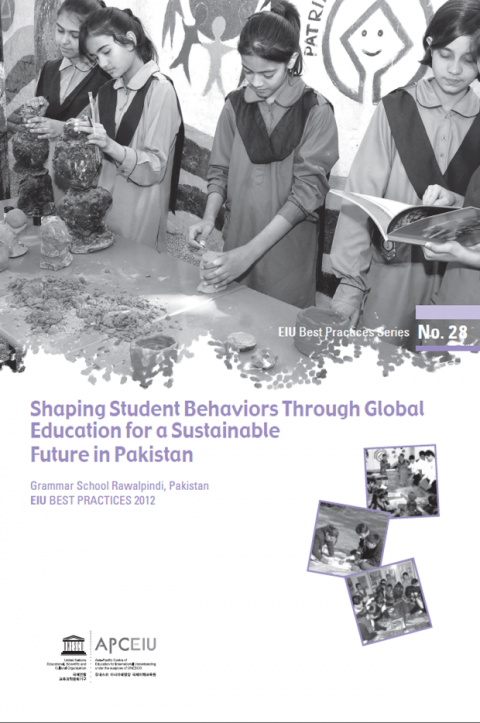 EIU Best Practice Series No. 28: Shaping student behaviors through global education for a sustainable future in Pakistan Year of publication: 2012 Author: Nasreen Iqbal Corporate author: APCEIU Issue No. 28 introduces a Global Education programme with its various activities from Grammar School Rawalpindi in Pakistan. It aims to enable and empower young people to become responsible and humane citizens to achieve a peaceful and sustainable future. It is targeted at all levels of students, including preschool level, to increase their awareness of social and civic values. The programme mainly focuses on EIU while equipping learners with conflict resolution skills, cultural and national identities and global citizenship. Also, it incorporates issues such as universal values, human rights, health, sustainable development, gender, multiculturalism, respect for minority groups, identity and self-worth, tolerance, etc. into the school ethos and curriculum so that the students will be able to perform positive changes on national as well as on international level. Façonner le comportement des élèves par le biais de l'éducation mondiale pour un avenir durable au Pakistan (ECI Série des Meilleures Pratiques no.28) Year of publication: 2012 Author: Nasreen Iqbal Corporate author: Centre Asie-Pacifique d'éducation pour la compréhension internationale (APCEIU) Question n ° 28 introduit un programme d’Éducation Mondiale avec ses diverses activités de Grammar School Rawalpindi au Pakistan. Il vise à permettre et permettre aux jeunes de devenir des citoyens responsables et humains pour parvenir à un avenir pacifique et durable. Il est destiné à tous les niveaux des élèves, y compris le niveau préscolaire, afin d'accroître leur prise de conscience des valeurs sociales et civiques. Le programme se concentre principalement sur ECI tout aux apprenants des compétences de résolution des conflits, des identités culturelles et nationales et la citoyenneté mondiale. En outre, il intègre des questions telles que les valeurs universelles, les droits de l'homme, la santé, le développement durable, l'égalité, le multiculturalisme, le respect pour les groupes minoritaires, l'identité et l'estime de soi, la tolérance, etc. dans l'ethos et le curriculum de sorte que les étudiants seront en mesure école pour effectuer des changements positifs sur le national et au niveau international.
 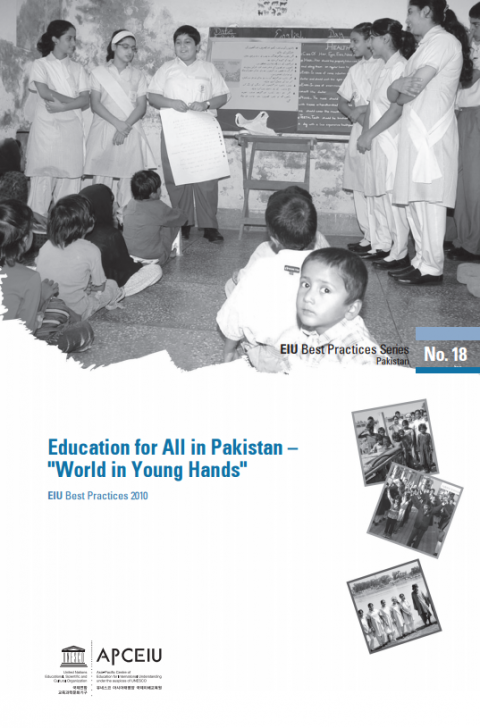 EIU Best Practices Series No.18: Education for All in Pakistan - "world in young hands" Year of publication: 2010 Author: Ayesha Saqib Corporate author: APCEIU The programme provides a student-participatory approach to face local problems that stem from ignorance and have roots in poverty. Bridging the school with the local community, Social Action Program (SAP) aims to inspire students with keen awareness on problems that threaten our community as well as to equip them with necessary tools to deal with challenges they may face. Through practices, SAP integrates EIU into curriculum that emphasizes maintaining peace and harmony among different folds of religions, ethnicity, and sects, dissipating the elements of hate and intolerance. The major areas of concern are Literacy for All, Sustainable Development, Cultural Diversity, and Peace Education.