
Resources
Explore a wide range of valuable resources on GCED to deepen your understanding and enhance your research, advocacy, teaching, and learning.
3,797 Results found
 加拿大学前儿童公民教育: 时代背景、内容向度与价值导向; 基于阿尔伯塔等三省早期学习框架的分析 Year of publication: 2019 Author: Xu Peng Corporate author: Primary and Secondary Education in Foreign Countries 当下,学前儿童公民教育愈发受到西方各国的关注。在国际政策话语、学前教育 课程改革以及儿童公民研究的共同推动下,公民教育逐渐成为加拿大各省学前教育课程的 重要组成部分。在近期儿童公民研究的基础上,形成以政治教育、社会性教育、主体性教育 和公民实践教育为内容向度的理论分析框架。通过主题分析,对阿尔伯塔省、不列颠哥伦比 亚省和新斯科舍省学前教育阶段的公民教育内容进行了分析。总的来看,三省的学前儿童 公民教育凸显了如下价值导向:强调儿童公民权责,倡导儿童为公民主体;变革传统公民身 份,视儿童参与为社会民主的根基;儿童公民话语多元,国际语境下凸显本土立场。
  Cultivating Civic Consciousness: The Path Choice and Promotion Strategy of Honesty Education for College Students Year of publication: 2020 Author: Xiong Da Corporate author: Hunan University of Science and Technology To solve the problem of college students’ lack of honesty,we need to find the root cause first. The lack of systematic civic education is an important reason for college students’ lack of honesty. We should promote the cultivation of college students’ good faith habit with the education of rule consciousness, promote the awakening of college students’ good faith morality with the education of honor consciousness, and guide college students’ noble good faith with the education of dedication consciousness. We should promote college students to understand the importance of honesty, constantly make self-reflections, improve their behavior to meet the requirements of honesty. On this basis, we should encourage college students to maintain the right of honesty by right awareness education, promote college students to be honest actively by participation awareness education, enhance college students’ responsibility of honesty by responsibility awareness education, change the idea from “I am wanted to be honest” to “I want to be honest by myself” and “I want the whole society to be honest”, so as to transform from heteronomy to self-discipline and even to be disciplined with honesty, and promote the whole society to make great progress in honesty. 培养公民意识: 大学生诚信教育的路径选择与提升策略 Year of publication: 2020 Author: Xiong Da Corporate author: 湖南科技大学 缺乏系统的公民意识教育是高校学生诚信缺失的重要原因。应当以规则意识教育促进高校学生诚信习惯 养成,以荣誉意识教育推进高校学生诚信道德觉醒,以奉献意识教育引导高校学生高尚诚信。促使高校学生认识诚信的 重要性,不断反思自我,改进自身行为以合乎诚信要求。在此基础上,应以权利意识教育鼓励高校学生维护诚信权利,以 参与意识教育推动高校学生积极诚信,以责任意识教育提升高校学生诚信担当,变“要我诚信”为“我要诚信”以至“我要 全社会诚信”,实现诚信他律向诚信自律以至诚信律他的转变,进而推动全社会诚信进步。
 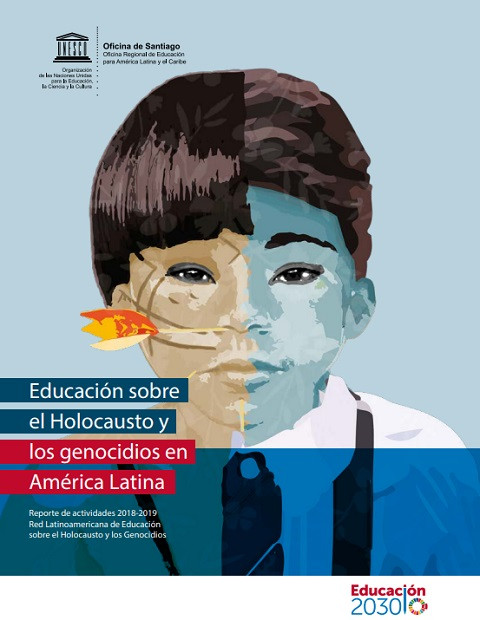 Holocaust and Genocide Education in Latin America: Activity Report 2018-2019 of the Latin American Network for Education on the Holocaust and Other Genocides Year of publication: 2019 Corporate author: UNESCO Santiago This document presents policies, experiences, plans and programs in Latin America dedicated to education about the holocaust and other genocides. Educación sobre el Holocausto y los genocidios en América Latina: Reporte de actividades 2018-2019 de la Red Latinoamericana de Educación sobre el Holocausto y los Genocidios Year of publication: 2019 Corporate author: UNESCO Santiago Este documento presenta políticas, experiencias, planes y programas en América Latina, dedicadas a la educación sobre el holocausto y otros genocidios.
  The Mass Education Movement and the Modern National Education in the 1920s: Centering on the Textbook of One Thousand Chinese Characters for Civilian Year of publication: 2020 Author: Guo Shuanglin Corporate author: Historiographic Studies The Mass Education Movement was essentially a kind of national education movement in modern China. After the rise of the Civic Education Movement in the 1920s, James Yen and others had been devoted to the development of this movement. But no matter from the perspective of their ideological understanding or from the angle of their social practices, their civic education movement was undoubtedly within the scope of national education. The main contribution of the Mass Education Movement on shaping the modern nationals was to disseminate the concept of modern state and national consciousness to the lower level of the society, which could be seen from the compilation of the textbook of One Thousand Chinese Characters for Civilians at that time. Even today, the Mass Education Movement’s act of disseminating the concept of modern state and national consciousness to the lower level of the society through the textbook is One Thousand Chinese Character of Civilians still has important reference value for us to achieve the great rejuvenation of the Chinese nation. 20世纪20年代平教运动与现代国民教育—以平民千字课本为中心 Year of publication: 2020 Author: Guo Shuanglin Corporate author: Historiographic Studies 从本质上讲,中国现代平民教育运动是一场国民教育运动。20世纪20年代公民教育运动兴 起后,晏阳初等人虽然也曾致力于此,但无论从其思想认识还是从社会实践上看,均不出国民教育的范围。 平民教育运动在塑造现代国民方面的主要贡献,是向底层社会播散现代国家观念和国民意识,这从当时编 写的平民千字课本中可以看出来。平教运动期间通过平民千字课向底层社会播散现代国家观念与国民意 识的做法,对我们今天完成民族复兴大业,仍有着重要的借鉴意义。
 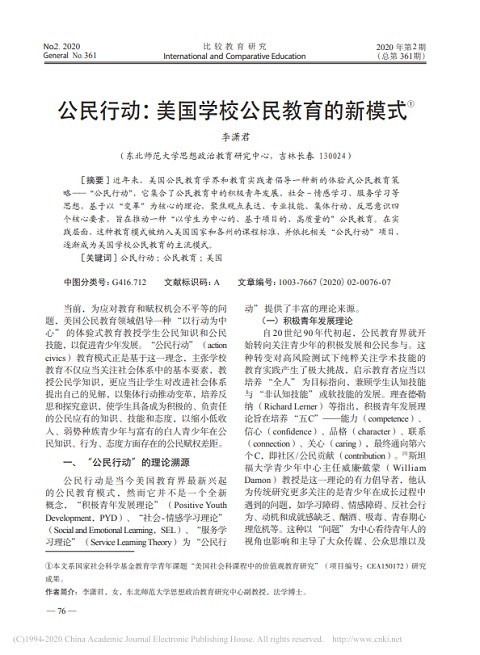 Action Civics: A New Mode of Civic Education in American Schools Year of publication: 2020 Author: Li Xiaojun Corporate author: International and Comparative Education In recent years, a new experimental civic education, action civics, was advocated by both researchers and practitioners. It derives educational philosophies from positive youth development, social and emotional Learning, and service learning. Based on the Theory of Change, it focuses on youth voice, youth expertise, collective action and reflection, so as to promote a new mode of civic education featuring student-centered, project-based and high-quality. In practice, it is gradually becoming the mainstream mode of civic education in current schools in the US by being introduced into state standards of curriculum and action civics projects. 公民行动: 美国学校公民教育的新模式 Year of publication: 2020 Author: Li Xiaojun Corporate author: International and Comparative Education 近年来,美国公民教育学界和教育实践者倡导一种新的体验式公民教育策略——“公民行动”,它集合了公民教育中的积极青年发展、社会- 情感学习、服务学习等思想,基于以“变革”为核心的理论,聚焦观点表达、专业技能、集体行动、反思意识四个核心要素,旨在推动一种“以学生为中心的、基于项目的、高质量的”公民教育。在实践层面,这种教育模式被纳入美国国家和各州的课程标准,并依托相关“公民行动”项目,逐渐成为美国学校公民教育的主流模式。
 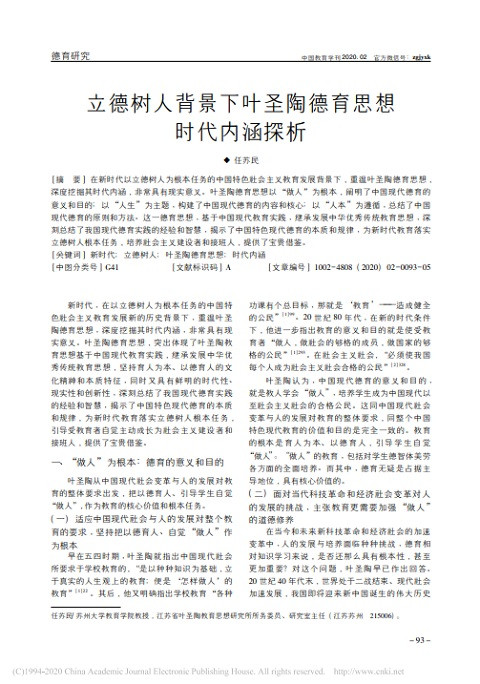 A Contemporary Exploration of the Thought of Ye Shengtao upon the Foundation of Developing Virtues for Planting Humans Year of publication: 2020 Author: Ren Sumin Corporate author: Chinese Educational Science Against the background of the new times of “developing virtues for planting humans”as the fundamental mission of educational development for establishing Socialism with Chinese characteristics, this article attempts to analyze the thoughts of Ye Sheng from the perspective of their implications for this new times. Ye’s thoughts on moral education are grounded upon the notion of “Learning to be”, thus with lots of insights for practice, and this demonstrates the meaning and aims of moral education in modern China, and constructs the contents and core of moral education in modern China. Grounded upon “Learning to be” as the principle, this thoughts concludes the principle and method of moral education for modern China. This thought on moral education is also founded on educational practice in modern China, which carries the wonderful tradition of Chinese educational thoughts, and there wisdom for moral education practice for modern China. They also demonstrate the nature and principle for today’s moral education with Chinese characteristics, and consolidate the thought of “developing virtues for planting humans” as a fundamental mission in preparing the next generation as leaders for the socialist society.