
Resources
Explore a wide range of valuable resources on GCED to deepen your understanding and enhance your research, advocacy, teaching, and learning.
3,448 Results found
 高校公民精神教育路径新探 (江苏高教; No. 2) Year of publication: 2017 Author: Yang Sihai | Cheng Qian Corporate author: Jiangsu Education Press 公民精神具有时代性的特点,应当在继承的基础上加以建构。目前高校公民精神的教育,理 应 包 含世界主义精神、合作理念和集体主义价值观在内。公民精神内容的新发展,要求有与之相适应的教育路径:一是 要把世界主义精神渗透在课程中;二是塑造和强化有助于公民合作理念培养的公共生活;三是铸造体现公民责任 导向的集体主义实践平台。
  The Connective “Public” and the Chinese Logic of Citizenship Education (Journal of Educational Studies; Vol. 13, No. 2) Year of publication: 2017 Author: Qiu Kunshu | Yan Yajun Corporate author: Beijing Normal University Cultural tradition has pre-conditionality on citizenship education. From the point of view of cultural tradition, the “public” in citizenship education has different meaning in China and the West: Chinese “public” is mainly a kind of connective “public”, while the western “public” mainly means domanial “public”. This lead to the difference in Chinese and modern western main stream values. The former emphasizes the common goodness of the whole society, social responsibility and virtue which is favorable to harmony, while the later emphasizes individualist rights and priority of freedom. They represent two kinds of ethics language and position. It is essential to maintain high cultural awareness for the implementation of citizenship education in China and the localization of exotic “citizenship education”. Guided by Marxism and rooted in Chinese cultural tradition, Chinese citizenship education should be based on “people in relation”, use the actual support of “state-society” cooperation, and offer ultimate concern to “the free and comprehensive development of human”. 连带的“公”与公民教育的中国理路 (教育学报; Vol. 13, No. 2) Year of publication: 2017 Author: Qiu Kunshu | Yan Yajun Corporate author: Beijing Normal University 文化传统对公民教育具有预制性。从文化传统来看,中西方社会和文化语境中的“公”并不相同:中国 的“公”主要是连带的“公”,而西方的“公”主要是领域的“公”,由此而导致中华文明的价值与现代西方主流价值的 差异,前者强调社会共同的善、社会责任和有益于和谐的美德,后者则强调个人主义的权利和自由优先,它 们 分 别 代表了两种不同的伦理学语言和立场。在中国开展公民教育,只有保持高度的文化自觉,作 为 舶 来 品 的“公 民 教 育”才可能落地生根。以马克思主义为指导,根植于中 华 文 化 传 统,中国公民教育需要以“关 系 中 的 人”为 立 足 点, 以“国家—社会”的互构合作为现实支撑,以“人的自由全面发展”为终极关怀。
  The Theory of Civic Education in the Context of Key Competence (Educational Science Research) Year of publication: 2017 Author: Wang Min Corporate author: Beijing Open University From quality-oriented education to key competence, Chinese education has always been committed to cultivating “well-rounded people” who meet the needs of individual lifelong development and social development. In the context of key competence, it is necessary to clarify the logical relationship between key competence and civic education. On the basis of understanding the essence of quality education, the pursuit of key competence and the connotation of civic education, this paper attempts to answer the question of “who to train” in civic education through theoretical reflection on the legal, educational and practical provisions of “qualified citizen”. Through thinking about the subject orientation, curriculum implementation and evaluation system of civic education, this paper seeks the way of “how to train people”. 核心素养语境下的公民教育论 (教育科学研究) Year of publication: 2017 Author: Wang Min Corporate author: Beijing Open University 从素质教育到核心素养,中国教育一直致力于培养符合个体终身发展与社会发展需要的“全面 发展的人”。核心素养语境下,厘清核心素养与公民教育的逻辑关系是很有必要的。在对素质教育之 要旨、核心素养之追求和公民教育之要义的内涵解读基础上,通过对“合格公民”的法律规定性、教 育规定性和现实规定性的理论反思,尝试回答公民教育“培养什么人”的问题;通过对公民教育学科 定位、公民教育课程实施与公民教育评价制度的思考,寻求“如何培养人”的路径。
  Research on Countermeasures of College Citizenship Education Based on the Return of Service Learning Essence (Journal of Socialist Theory Guide) Year of publication: 2017 Author: Zhang Jianglong | Tan Zuxue | Zhang Xiao Corporate author: Shaanxi Provincial Party School of the Communist Party of China Service learning has always been closely related to the cultivation of civic sense of responsibility since its birth, and has gradually become an important method of civic education. In the process of introducing and applying service learning in our country, its concept is more and more biased to its essence, or emphasizes service or learning, and it also encounters the dilemma of curriculum setting, role integration and other aspects at the specific operation level. Only by implementing the process of service learning objectives and concepts, the project of curriculum setting, the normalization of students’ reflection, the Sinicization of value elements and other measures, and promoting its localization, can we provide effective method support for college students’ civic education.
  Analysis of the Education for Democratic Citizenship Policies in Norway (Global Education; No. 5) Year of publication: 2013 Author: Yang Tingting Corporate author: East China Normal University There are growing concerns about Islamophobia and far-right and anti-democratic movements across Europe. Norway’s vulnerability was not perceived until the July 2011 attacks happened in Norway in which 77 people died. This paper will examine education for democratic citizenship policies in the context both of extreme right political activity happened nationally and inter- nationally, considering ways in which it supports the national identity, cultural diversity, social cohesion, seeking the value orientation, core content and weaknesses of education for democratic citizenship policies in Norway. 试析挪威的民主公民教育政策 (全球教育展望; No. 5) Year of publication: 2013 Author: Yang Tingting Corporate author: East China Normal University 放眼整个欧洲,近来伊斯兰教恐慌、极端右翼分子和反民主运动此起彼伏,挪威也直 到 2011 年 7 月发生 77 人死亡的恶性案件后,才察觉到本国民主的脆弱性。本文在极端右翼 活动频发的国际和国内背景下,对挪威的民主公民教育政策进行文本分析,阐述各相关政策 文件是如何对国家认同、文化多样性、社会整合加以强调的,试图探求挪威民主公民教育政策 的价值导向与核心观点,以及挪威民主公民教育可能存在的不足。
  한 세대 후 교육 2050년의 한국교육은 어떻게 변해 있을까? (Future Horizon Plus 제42권 제5호) Year of publication: 2019 Author: 서영인 Corporate author: 과학기술정책연구원 세대를 평균 30년으로 보면 향후 약 2050년경의 한국교육은 어떻게 변해 있을까? 변화에는 인간의 의지가 작동하는 변화와 그와 상관없이 나타나는 변화가 있을 수 있다. 전자의 경우가 대부분이지만 간혹 후자가 작동하는 경우도 있다. 자연재해나 불의의 각종 사고 등이 그것이다. 그러나 현재의 모습이 과거 인간의 생각과 상상력의 결과라는 점을 인정한다면 한 세대 후 교육 역시 현재 인간의 상상력과 의지가 작동한 결과로 볼 수 있어 전자의 경우에만 한정하여 미래 교육을 예측해보려고 한다.
 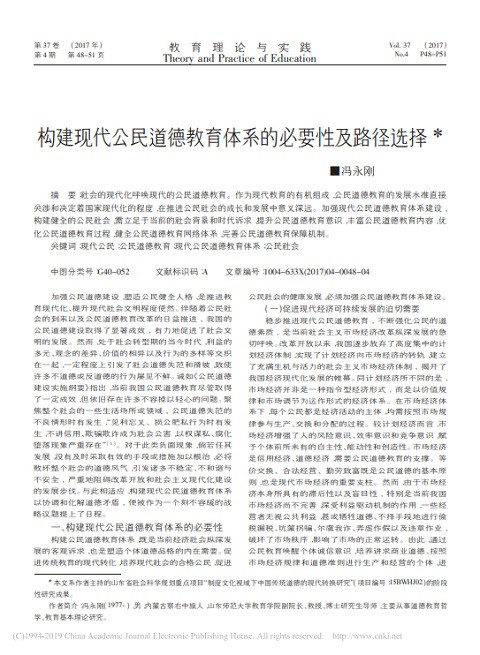 The Necessity and Path Selection for the Construction of Modern Citizen Moral Education System (Theory and Practice of Education; Vol. 37, No. 4) Year of publication: 2017 Author: Feng Yong-gang Corporate author: Shanxi Education Association Social modernization calls for modern citizen moral education. As the organic composition of modern education, development quality of citizen moral education directly relate and determine the country’s modernization level, have the far- reaching significance in promoting the growth and development of the civil society. The strengthen of the construction of modern citizen moral education system which can help build a healthy civil society, should base on the current social background and era demand, enhance the consciousness of citizen moral education, enrich the content of citizen moral education, optimize the process of citizen moral education, improve the network system of citizen moral education, perfect the safeguard mechanism of citizen moral education.