
Resources
Explore a wide range of valuable resources on GCED to deepen your understanding and enhance your research, advocacy, teaching, and learning.
882 Results found
 Cyberbullying among Adolescents: A Study Applied to a Sample of Middle School Students Who Used the Game of Fortnite Year of publication: 2019 Author: Moudi Al-Anzi Corporate author: Qassim University The study aimed to identify the personal causes of cyberbullying and the role of the family and school climate in cyberbullying. The study used the game Fortnite as an example to recognize bullying that occurs through electronic games. A questionnaire was used to collect data.
 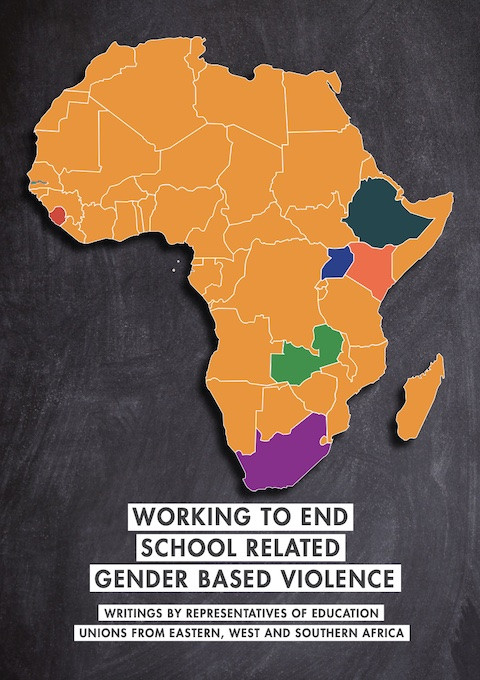 Trabajando para acabar con la violencia de género en el ámbito escolar: Ensayos por representantes de sindicatos de la educación de África Oriental, Occidental y Austral Year of publication: 2019 Author: Shamim Meer Corporate author: Gender at Work | Labour Research Service (LRS) | Global Affairs Canada (GAC) | United Nations Girls' Education Initiative (UNGEI) | Education International (EI) La Violencia de Género en el Ámbito Escolar (VGAE) es una forma de violencia que menoscaba la integridad corporal, los derechos humanos y la igualdad de género de todas las personas involucradas, pero especialmente de los niños y niñas escolares. En 2016, 7 docentes sindicales - SADTU y NAPTOSA de Sudáfrica, BETUZ y ZNUT de Zambia, UNATU de Uganda, ETA de Etiopía y KNUT de Kenia y en 2018, SLTU de Sierra Leona, GTU de Gambia y el personal de la Oficina Regional de África de la Internacional de la Educación con base en Ghana – participaron activamente en Gender at Work (G@W) – Proceso de Acción de Aprendizaje en Género (GAL, por sus siglas en inglés). El objetivo principal de este proceso GAL específico fue crear un programa piloto participativo de la IE en África, oriental, occidental y del sur enfocado en la capacidad de docentes individuales y sindicatos de docentes para abordar la VGAE. Con el apoyo de facilitadoras de Gender at Work, las y los participantes fortalecieron su comprensión de la desigualdad de género y la violencia basada en el género en el contexto escolar. A lo largo del proceso GAL, las y los participantes hablaron con el corazón, compartiendo historias inspiradoras sobre el cambio. Oeuvrer pour mettre un terme à la violence liée au genre en milieu scolaire: Écrits de représentantes et représentants de syndicats de l’enseignement en Afrique de l’est, Afrique de l’ouest et Afrique australe Year of publication: 2019 Author: Shamim Meer Corporate author: Gender at Work | Labour Research Service (LRS) | Global Affairs Canada (GAC) | United Nations Girls' Education Initiative (UNGEI) | Education International (EI) La violence liée au genre en milieu scolaire (VGMS) est un type de violence qui porte atteinte à l’intégrité physique, aux droits humains et à l’égalité entre tous les acteurs de la vie de l’école, mais avant tout à ceux de l’enfant scolarisé.En 2016, sept syndicats d’enseignants, le SADTU et la NAPTOSA d’Afrique du Sud, le BETUZ et la ZNUT de Zambie, l’UNATU d’Ouganda, l’ETA d’Éthiopie et le KNUT du Kenya, puis en 2018, le SLTU de la Sierra Leone, le GTU de Gambie, ainsi que les collaborateurs et collaboratrices du Bureau régional Afrique de l’Internationale de l’Éducation sis au Ghana, se sont activement engagés dans un programme de Gender at Work, le processus d’apprentissage par l’action en genre.Ce processus spécifique visait à créer un programme pilote participatif de l’IE en Afrique de l’Est, de l’Ouest et australe qui porterait sur la capacité individuelle des enseignants et enseignantes et sur celle de leurs syndicats à affronter la violence fondée sur le genre. Avec l’appui des animatrices de Gender at Work, les participants et participantes ont pu comprendre de façon plus approfondie l’inégalité entre les genres et la violence liée au genre en milieu scolaire. Tout au long de ce processus d’action-apprentissage, les participants et participantes ont été en mesure de parler à coeur ouvert et de partager des histoires de changement inspirantes.
 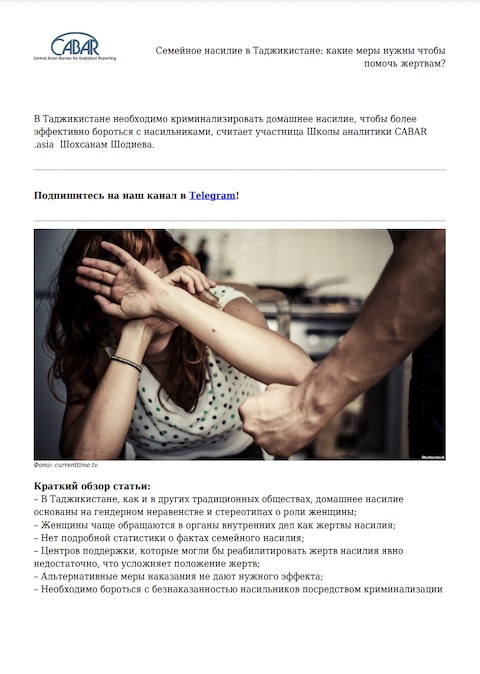 Domestic Violence in Tajikistan: What Measures Are Needed to Be Taken in Order to Help Victims? Year of publication: 2021 Author: Shokhsanam Shodiyeva Corporate author: Central Asian Bureau for Analytical Reporting (CABAR) In this article, the author discusses the current state of affairs in Tajikistan in the field of preventing domestic violence, and the measures taken. In addition, according to the authore, it is necessary to criminalize domestic violence in order to more effectively deal with rapists. Семейное насилие в Таджикистане: Какие меры нужны чтобы помочь жертвам? Year of publication: 2021 Author: Shokhsanam Shodiyeva Corporate author: Central Asian Bureau for Analytical Reporting (CABAR) В данном статье автор обсуждает текущее состояние дел в Таджикистане в области предотвращения домашнего насилия, предпринимаемые меры. Кроме того, по мнению автора статьи необходимо криминализировать домашнее насилие, чтобы более эффективно бороться с насильниками.
  Policy Brief: Talking Across Generations on Education; #TAGe Bujumbura: Youth, Social and Emotional Education and the Prevention of Violent Extremism Year of publication: 2020 Corporate author: Mahatma Gandhi Institute of Education for Peace and Sustainable Development (MGIEP) With the aim to mainstream the voices of Burundi youth and include them in the policymaking process in the areas of education for peace, sustainable development and global citizenship, UNESCO MGIEP, YELI-Burundi (Youth Empowerment and Leadership Initiative Burundi) and the Government of Burundi organised a series of high-level #TAGeBujumbura dialogues. These were an integral part of the Annual Prevention of Violent Extremism (PVE) Youth Blast, which was organised by YELI-Burundi on September 16-17, 2019 in Bujumbura, Burundi. H.E Everlyne Butoyi, Minister of Youth, IT and Posts, inaugurated the event. The theme of the main TAGe plenary was The Place of the Youth and Social and Emotional Learning for the Prevention of Violent Extremism – within the broader context of United Nations Security Council Resolution 2250.This unique UNESCO MGIEP TAGe modality for actionable dialogue comprised the following components – month-long online discussions, live TAGe and actionable outputs. The preceding online discussion had over 1,000 participants, and witnessed rich discussion threads being compressed into insightful, actionable ideas. Subsequently, based on the online engagement and the on-ground work done, six representatives were chosen from these participants to represent the collective voices of the youth. They were joined by three distinguished senior decision-makers (from the Government of Burundi and civil society) in a live TAGe exchange, where they delved into issues and unearthed creative solutions in front of an audience of over 200.
 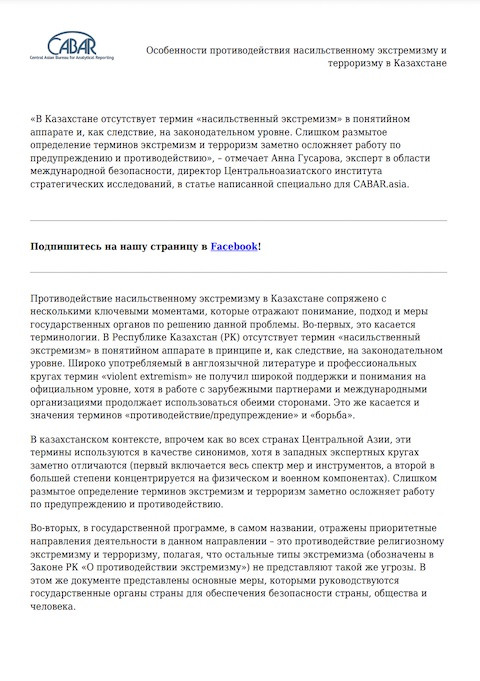 Features of Countering Violent Extremism and Terrorism in Kazakhstan Year of publication: 2019 Author: Anna Gusarova Corporate author: Central Asian Bureau for Analytical Reporting (CABAR) | Institute for War and Peace Reporting (IWPR) «In Kazakhstan there is no term as “violent extremism” in the conceptual construct, and as a result at the legislative level. Too vague definition of the terms extremism and terrorism significantly complicates the work on prevention and counteraction», – said Anna Gusarova, an expert in international security, director of the Central Asian Institute for Strategic Studies, in her article written specifically for CABAR.asia. Особенности противодействия насильственному экстремизму и терроризму в Казахстане Year of publication: 2019 Author: Anna Gusarova Corporate author: Central Asian Bureau for Analytical Reporting (CABAR) | Institute for War and Peace Reporting (IWPR) «В Казахстане отсутствует термин «насильственный экстремизм» в понятийном аппарате и, как следствие, на законодательном уровне. Слишком размытое определение терминов экстремизм и терроризм заметно осложняет работу по предупреждению и противодействию», – отмечает Анна Гусарова, эксперт в области международной безопасности, директор Центральноазиатского института стратегических исследований, в статье написанной специально для CABAR.asia.
 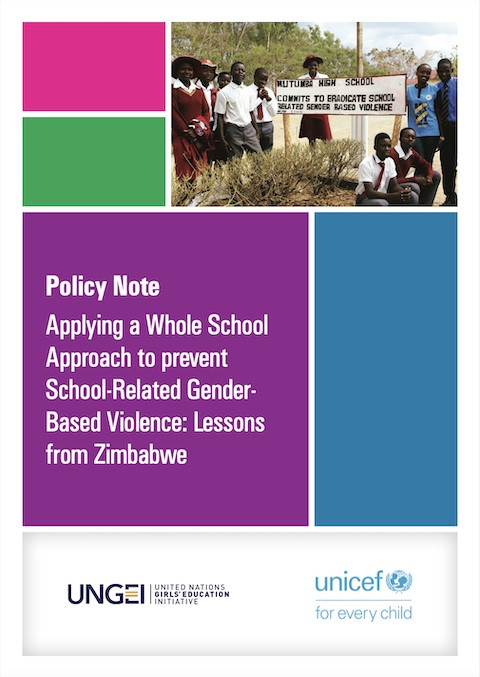 Applying a Whole School Approach to Prevent School-Related Gender-Based Violence: Lessons From Zimbabwe Year of publication: 2021 Corporate author: United Nations Girls' Education Initiative (UNGEI) In 2018, the United Nations Girls’ Education Initiative (UNGEI) along with the Forum for African Women Educationalists Zimbabwe Chapter (FAWEZI), with support from UNICEF, launched a pilot initiative to test whether and how the eight domains and minimum standards can be operationalized in schools. Miske Witt & Associates (MWAI), a technical partner in the initiative, supported FAWEZI to design and monitor interventions aligned to the minimum standards. The pilot was implemented in ten schools (five primary and five secondary) across two districts in Zimbabwe.Implemented over the period October 2018 – December 2020, including during the COVID-19 lockdown, this policy note briefly describes the pilot, highlights what worked and lessons and recommendations for policy action. The target audience for this policy note are education practitioners, policymakers, researchers and donors.
 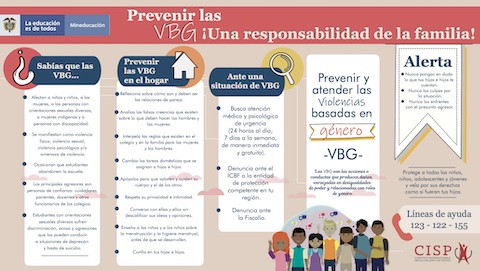 Prevenir las VBG: ¡Una responsabilidad de la familia! Corporate author: Ministry of National Education of Colombia Esta infografía habla de lo que sucede con las violencias basadas en género, define este tipo de violencias y explica qué hacer cuando se presentan. En este documento se pretende hacer consciente a la familia de su papel dentro de este fenómeno y el papel se juega en el mismo.