
Resources
Explore a wide range of valuable resources on GCED to deepen your understanding and enhance your research, advocacy, teaching, and learning.
3,436 Results found
 المجتمع الخليجي.. وتعدد الثقافات الوافدة Year of publication: 2014 Corporate author: Sky News Arabia برنامج تلفزيوني يناقش قضية التعددية الثقافية في دول الخليج العربي، ويتطرق لجلب التعددية الثقافية إلى الخليج من قبل العمال الأجانب. ويستضيف البرنامج مجموعة من الضيوف لمناقشة القضية. ويجاوب على الاسئبة التالية: ما هي الآثار السلبية والإيجابية للثقافات الأجنبية على الثقافة المحلية في دول المنطقة؟ ما هي طرق الحفاظ على هوية المجتمع وقيمه؟لمشاهدة المزيد، يرجى زيارة صفحة البرنامج على الموقع الإلكتروني لسكاي نيوز عربية من خلال الضغط على الرابط التالي:http://www.skynewsarabia.com/web/AlMasaa
 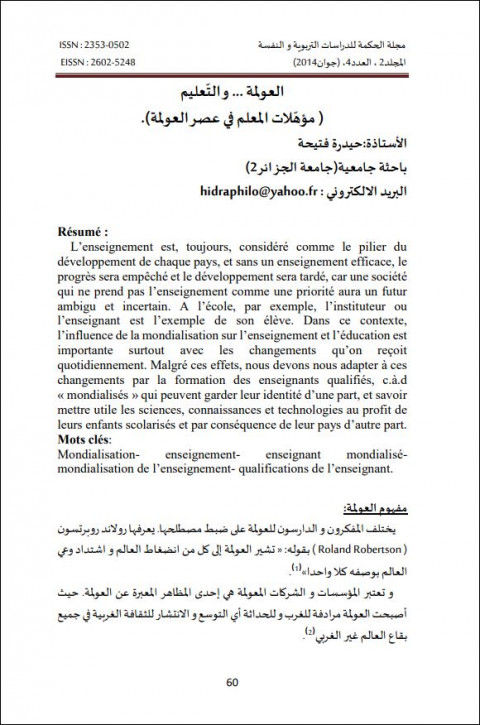 Globalization and Education (Teacher Qualifications in the Era of Globalization) Year of publication: 2014 Author: Haidara Fatiha Education is, always, considered as the pillar of the development of every country, and without effective education, progress will be impeded and development will be delayed. This is because a society that does not take education as a priority will have an ambiguous future. In school, for example, the teacher is the model for his students. In this context, the influence of globalization on teaching and education is important especially with the changes that we receive daily. Despite these effects, we must adapt to these changes by training qualified teachers, ie "globalized" teachers who can keep their identity on the one hand, and know how to use science, knowledge and technology for the benefit of their teachers. children in school and consequently from their country on the other hand. العولمة ... و التّعليم ( مؤهّلات المعلم في عصر العولمة) Year of publication: 2014 Author: Haidara Fatiha يعتبر التعليم دائمًا ركيزة التنمية في كل بلد ، وبدون تعليم فعال ، سيتم إعاقة التقدم وستتأخر التنمية. هذا لأن المجتمع الذي لا يأخذ التعليم كأولوية سيكون له مستقبل غامض. في المدرسة ، على سبيل المثال ، المعلم هو نموذج لطلابه. في هذا السياق ، فإن تأثير العولمة على التدريس والتعليم مهم خاصة مع التغييرات التي نتلقاها يوميًا. على الرغم من هذه التأثيرات ، يجب أن نتكيف مع هذه التغييرات من خلال تدريب المعلمين المؤهلين ، أي المعلمين "المعولمين" الذين يمكنهم الحفاظ على هويتهم من ناحية ، ومعرفة كيفية استخدام العلم والمعرفة والتكنولوجيا لصالح معلميهم. الأطفال في المدرسة وبالتالي من بلدهم من ناحية أخرى.
 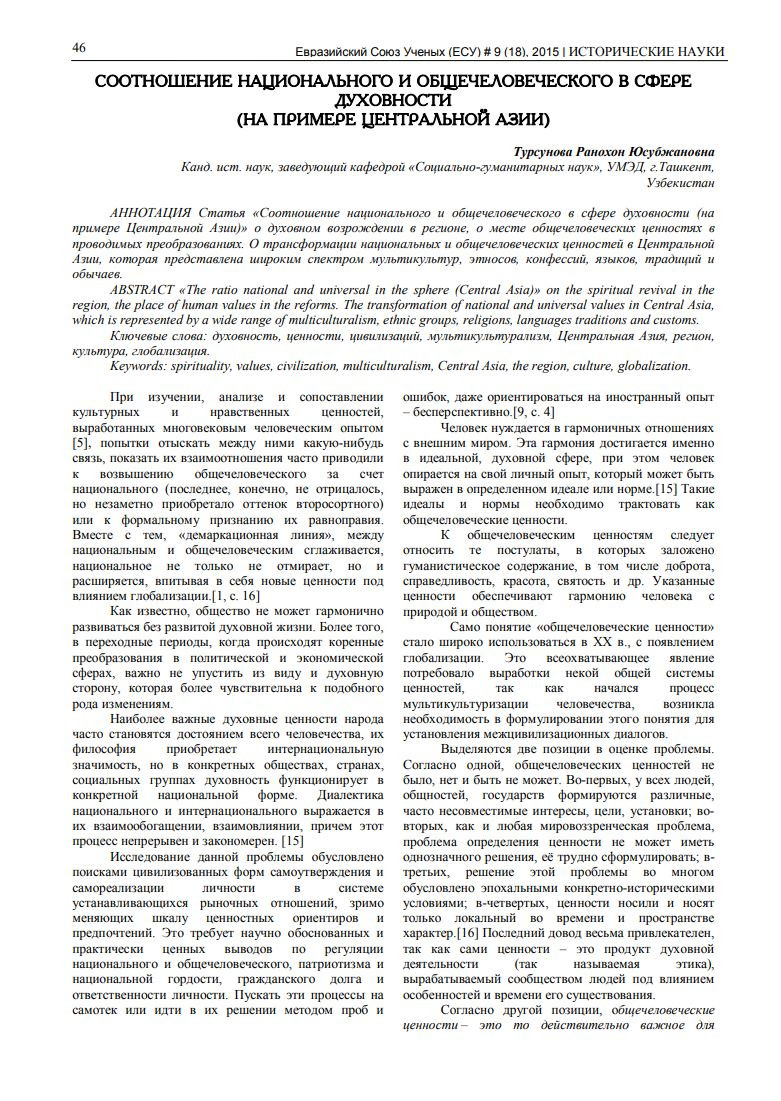 The Ratio of the National and Universal in the Sphere of Spirituality (on the example of Central Asia) Year of publication: 2015 Author: Ranokhon Tursunova The ratio national and universal in the sphere (Central Asia)» on the spiritual revival in the region, the place of human values in the reforms. The transformation of national and universal values in Central Asia, which is represented by a wide range of multiculturalism, ethnic groups, religions, languages traditions and customs. Соотношение национального и общечеловеческого в сфере духовности (на примере Центральной Азии) Year of publication: 2015 Author: Ranokhon Tursunova Статья «Соотношение национального и общечеловеческого в сфере духовности (на примере Центральной Азии)» о духовном возрождении в регионе, о месте общечеловеческих ценностях в проводимых преобразованиях. О трансформации национальных и общечеловеческих ценностей в Центральной Азии, которая представлена широким спектром мультикультур, этносов, конфессий, языков, традиций и обычаев.
  Global Citizenship: Lessons from the Ancients (Curriculum on the Move Global, Thematic Notes No.5) Year of publication: 2022 Author: Conrad Hughes Corporate author: UNESCO International Bureau of Education (IBE) "Curriculum On The Move" is a new UNESCO-IBE Series aim at reflecting, debating, producing and disseminating knowledge and ways forward on emerging issues in curriculum-related aspects. The Series emerges from a bottom-up approach, with teachers and students providing their perspectives and experiences on the curriculum.The goal is to rethink the way curriculum is understood and practiced via Webinars, Concept Notes and Global Debates (via Blogs, Twitter, etc.) by involving in a participatory way youth and school practitioners.Right at the centre of the mission statement of many schools, universities and organisations is the phrase “global citizen”. But what does it mean to be a global citizen?
  Couleur? Quelle couleur? Rapport sur la lutte contre la discrimination et le racisme dans le football Year of publication: 2015 Author: Albrecht Sonntag | David Ranc Football has been shown to be a mirror of society, it may also be viewed as providing a temporary suspension of reality for an interlude of high emotion and idealized hopes and dreams. Football’s public transcends differences of age, gender, culture, religion, and socioeconomic status to unite in support of their team. The broad diversity of backgrounds of football players represents tangible evidence of equal opportunity and meritocracy. The sport itself has team solidarity, fair play and mutual respect among members and for opponents ingrained within its rules and practices. Yet, the ‘beautiful game’ is one with an imbedded paradox. Football is also a game that may in many vaguely resemble war, where opponents face each other in a struggle to win over the other side, with the noisy and emphatic support of the spectators. An ‘us’ and ‘them’ mentality is an integral part of trying to help a team reach the objective, which is to win the game. This setting naturally produces a desire by supporters to intimidate the other side by encouraging their team and expressing both confidence and superiority through their words and actions. When the ‘us’ and ‘them’ mentality turns into symbolic exclusion of others, language of disparagement and insult based on racism or discrimination, or physical confrontation, the ‘beautiful game’ is debased. The existence of racism and discrimination in football is not a secret, but it is a shame on the game. Although much is already being done, both observers and experts feel too many problems persist and measures to tackle them have not been effective enough. This report was commissioned by UNESCO within the framework of UNESCO’s partnership with Juventus. It focuses on discrimination and racism in professional football and to some extent the amateur clubs that funnel into the leagues. It provides an overview of the historic and theoretical background. It reports on the state of affairs on the ground. It summarizes what has been done and is being done to mitigate racism and discrimination in domestic and international football, how the effects of these actions may be evaluated, and which new avenues for further, complementary action are promising. The report is based on a literature review, desk research, regional reports from the Unesco network and a field survey among a purposive sample of experts and actors in a number of countries. The report has a somewhat European focus, in its sources and examples. Europe has a unique position Executive Summary in the world of football, with its leading competitions, championships and clubs. It is the region where racism and discrimination in football has been most intensively researched. A number of civil society organisations from Europe have played a pioneering role in the fight against racism and discrimination in football. Moreover, the pressure that comes with the money invested in and generated by western European football, as well as its exposure in the media, has also made clubs, federations and UEFA particularly sensitive to the negative impact that discrimination can have on the game and its image, within Europe and worldwide. Europe must therefore occupy a central role in a study of the fight against discrimination in professional football and in determined policies to mitigate racism and discrimination related to football wherever they occur. The examples of incidents of discrimination and racism, as well as of existing measures to combat them have been selected to be as wide-ranging as possible. The authors do not, however, claim the report to be a comprehensive listing. Similarly, the examples of best practice have been collected through extensive reading and contacts, but must be looked at as an overview rather than as a directory. They are chosen by the authors to illustrate types of actions and institutions with the potential for greatest impact. The report also does not deal with the methods of allocation of resources to football, with issues of employment, or with womens’ football. While these are significant topics on which concerns can be expressed, the necessary focus of a report of this type means that they are alluded to without being treated in depth. ¿Color?¿Qué color? Informe sobre la lucha contra el racismo y la discriminación en el fútbol Year of publication: 2015 Author: Albrecht Sonntag | David Ranc Football has been shown to be a mirror of society, it may also be viewed as providing a temporary suspension of reality for an interlude of high emotion and idealized hopes and dreams. Football’s public transcends differences of age, gender, culture, religion, and socioeconomic status to unite in support of their team. The broad diversity of backgrounds of football players represents tangible evidence of equal opportunity and meritocracy. The sport itself has team solidarity, fair play and mutual respect among members and for opponents ingrained within its rules and practices. Yet, the ‘beautiful game’ is one with an imbedded paradox. Football is also a game that may in many vaguely resemble war, where opponents face each other in a struggle to win over the other side, with the noisy and emphatic support of the spectators. An ‘us’ and ‘them’ mentality is an integral part of trying to help a team reach the objective, which is to win the game. This setting naturally produces a desire by supporters to intimidate the other side by encouraging their team and expressing both confidence and superiority through their words and actions. When the ‘us’ and ‘them’ mentality turns into symbolic exclusion of others, language of disparagement and insult based on racism or discrimination, or physical confrontation, the ‘beautiful game’ is debased. The existence of racism and discrimination in football is not a secret, but it is a shame on the game. Although much is already being done, both observers and experts feel too many problems persist and measures to tackle them have not been effective enough. This report was commissioned by UNESCO within the framework of UNESCO’s partnership with Juventus. It focuses on discrimination and racism in professional football and to some extent the amateur clubs that funnel into the leagues. It provides an overview of the historic and theoretical background. It reports on the state of affairs on the ground. It summarizes what has been done and is being done to mitigate racism and discrimination in domestic and international football, how the effects of these actions may be evaluated, and which new avenues for further, complementary action are promising. The report is based on a literature review, desk research, regional reports from the Unesco network and a field survey among a purposive sample of experts and actors in a number of countries. The report has a somewhat European focus, in its sources and examples. Europe has a unique position Executive Summary in the world of football, with its leading competitions, championships and clubs. It is the region where racism and discrimination in football has been most intensively researched. A number of civil society organisations from Europe have played a pioneering role in the fight against racism and discrimination in football. Moreover, the pressure that comes with the money invested in and generated by western European football, as well as its exposure in the media, has also made clubs, federations and UEFA particularly sensitive to the negative impact that discrimination can have on the game and its image, within Europe and worldwide. Europe must therefore occupy a central role in a study of the fight against discrimination in professional football and in determined policies to mitigate racism and discrimination related to football wherever they occur. The examples of incidents of discrimination and racism, as well as of existing measures to combat them have been selected to be as wide-ranging as possible. The authors do not, however, claim the report to be a comprehensive listing. Similarly, the examples of best practice have been collected through extensive reading and contacts, but must be looked at as an overview rather than as a directory. They are chosen by the authors to illustrate types of actions and institutions with the potential for greatest impact. The report also does not deal with the methods of allocation of resources to football, with issues of employment, or with womens’ football. While these are significant topics on which concerns can be expressed, the necessary focus of a report of this type means that they are alluded to without being treated in depth.
 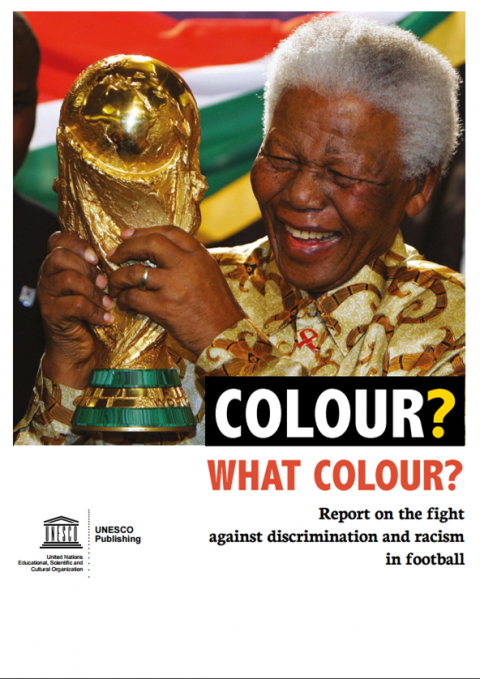 Colour? What colour? Relazione sulla lotta contro la discriminazione e il razzismo nel calcio Year of publication: 2015 Author: Albrecht Sonntag | David Ranc Football has been shown to be a mirror of society, it may also be viewed as providing a temporary suspension of reality for an interlude of high emotion and idealized hopes and dreams. Football’s public transcends differences of age, gender, culture, religion, and socioeconomic status to unite in support of their team. The broad diversity of backgrounds of football players represents tangible evidence of equal opportunity and meritocracy. The sport itself has team solidarity, fair play and mutual respect among members and for opponents ingrained within its rules and practices. Yet, the ‘beautiful game’ is one with an imbedded paradox. Football is also a game that may in many vaguely resemble war, where opponents face each other in a struggle to win over the other side, with the noisy and emphatic support of the spectators. An ‘us’ and ‘them’ mentality is an integral part of trying to help a team reach the objective, which is to win the game. This setting naturally produces a desire by supporters to intimidate the other side by encouraging their team and expressing both confidence and superiority through their words and actions. When the ‘us’ and ‘them’ mentality turns into symbolic exclusion of others, language of disparagement and insult based on racism or discrimination, or physical confrontation, the ‘beautiful game’ is debased. The existence of racism and discrimination in football is not a secret, but it is a shame on the game. Although much is already being done, both observers and experts feel too many problems persist and measures to tackle them have not been effective enough. This report was commissioned by UNESCO within the framework of UNESCO’s partnership with Juventus. It focuses on discrimination and racism in professional football and to some extent the amateur clubs that funnel into the leagues. It provides an overview of the historic and theoretical background. It reports on the state of affairs on the ground. It summarizes what has been done and is being done to mitigate racism and discrimination in domestic and international football, how the effects of these actions may be evaluated, and which new avenues for further, complementary action are promising. The report is based on a literature review, desk research, regional reports from the Unesco network and a field survey among a purposive sample of experts and actors in a number of countries. The report has a somewhat European focus, in its sources and examples. Europe has a unique position Executive Summary in the world of football, with its leading competitions, championships and clubs. It is the region where racism and discrimination in football has been most intensively researched. A number of civil society organisations from Europe have played a pioneering role in the fight against racism and discrimination in football. Moreover, the pressure that comes with the money invested in and generated by western European football, as well as its exposure in the media, has also made clubs, federations and UEFA particularly sensitive to the negative impact that discrimination can have on the game and its image, within Europe and worldwide. Europe must therefore occupy a central role in a study of the fight against discrimination in professional football and in determined policies to mitigate racism and discrimination related to football wherever they occur. The examples of incidents of discrimination and racism, as well as of existing measures to combat them have been selected to be as wide-ranging as possible. The authors do not, however, claim the report to be a comprehensive listing. Similarly, the examples of best practice have been collected through extensive reading and contacts, but must be looked at as an overview rather than as a directory. They are chosen by the authors to illustrate types of actions and institutions with the potential for greatest impact. The report also does not deal with the methods of allocation of resources to football, with issues of employment, or with womens’ football. While these are significant topics on which concerns can be expressed, the necessary focus of a report of this type means that they are alluded to without being treated in depth.
  Discussing Terrorism: a pupil-inspired guide to UK counter-terrorism policy implementation in religious education classroom in England Year of publication: 2016 Author: Angela Quartermaine Corporate author: Christian Education | Taylor & Francis Religious education (RE) in England is affected by the challenging of terrorist ideologies and improving community cohesion, but many RE teachers feel ill-equipped in dealing with the issues that might arise from terrorism discussions. Therefore, I suggest that clarification could help alleviate some of the teacher’s concerns and help provide routes by which critical RE teaching and learning can take place.