
Resources
Explore a wide range of valuable resources on GCED to deepen your understanding and enhance your research, advocacy, teaching, and learning.
2,199 Results found
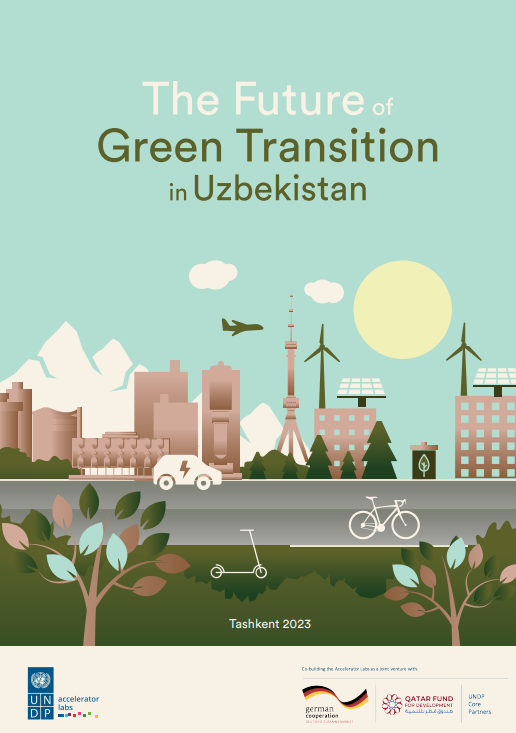 The Future of Green Transition in Uzbekistan Year of publication: 2023 Corporate author: UNDP Kazakhstan In support of the government, UNDP Uzbekistan applied participatory futures and foresight tools to explore possibilities for a Green Transition in Uzbekistan. The process produced a range of outputs, including a signals database, drivers, narrative scenarios, and a custom scenario exploration system. They were used to develop policy ideas, which outline innovative approaches.
  SDG4 - 교육 2030: 포용성과 교육에 관한 연구 Year of publication: 2019 Author: 임후남 | 이대식 | 류방란 | 박성호 | 김혜자 | 윤선애 | 조혜승 Corporate author: 한국교육개발원 이 연구는 한국 교육의 포용성 실태 및 수준을 분석하고, 포용적 교육의 목표를 실현하기 위해 정책적 개선이 필요한 과제가 무엇인지를 제안하는 것을 목적으로 하였다.포용적 교육 관련 이론들을 탐구하는 한편, 포용적 교육의 개념과 요소, 유사 개념들에 대한 논의를 고찰하였다. 논의를 종합하면, 포용적 교육은 모든 학생이 처한 상황과 조건, 특성과 요구를 반영한 동등한 양질의 교육 기회와 권리를 보장하고, 이를 통해 공동체의 지속가능한 발전 또한 보장하는 교육을 지향한다. 이는 기존의 공정성 및 형평성 교육을 계승한 것이며, 그 대상 및 가치와 지향을 확장한 것이다. 포용적 교육은 “누구도 소외(배제)되지 않고, 다양한 개인의 요구와 특성(차이)을 고려한 유연한 교육과정을 통해 성, 민족(인종), 경제력 등에 따라 차별받지 않고, 공동체의 지속가능한 발전과 웰빙에 기여할 수 있는 개인으로 성장할 수 있도록 하는 교육”이라고 정의될 수 있다. 포용적 교육은 취약계층 중심의 정책목표를 전체(누구나)로 확대하고, 교육의 접근, 참여를 넘어서 성취의 격차와 차별의 철폐를 강조한다.
  포용성 증진을 위한 교육과 도시 Year of publication: 2019 Corporate author: 대한민국 교육부 | 한국교육개발원 | 유네스코한국위원회 이 발간물은 유네스코한국위원회, 교육부, 한국교육개발원의 주최로 2019년 11월 5일 개최한 「제3회 SDG4-교육 2030 포럼」 및 「학습도시와 SDGs 포럼」의 관련 정보와 발표 및 토론자료를 엮은 자료집으로 지속가능발전을 위한 포용성과 교육을 주제로 다루고 있다.
 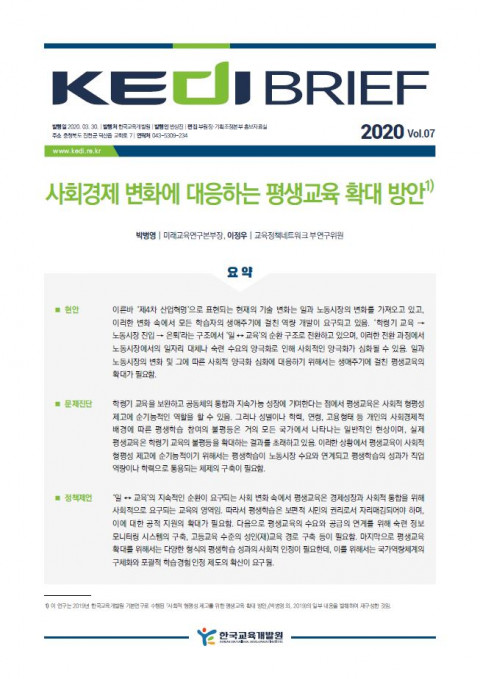 사회경제 변화에 대응하는 평생교육 확대 방안 (KEDI Brief, 2020년 제7호) Year of publication: 2020 Author: 박병영 | 이정우 Corporate author: 한국교육개발원 2019년 한국교육개발원 기본연구로 수행된 「사회적 형평성 제고를 위한 평생교육 확대 방안」 (박병영 외, 2019)의 일부 내용을 발췌하여 재구성한 자료로서 한국 사회에서 평생교육의 필요성을 짚어보고 그에 따른 평생학습 확대를 위한 정책 과제를 제시한다.
 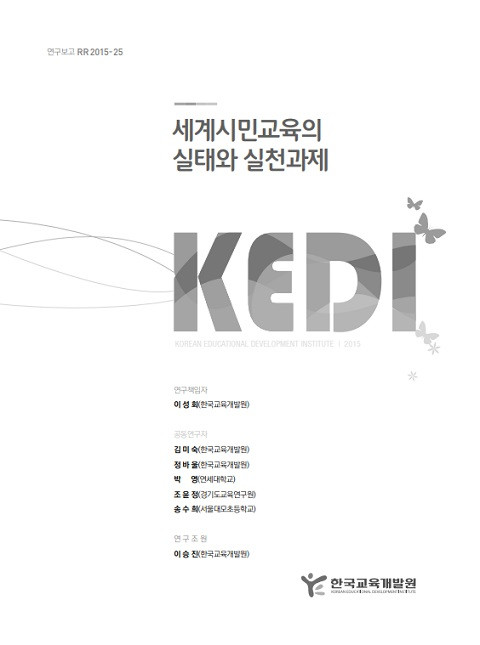 세계시민교육의 실태와 실천과제 Year of publication: 2015 Author: 이성회 | 김미숙 | 정바울 | 이승진 | 박영 | 조윤정 | 송수희 Corporate author: 한국교육개발원 본 연구는 ‘학교 교육현장에서의’ 세계시민 교육에 대한 실증적 연구로 특히 교사의 세계시민교육에 대한 인식과 실천을 중심으로 세계시민 교육의 실태를 파악하고자 한다. 먼저 학교 교육현장에서의 세계시민교육 실태를 파악하기 위하여 전국의 99개교(초등학교 33 개교, 중학교 32개교, 고등학교 34개교)의 교사 1968명(초등학교 656명, 중학교 628명, 고등학교 684명)을 대상으로 설문조사를 실시하였다. 또한 교사들이 이해하고 있는 세계시민교육에 대한 인식과 실천 현황에 대한 보다 심도 있고 입체적인 분석을 위해 질적 사례 연구(중학교 한 사례, 초등학교 교사연구동아리 한 사례)를 병행하였다. 즉 본 연구는 양적 연구를 통해 학교 교육 현장에서의 세계시민교육의 전반적인 ‘양상(pattern)’을 파악하고 질적 연구를 통해 세계시민교육이 수행되는 ‘과정(process)’을 보다 총체적이고 심층적으로 탐색할 수 있도록 연구를 설계하였다.
  A Study on Contextualization of Global Education Agenda: Focusing on Education Policies of Global Citizenship Education in South Korea (The Journal of Korean Education; Vol.46, No.3) Year of publication: 2019 Author: Insun Jeon Corporate author: Korean Educational Development Institute (KEDI) This study aims to provide a concrete discussion on contextualization of global education agenda with the case of Global Citizenship Education(GCED) policies in South Korea.Design/Methodology: With a theoretical approach based on neoinstitutionalism, this study investigates influential factors in determining the direction and key words of GCED policies in policy-making process. Policy documents of Ministry of Education, the local education authority of Seoul city, Kyeonggi-province, Incheon city and the Asia-Pacific Centre of Education for International Understanding of UNESCO, and the speeches of key stakeholders such as presidents, ministers and superintendents from 2014 to April 2019 are analyzed by using KHcoder for text mining and mapping. Semi-structured interviews are conducted with experts to supplement the text analysis.Findings/Result: The result shows that the influence of key stakeholders on directing GCED policies is significant. By and large, GCED is re-defined by purpose in the socio-political context of South Korea, which contributes to the expansion of GCED but also results in inconsistency and fragmentation.Value: This study shows a limit of the top-down approach to GCED policy decisions, and the necessity to allow more bottom-up proposals, transparency of the policy-making process, the participation of diverse groups and ongoing discussions focusing on the process of contextualization for future GCED. 국제교육의제의 지역적 맥락화에 대한 고찰: 한국의 세계시민교육 정책을 중심으로 (한국교육; Vol.46, No.3) Year of publication: 2019 Author: 전인선 Corporate author: 한국교육개발원 본 연구는 한국의 세계시민교육 정책을 통해 국제교육의제의 지역적 맥락화의 구체적인 사례와 논의의 발전가능성을 제시하고자 하였다. 신제도주의에 기반을 둔 이론적 접근방식을 통해, 세계시민교육정책의 핵심주제와 연계정책 결정에 영향을 미친 요인을 분석하였다. 연구방법으로는 KHcoder를 이용하여 2014년부터 2019년 4월까지의 서울특별시, 경기도, 인천광역시교육청의 세계시민교육 관련 정책자료와 유네스코 아시아태평양 국제이해교육원의 문서, 교육부 보도자료, 대통령, 교육부장관, 차관, 교육감 등 주요인사의 공식 발언 자료를 분석하고, 전문가 그룹과의 반구조면담을 통해 분석내용을 검증・보완하였다. 분석결과, 한국은 정책결정권자가 세계시민교육 정책의 핵심주제와 방향 설정에 미치는 영향이 매우 크며, 세계시민교육의 역할과 개념이 한국의 사회・정치적 맥락에서 목적 중심으로 재정립되는 것으로 나타났다.하향식 정책결정구조를 통해 이뤄진 ‘목적’ 중심의 세계시민교육의 맥락화는 양적팽창에는 긍정적으로 작용하였으나, 결정권자가 변경됨에 따라 생기는 정책의 비일관성과 파편화를 야기했다. 따라서 본 연구는 앞으로의 세계시민교육의 맥락화는 ‘목적’이 아닌 ‘과정’에 초점을 두어야하며, 이를 위해 정책구조의 개선을 통한 활발한 상향식 담론 생산과 정책결정과정의 투명성 보장과 다양한 그룹의 공식적인 참여, 그리고 지속적이고 공개적인 성찰이 필요하다.
 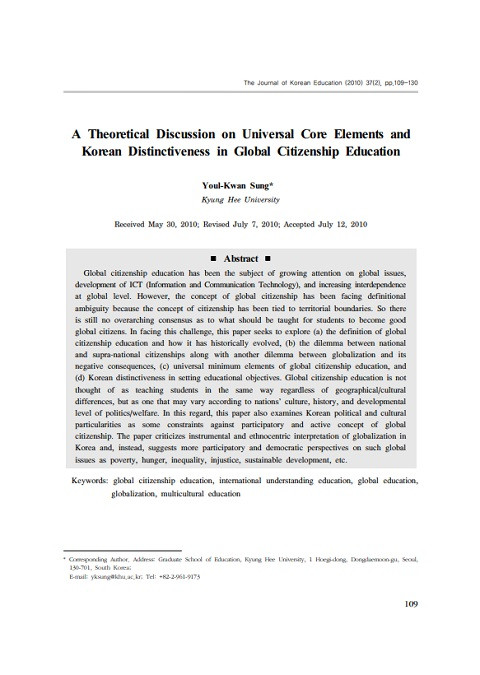 A Theoretical Discussion on Universal Core Elements and Korean Distinctiveness in Global Citizenship Education (The Journal of Korean Education; Vol. 37, No. 2) Year of publication: 2010 Author: Youlkwan Sung Corporate author: Korean Educational Development Institute (KEDI) Global citizenship education has been the subject of growing attention on global issues, development of ICT (Information and Communication Technology), and increasing interdependence at global level. However, the concept of global citizenship has been facing definitional ambiguity because the concept of citizenship has been tied to territorial boundaries. So there is still no overarching consensus as to what should be taught for students to become good global citizens. In facing this challenge, this paper seeks to explore (a) the definition of global citizenship education and how it has historically evolved, (b) the dilemma between national and supra-national citizenships along with another dilemma between globalization and its negative consequences, (c) universal minimum elements of global citizenship education, and (d) Korean distinctiveness in setting educational objectives. Global citizenship education is not thought of as teaching students in the same way regardless of geographical/cultural differences, but as one that may vary according to nations' culture, history, and developmental level of politics/welfare. In this regard, this paper also examines Korean political and cultural particularities as some constraints against participatory and active concept of global citizenship. The paper criticizes instrumental and ethnocentric interpretation of globalization in Korea and, instead, suggests more participatory and democratic perspectives on such global issues as poverty, hunger, inequality, injustice, sustainable development, etc. 세계시민교육 교육과정의 보편적 핵심 요소와 한국적 특수성에 대한 고찰 (한국교육; Vol.37, No. 2) Year of publication: 2010 Author: 성열관 Corporate author: 한국교육개발원 최근 정보통신의 발달은 물론 경제적 상호 의존성이 급격히 높아지면서 세계시민교육에 대한 관심이 부상하고 있다. 그러나 세계시민은 일국의 국경을 넘는 개념이기 때문에 세계시민 자체는 물론 세계시민교육의 개념은 정의상의 곤란에 직면하고 있다. 이 때문에 세계시민교육의 내용이 무엇이어야 하는 지가 분명하지 않은 상태에 있다. 이에 본고는 ① 일국의 시민과 세계의 시민 사이의 딜레마는 무엇인가, 그리고 세계화와 그 결과 사이의 딜레마는 무엇인가에 대해 살펴본 후, ② 의미연결망 분석과 문헌분석을 통해 세계시민교육에서 다루어야 할 핵심 요소로서 전지구적 보편성은 무엇이고, ③ 세계시민교육의 방향을 정립하는 데 있어 고려해야 할 한국적 특수성은 무엇인가에 대해 논의해 보았다. 세계시민교육은 전 세계의 모든 학생들에게 한 종류의 교육을 실시하는 것이 아니라 자국의 문화, 지정학적 위치, 정치 및 인권 발전 수준 등을 고려할 때 보다 효과적일 수 있기 때문에 보편성과 함께 특수성에 대한 논의를 수행하였다. 또한 본고는 세계시민교육을 도구주의적 관점에서 보는 것을 탈피하여 기아, 빈곤, 불평등, 인권, 환경 등 글로벌 이슈에 대해 참여적인 태도를 중시하는 변화지향적 관점의 중요성을 강조하였다.
 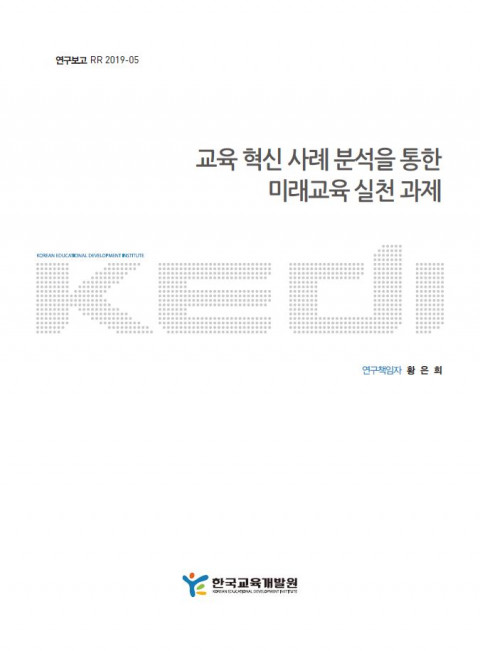 The Tasks for Future Education through the Analysis of Educational Innovation Cases Year of publication: 2019 Author: Eunhee Hwang | Sujin Choi | Jongheon Lim | Heejin Park | Jaeduck Lee | Sungki Kim | Giljae Lee | Hunho Kim | Ammi Jang Corporate author: Korean Educational Development Institute (KEDI) It is predicted that the future society will be low populated of the school-age but high populated of the elderly, intelligent information centered, and multicultural society. According to these changes of the society, it is time for education to shift to preparing for a future education system rather than growth from competition. Based on this perspectives, this study aims to explore the tasks of the future education by analyzing domestic and international cases of educational innovations. Specifically, this study suggests several practical tasks that general high schools can implement for the future education, analyzing the selected cases contributed to the educational innovation. This is because the cases of educational innovation are the stepping stones for general high school to move forward to the future education, although the cases are not perfect examples.