
Resources
Explore a wide range of valuable resources on GCED to deepen your understanding and enhance your research, advocacy, teaching, and learning.
3,446 Results found
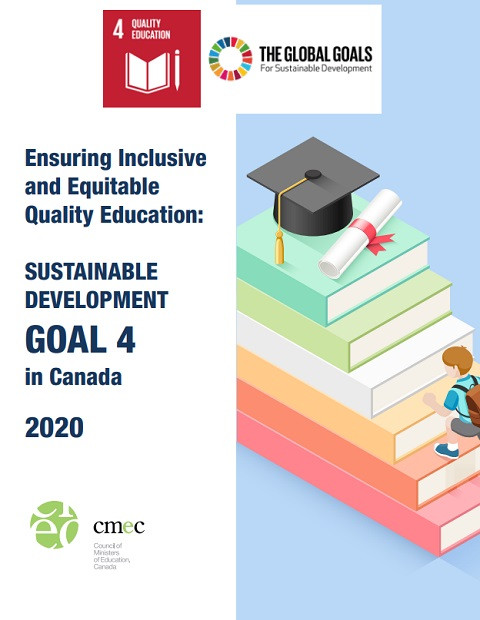 Ensuring Inclusive and Equitable Quality Education: Sustainable Development Goal 4 in Canada Year of publication: 2020 Corporate author: Council of Ministers of Education, Canada (CMEC) This report provides a framework to share information at the pan-Canadian and international levels on work underway in Canada to achieve SDG 4. The report builds on SDG 4 data and indicators and includes, where possible, provincial and territorial data.
 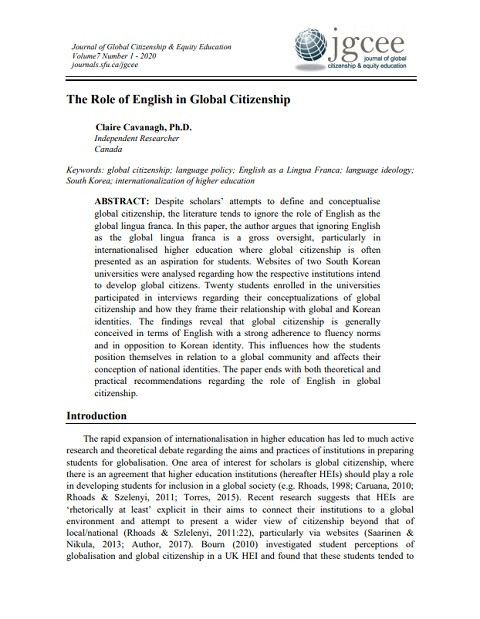 The Role of English in Global Citizenship (Journal of Global Citizenship & Equity Education; Vol. 7, No. 1) Year of publication: 2020 Author: Claire Cavanagh Corporate author: Centennial College Despite scholars’ attempts to define and conceptualise global citizenship, the literature tends to ignore the role of English as the global lingua franca. In this paper, the author argues that ignoring English as the global lingua franca is a gross oversight, particularly in internationalised higher education where global citizenship is often presented as an aspiration for students. Websites of two South Korean universities were analysed regarding how the respective institutions intend to develop global citizens. Twenty students enrolled in the universities participated in interviews regarding their conceptualizations of global citizenship and how they frame their relationship with global and Korean identities. The findings reveal that global citizenship is generally conceived in terms of English with a strong adherence to fluency norms and in opposition to Korean identity. This influences how the students position themselves in relation to a global community and affects their conception of national identities. The paper ends with both theoretical and practical recommendations regarding the role of English in global citizenship.
 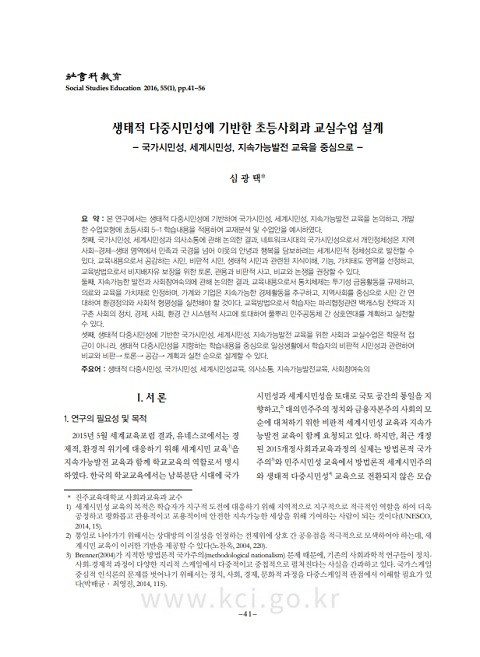 Instructional Design Based on Ecological Multiple Citizenship for Elementary Social Studies Classroom: Focusing on National Citizenship, Global Citizenship and Sustainable Development Education (Social studies education; Vol. 55, No. 1) Year of publication: 2016 Author: Kwangtaek Sim Corporate author: Korean Social Studies Association An instructional model for national citizenship, global citizenship, and sustainable development education was developed. Four lesson plans in the elementary 5thgrade social studies were suggested to show the practice of the instructional model. Three outcomes are reported. First, identity as a citizen of a nation, global citizenship, communications are interrelated. National citizenship and communications in the network society can result in a stronger vision of one’s global citizenship. This is especially the case when the wellbeing and happiness of people in neighboring countries who live across the national boundary are viewed within the domain of community- economy- ecology. Each prepares citizens through knowledge and skills that enable them to empathize, criticize constructively, and live together sustainably. The educational methods recommended to attain global citizenship perspectives are critical thinking, comparative studies, and teaching controversial issues. Those methods tend to result in a commitment to guarantee of non-domination freedom and tolerance of others. Second, discussions regarding sustainable development focused largely on deliberative engagement as a teaching method. Issues discussed were: speculative banking and its regulation; medical treatment and education as value goods; the steps necessary for households and businesses to attain sustainability; and environmental justice and social equity. The educational methods recommended to live together sustainably are planning and practice for grassroots democratic communities’ solidarity by applying back-casting strategy and systematic thinking. Thirdly, social studies classrooms intent on to enhance national citizenship, global citizenship, and sustainable development have a five step task. They, should emphasize comparison and critique→ discussion→ empathy→ planning and lastly the engagement of learners in content critical to ecological multiple citizenship. 생태적 다중시민성에 기반한 초등사회과 교실수업 설계: 국가시민성, 세계시민성, 지속가능발전 교육을 중심으로 (사회과교육; Vol. 55, No. 1) Year of publication: 2016 Author: 심광택 Corporate author: 한국사회과교육연구학회 본 연구에서는 생태적 다중시민성에 기반하여 국가시민성, 세계시민성, 지속가능발전 교육을 논의하고, 개발한 수업모형에 초등사회 5-1 학습내용을 적용하여 교재분석 및 수업안을 예시하였다. 첫째, 국가시민성, 세계시민성과 의사소통에 관해 논의한 결과, 네트워크시대의 국가시민성으로서 개인정체성은 지역 사회-경제-생태 영역에서 민족과 국경을 넘어 이웃의 안녕과 행복을 담보하려는 세계시민적 정체성으로 발전할 수 있다. 교육내용으로서 공감하는 시민, 비판적 시민, 생태적 시민과 관련된 지식이해, 기능, 가치태도 영역을 선정하고, 교육방법으로서 비지배자유 보장을 위한 토론, 관용과 비판적 사고, 비교와 논쟁을 권장할 수 있다. 둘째, 지속가능한 발전과 사회참여숙의에 관해 논의한 결과, 교육내용으로서 통치체제는 투기성 금융활동을 규제하고, 의료와 교육을 가치재로 인정하며, 가계와 기업은 지속가능한 경제활동을 추구하고, 지역사회를 중심으로 시민 간 연대하여 환경정의와 사회적 형평성을 실천해야 할 것이다. 교육방법으로서 학습자는 파리협정관련 백캐스팅 전략과 지 구촌 사회의 정치, 경제, 사회, 환경 간 시스템적 사고에 토대하여 풀뿌리 민주공동체 간 상호연대를 계획하고 실천할 수 있다. 셋째, 생태적 다중시민성에 기반한 국가시민성, 세계시민성, 지속가능발전 교육을 위한 사회과 교실수업은 학문적 접근이 아니라, 생태적 다중시민성을 지향하는 학습내용을 중심으로 일상생활에서 학습자의 비판적 시민성과 관련하여 비교와 비판→ 토론→ 공감→ 계획과 실천 순으로 설계할 수 있다.
 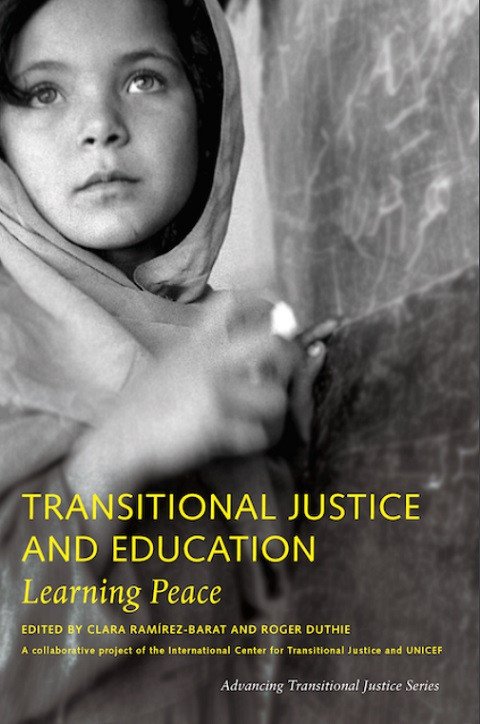 Transitional Justice and Education: Learning Peace (Advancing Transitional Justice Series) Year of publication: 2017 Author: Clara Ramírez-Barat | Roger Duthie Corporate author: Social Science Research Council (SSRC) | United Nations Children's Fund (UNICEF) After periods of conflict and authoritarianism, education institutions often need to be reformed or rebuilt. But in settings where education has been used to support repressive policies and human rights violations, or where conflict and abuses have resulted in lost educational opportunities, legacies of injustice may pose significant challenges to effective reform. Peacebuilding and development perspectives, which normally drive the reconstruction agenda, pay little attention to the violent past. Transitional Justice and Education: Learning Peace presents the findings of a collaborative research project of the International Center for Transitional Justice and UNICEF on the relationship between transitional justice and education in peacebuilding contexts. The book examines how transitional justice can shape the reform of education systems by ensuring programs are sensitive to the legacies of the past, how it can facilitate the reintegration of children and youth into society, and how education can engage younger generations in the work of transitional justice.
  Practice as Prize: Citizenship Education in Two Primary Classrooms in Ireland (Journal of Social Science Education; Vol. 13, No. 1) Year of publication: 2014 Author: Fionnuala Waldron | Brian Ruane | Rowan Oberman Corporate author: Bielefeld University While citizenship education forms part of the formal curriculum at primary level in Ireland, its inclusion as a strand unit of Social, Personal and Health Education, rather than as a discrete subject, tends to make it less visible. In practice, citizenship education is strongly influenced by external agencies and non‐governmental organisations (NGOs) active in the field as the dominant producers of teaching resources and programmes in the area. In many cases, these programmes are award‐driven, requiring schools to compete with others for recognition or to exemplify a particular standard of practice. Using thick description (Geertz 1973) and teachers' narratives, this article presents two cases based on the practice of two experienced primary teachers who negotiate the complex space between professional practice and the particular agendas of external agencies and NGOs. Focusing on two exemplars of their teaching, the article locates their work within the broader context of citizenship education in Ireland, highlighting the extent to which the exemplars chosen typify or challenge existing practice. The article includes the outline plans used by the participating teachers and draws on an extended dialogue between the participants and the researchers in which issues relating to citizenship education, classroom and whole school practice and the broader educational context were discussed and probed.
  Global Citizenship Education in a Secondary Geography Course: The Students’ Perspectives (Review of International Geographical Education Online; Vol. 4, No. 2) Year of publication: 2014 Author: Kyle Massey Corporate author: Eskisehir Osmangazi University Global citizenship education is increasingly appreciated in Ontario, Canada, as an important component of formal schooling. Although all disciplinary areas have a role to play in global citizenship education, geography provides an especially relevant context in which to foster the values and attitudes often cited as important for global citizenship. This study investigates how Grade 12 students, who had recently completed the course “Canadian and World Issues: A Geographic Analysis”, conceive of the concept of global citizenship, and experienced its values within this course. Qualitative data was collected through interviews with seven students. The interviews revealed four major themes relating to how the students conceptualized global citizenship: global awareness, belonging, caring, and commitment to action. It revealed students’ personal involvement with the concepts studied helped them learn to be global citizens, as did the rich discussions of global issues they experienced in class. Careful analysis of both students’ conceptions of global citizenship and how they experienced global citizenship in the curriculum exposed an uncritical perspective – one which emphasizes acts of charity and volunteerism rather than a commitment to social justice. The findings are valuable to teachers and teacher candidates seeking to better engage their students in global issues and equip them with global thinking strategies, and to curriculum developers wishing to effectively incorporate values and topics concerning global citizenship within school curricula.
  International Environmental Politics and Critical Approach to Global Citizenship Education (International and Comparative Education; No. 8) Year of publication: 2017 Author: Zheng Fuxing Corporate author: Beijing Normal University The research and practice of global citizenship education have thrived since 1990s, but the effectiveness of global citizenship education is limited. The researcher cannot avoid the problematic premise of the possibility of global citizenship education. The identity predicament of global citizen and alienation of local implementing make probability of the global citizenship education problematic. The practical predicament of the global citizenship education manifests that the nation state is the key factor of policy implementation. Environmental question, which is about global common good, attracts the attention from the government of most of nations, and becomes the good case for exploring the feasibility of global citizenship education. Environmental politics explain the inequality and injustice in the globally environmental governance which made the global citizenship education critical. The critical ecopedagogy becomes the new form of global citizenship. The practice of the global citizenship education becomes viable by hybrid activism generated by dialectical movement between local and global in the limit of nation-state. 国际环境政治与全球公民教育的批判路径 (比较教育研究; No. 8) Year of publication: 2017 Author: Zheng Fuxing Corporate author: Beijing Normal University 自 20 世纪 90 年代以来 , 全球公民教育研究和实践蓬勃发展,然而全球公民教育 实践的效果很有限。对于全球公民教育的探讨不能回避“全球公民教育如何可能”这一前提性 问题。“全球公民”身份推衍困境、“在地实施”的“异化”后果让全球公民教育实施的可能性成 为问题。环境问题既是一个“全球共同利益”问题,也是各国政府关心的问题,为解答“全球 公民教育何以可能”提供了较好的切入点。国际环境政治解释了全球环境治理中发展中国家与 发达国家的不合作与不平等状况。以全球环境问题及其治理作为教育内容,全球公民教育具有 批判性。批判的生态教育学成为全球公民教育的重要实践形态。在既有的国家边界限制下,批 判的生态教育学通过全球与在地的混合行动,让全球公民教育获得了一种新的可能性。
  La migration et le Programme 2030 : Un guide à l’usage des praticiens Year of publication: 2018 Author: Elisa Mosler Vidal Corporate author: International Organization for Migration (IOM) Ce guide est destiné aux acteurs gouvernementaux, à la fois nationaux et locaux, qui sont impliqués dans des activités de mise en œuvre des Objectifs de développement durable, y compris ceux qui travaillent spécifiquement dans le domaine de la migration et ceux d’autres secteurs qui souhaitent intégrer la question de la migration. Il s’adresse également aux acteurs gouvernementaux qui travaillent dans le domaine de la migration et souhaitent intégrer les ODD dans leur travail.L’objectif de ce guide est d’aider les responsables politiques à mettre en œuvre les aspects des ODD qui touchent à la migration. Les responsables politiques peuvent utiliser ce guide pour intégrer la migration dans les activités de développement à l’échelle locale ou nationale, par l’élaboration et la mise en œuvre d’interventions qui portent sur la migration dans le cadre des ODD. Ces interventions peuvent se présenter sous forme de lois, de politiques, de programmes, de projets ou d’autres activités et peuvent être liées à des thèmes de base de la migration ou intégrer la migration dans les activités d’un autre secteur. Par exemple, les responsables politiques peuvent utiliser ce guide pour élaborer des interventions qui sont directement consacrées à la traite des personnes, ainsi que des interventions dans le secteur de la santé qui permettent de protéger les victimes de la traite des personnes.Pour les acteurs disposant d’une expérience de l’intégration de la migration, ce guide offre une nouvelle approche qui repose sur le Programme 2030. Pour ceux qui ne possèdent aucune expérience de l’intégration de la migration, il présente les liens entre la migration et le développement dans le cadre des ODD, et les mesures à prendre compte tenu de ces liens.