
Resources
Explore a wide range of valuable resources on GCED to deepen your understanding and enhance your research, advocacy, teaching, and learning.
2,776 Results found
 Programme mondial de partenariats scolaires et Rapport d'évaluation d'impact Year of publication: 2011 Author: Juliet Sizmur | Bernadetta Brzyska | Louise Cooper | Jo Morrison | Kathryn Wilkinson | David Kerr Corporate author: National Foundation for Educational Research L'objectif principal de cette évaluation est d'évaluer l'impact de partenariats scolaires internationaux(PSI) et le programme de DFID sur les niveaux de prise de conscience globale et attitudes aux enjeux mondiaux chez les élèves fréquentant les écoles PSI au Royaume-Uni. Cet objectif principal peut être décomposé en quatre objectifs subsidiaires, à savoir: 1. pour mesurer les niveaux de prise de conscience globale et attitudes à l'égard des enjeux mondiaux entre les élèves qui participent aux activités du programme PSI 2. pour comparer les niveaux de sensibilisation et les attitudes des élèves dans les écoles du PSI avec ceux des élèves des écoles non-PSI 3. afin d'évaluer si l'impact du PSI sur la sensibilisation et les attitudes envers les problèmes mondiaux global diffère selon les élèves «âges et niveaux d'enseignement (par exemple, au primaire ou au secondaire) 4. d'évaluer si les niveaux de sensibilisation et attitudes parmi les élèves participants changent à mesure que le programme PSI devient plus intégré dans les écoles (à savoir si, au fil du temps, le programme a un impact positif, neutre ou négatif sur le niveau des élèves de sensibilisation au développement).
  Learning to live together: an intercultural and interfaith programme for ethics education; Good Practices Series 2; Learning to Play Together Year of publication: 2014 Corporate author: United Nations Children's Fund (UNICEF) | Interfaith Council on Ethics Education for Children | Arigatou Foundation Learning to live together: an intercultural and interfaith programme for ethics education; Good Practices Series 2; Learning to Play Together Aprender a vivir juntos Un programa intercultural e interreligioso para la educación ética: Series de Buenas Prácticas 2; Aprender a jugar juntos Year of publication: 2014 Corporate author: United Nations Children's Fund (UNICEF) | Interfaith Council on Ethics Education for Children | Arigatou Foundation Aprender a vivir juntos Un programa intercultural e interreligioso para la educación ética: Series de Buenas Prácticas 2; Aprender a jugar juntos
  Learning to live together: an intercultural and interfaith programme for ethics education: Traning guides series 1; international train the trainers course; a report Year of publication: 2012 Corporate author: United Nations Children's Fund (UNICEF) | Interfaith Council on Ethics Education for Children | Arigatou Foundation In 2010, Arigatou International offered an International Train the Trainers course designed to help those providing training programmes on the use of the Learning to Live Together. The University of Edinburgh helped develop and evaluate the Train the Trainers as a pilot project.
  Learning to live together: an intercultural and interfaith programme for ethics education: Executive Summary Year of publication: 2015 Corporate author: United Nations Children's Fund (UNICEF) | Interfaith Council on Ethics Education for Children | Arigatou Foundation What is the Learning to Live Together? How was it developed? Where and how can it be used? In the Executive Summary you can find answers to all these questions, as well as information about outstanding projects that show the potential of the programme. Apprendre à vivre ensemble: Un programme interculturel et interreligieux pour l’enseignement de l’éthique: Résumé Year of publication: 2015 Corporate author: United Nations Children's Fund (UNICEF) | Interfaith Council on Ethics Education for Children | Arigatou Foundation What is the Learning to Live Together? How was it developed? Where and how can it be used? In the Executive Summary you can find answers to all these questions, as well as information about outstanding projects that show the potential of the programme. Aprender a vivir juntos: Un programa intercultural e interreligioso para la educación ética: Resumen Year of publication: 2015 Corporate author: United Nations Children's Fund (UNICEF) | Interfaith Council on Ethics Education for Children | Arigatou Foundation What is the Learning to Live Together? How was it developed? Where and how can it be used? In the Executive Summary you can find answers to all these questions, as well as information about outstanding projects that show the potential of the programme. Learning to live together: an intercultural and interfaith programme for ethics education: Executive Summary Year of publication: 2015 Corporate author: United Nations Children's Fund (UNICEF) | Interfaith Council on Ethics Education for Children | Arigatou Foundation What is the Learning to Live Together? How was it developed? Where and how can it be used? In the Executive Summary you can find answers to all these questions, as well as information about outstanding projects that show the potential of the programme.
 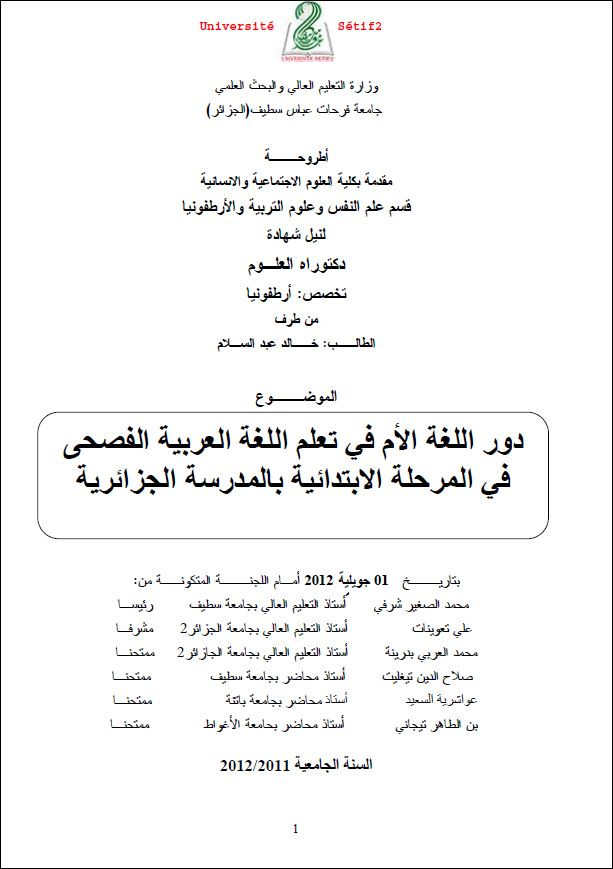 The Role of the Mother Tongue in Learning Standard Arabic at the Primary Stage in the Algerian School Year of publication: 2012 Author: Khaled Abdel Salam Corporate author: Farhat Abbas Setif University Our study has two mean objectives: To determine the first language consequences, whatever they are general, Arabic, or Kabyle, in the learning of school language at different vocabulary, singular, grammar, and, conjugation structures, therefore, exploring if they are helping factors in the learning process or hampering it. To identify the cognitive strategies used by the novices in their learning process in relation to their language performance and errors made in the oral and written expression. In order to deal with this situation, we utilized the descriptive analytical method, in which we had chosen randomly two samples composed of 90 scholars (45 scholars speaking general Arabic language, and 45 scholars speaking Kabyle language), on which we administered two tests, one in the form of an interview about personal and health informations, and the other one about the environment conservation. After, we had analysed the content of the responses, via the extraction of the language errors expanded, and categorising them to different styles or patterns, and computing their frequencies, and explaining them, we founded the following results: Whatever, the first language is general, Arabic or Kabyle, it has a big consequence over all the language structures, therefore, making the scholars language not different from them. According to these results, we can conclude that these factors are not considered as helping factors in the learning process. There is a tendency for the novices to utilize more, both of the revising strategies of courses and the deduction strategy compared to the others. there are no significant differences between scholars speaking general Arabic language and scholars speaking kabyle language in the vocabulary structure, but, there are significant differences between these two samples on the grammatical and conjugational structures, related to personal, pedagogical and familiar factors. According to these results, we can conclude that the language level of the novices on both samples is not related to the abilities required by the school system. دور اللغة الأم في تعلم اللغة العربية الفصحى في المرحلة الابتدائية بالمدرسة الجزائرية Year of publication: 2012 Author: Khaled Abdel Salam Corporate author: Farhat Abbas Setif University تهدف دراستنا إلى التعرف على تأثيرات اللغة األولى سواء كانت عامية عربية او قبائلية في تعلم اللغة المدرسية في مختلف البنيات اللغوية الصوتية والمفرداتية والتركيبية والنحوية والصرفية. وبالتالي الكشف إن كانت ،عامال ميسرا في التعلم أو معرقال. و التعرف على االستراتيجيات المعرفية التي يستعملها المتعلمون في تعلمهم وعالقتها بأدائهم اللغوي في التعبيرين الشفوي والكتابي. ولتحقيق ذلك استعملنا المنهج الوصفي التحليلي، فاخترنا عينتين بمجموع 90 تلميذا (45 ناطقا بالعامية العربية و45 ناطقا بالقبائلية). فطبقنا عليهما ثالث اختبارات، أحدهما شفوي على شكل مقابلة حول معلومات شخصية وصحية واآلخر كتابي حول المحافظة على البيئة، ومقياس حول ،استراتيجيات التعلم. ولما حللنا محتوى االجابات واستخرجنا األخطاء اللغوية المنتشرة وصنفناها إلى مختلف األنماط وبعد حسابنا لتكراراتها و تحليلنا وتفسيرنا لها، توصلنا إلى النتائج اآلتية: ـ أن اللغة األولى سواء كانت عامية عربية او قبائلية قد أثرت بشكل كبير في كل بنيات اللغة الصوتية، التركيبية، النحوية والصرفية بشكل كبير حتى أصبحت .لغة التعليم ال تختلف كثيرا عنها. لذلك استنتجنا أنه ال يمكن اعتبارها عامال ميسرا في التعلم .ـ أن المتعلمين يستخدمون كثيرا استراتيجيات المراجعة للدروس واالستنباط أكثر من االستراتيجيات األخرى .ـ أنه ال توجد عالقة بين االستراتيجيات المستعملة وأداء المعلمين باللغة المدرسية شفويا وكتابيا ـ وأنها ال توجد فروق ذات داللة إحصائية بين الناطقين بالعامية العربية و الناطقين بالقبائلية في البنية الصوتية لكن هناك فروقا دالة إحصائيا بينهما في البنيتين النحوية والصرفية لكنها تعود إلى عوامل اخرى ذاتية وبيداغوجية .وأسرية .واستنتجنا ان مستوى المتعلمين من العينتين بلغة التعليم لم يرتق إلى الكفاءات المنشودة في المنهاج المدرسي.