
Resources
Explore a wide range of valuable resources on GCED to deepen your understanding and enhance your research, advocacy, teaching, and learning.
1,450 Results found
 Дискурсы и стратегии решения экологических проблем: В Центральной Азии Year of publication: 2020 Author: Muslimbek Buriev Corporate author: Central Asian Bureau for Analytical Reporting (CABAR) | Institute for War and Peace Reporting (IWPR) IWPR и CABAR.asia представляют аналитическую записку “Дискурсы и стратегии решения экологических проблем в Центральной Азии”. В работе предпринята попытка раскрыть основные экологические вызовы, проанализировать меры по решению экологических проблем, а также выявить успешные кейсы и определить основные недочёты проводимых программ в регионе.Публикация предназначена для молодых экспертов и консультантов, исследователей, лиц, принимающих управленческие решения, а также широкого круга читателей, интересующихся экологическими вопросами в Центральной Азии.
 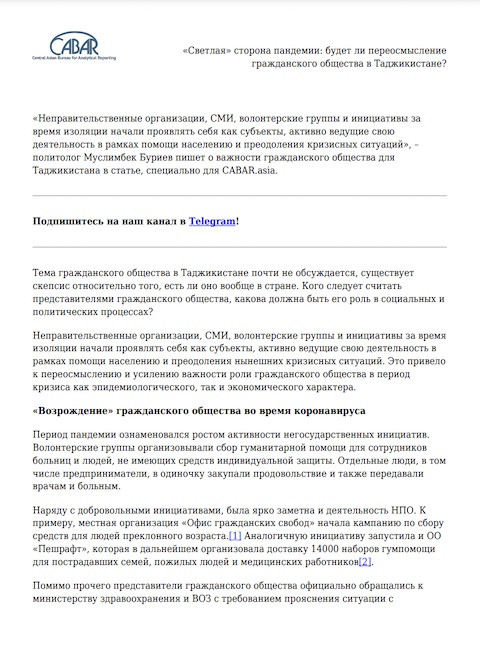 Silver Lining of Pandemic: Redefining Civil Society in Tajikistan Year of publication: 2020 Author: Muslimbek Buriev Corporate author: Central Asian Bureau for Analytical Reporting (CABAR) | Institute for War and Peace Reporting (IWPR) “Non-governmental organizations, mass media, community groups and initiatives have emerged amidst lockdown as actors actively engaged in assisting the population and addressing the crisis,” political scientist Muslimbek Buriev examines the role of civil society in Tajikistan in an article just for the CABAR.asia. «Светлая» сторона пандемии: будет ли переосмысление гражданского общества в Таджикистане? Year of publication: 2020 Author: Muslimbek Buriev Corporate author: Central Asian Bureau for Analytical Reporting (CABAR) | Institute for War and Peace Reporting (IWPR) «Неправительственные организации, СМИ, волонтерские группы и инициативы за время изоляции начали проявлять себя как субъекты, активно ведущие свою деятельность в рамках помощи населению и преодоления кризисных ситуаций», – политолог Муслимбек Буриев пишет о важности гражданского общества для Таджикистана в статье, специально для CABAR.asia.
  Tween Cyberbullying in 2020 Year of publication: 2020 Author: Justin W. Patchin | Sameer Hinduja Corporate author: Cyberbullying Research Center | Cartoon Network This report presents the results of a nationally representative survey of 1,034 children between the ages of 9 and 12 years-old. The survey was conducted online from June 19 through July 6, 2020, and was fielded by Ipsos using their probability-based KnowledgePanel. KnowledgePanel is the largest online panel that is representative of the U.S. population. KnowledgePanel recruitment employs an addressed-based sampling methodology from the United States Postal Service’s Delivery Sequence File—a database with full coverage of all delivery points in the U.S. As such, samples from KnowledgePanel cover all households regardless of their phone status. Member households without Internet access are furnished with a free computing device and Internet service. KnowledgePanel members are randomly recruited through probability-based sampling, and panel members are randomly selected so that survey results can properly represent the U.S. population with a measurable level of accuracy, features that are not obtainable from nonprobability panels. Ipsos currently recruits panel members by using address-based sampling methods (the firm previously relied on random-digit dialing for recruitment). Households without Internet connection are provided with a web-enabled device and free Internet service. In contrast, “convenience” or “opt-in” surveys recruit participants through emails, word-of-mouth, pop-up ads online, or other non-scientific methods.
  A Coherent European Approach to SDG Target 4.7 Year of publication: 2021 Author: Ana Teresa Santos Corporate author: Bridge 47 This document aims to showcase why a coherent approach to Target 4.7 of the Sustainable Development Goals’ (SDG) will strengthen the European Union’s role in achieving the targets and goals set out in Agenda 2030. The report suggests some pathways to follow in order to make this coherent approach a reality.It explores: Relevance of a coherent European approach to SDG Target 4.7 and connections with other EU processes Funding lines Possible pathways to make the coherent approach a reality
 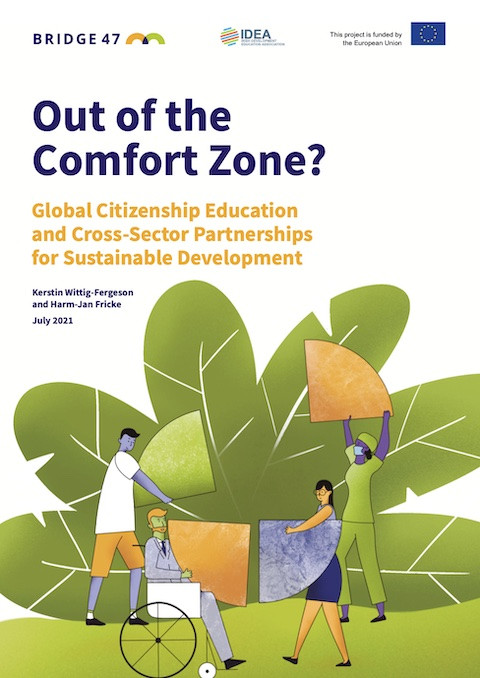 Out of the Comfort Zone?: Global Citizenship Education and Cross-Sector Partnerships for Sustainable Development Year of publication: 2021 Author: Kerstin Wittig-Fergeson | Harm-Jan Fricke Corporate author: Bridge 47 This publication provides examples of partnerships involving civil society and a wide range of actors in different sectors: from policy makers to academia, from media to health services, from businesses to museums. The partnerships, initiated by Bridge 47, promoted learning about and for sustainable development using a variety of Global Citizenship Education (GCE) methods. Their experiences form the basis for suggestions that aim to encourage further explorations of cross-sector collaborations.
 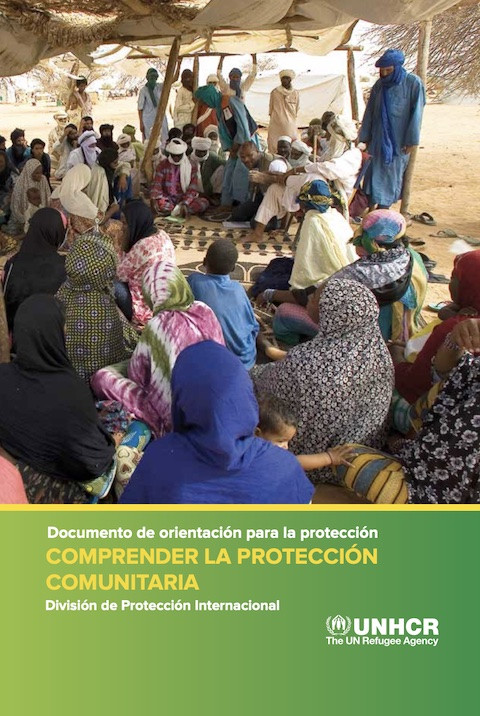 Comprender la protección comunitaria: Documento de orientación para la protección Year of publication: 2013 Corporate author: UN. Office of the United Nations High Commissioner for Refugees (UNHCR) Documento que orienta la protección comunitaria desde el reconocimiento del enfoque comunitario, la definción de la protección y la protección comunitaria. Deja las bases de 12 lecciones funadamentales para este proceso.
  Why Is Transformative Education a Vital Response to the Multiple Challenges of the Future? Year of publication: 2021 Author: Tereza Čajková Corporate author: Bridge 47 This report explores the role of transformative education as described in SDG Target 4.7 in responding to the global challenges, risks and trends of the future, and is split into three sections: Part 1 sets the context based on several foresight reports, suggesting that the physical effects of climate change are likely to intensify during the next two decades as humanity looks unlikely to meet the goal of limiting global warming to under 2°C. The burden of climate disruption and environmental decline is already felt by everyone, but disproportionately by the most vulnerable populations. Social challenges described in foresight reports reflect increasing levels of uncertainty, precarity, fragility and complexity. The future world will likely be more connected, yet more fragmented, characterised by multiple changes taking place at an unprecedented pace.Part 2 reflects on the role of education in times of social and ecological transformation. There is currently increasing momentum for questioning established education approaches in terms of whether they are able to equip future generations to cope with the multiple crises the foresight reports warn us of. Transformative education can contribute to this process given that preparing learners to address future challenges is one of its core commitments. Part 3 provides an insight into the types of learning which may be more suited to coping with these numerous challenges. Transformative learning develops the cognitive abilities to learn from the social and historical shortcomings of the dominant world-view and to address the driving forces responsible for degradation of life on the planet. It can support development of dispositions enabling learners to relate to each other and the world in a radically different way, understanding that we cannot separate humanity from the planet and all other living beings and that humanity may need to learn how to live in, and with the world, without occupying its centre.
  Imagining Transformation Otherwise: Case Studies of Learning Practices Year of publication: 2021 Author: Rene Suša Corporate author: Bridge 47 This publication is written by Rene Suša, on behalf the Bridge 47 project. It features ten case studies of organizations and initiatives from around the world that are committed to bringing about positive changes in society and strive to do that in different ways. Working in diverse social, cultural and political contexts, the organizations and initiatives presented in this publication seek to address the systemic inequalities, injustices and harm they perceive as important. They strive to do that in ways that correspond to their analysis of the problems, their respective theories of change and their available means and resources. Although highly diverse in the ways they approach social change, these organizations and initiatives emphasize the importance of learning and unlearning in their work. This applies in equal measure to those initiatives with an explicitly education-oriented mission and to those that work on other approaches to social change, such as different practices of (internal) organizational transformation.
  Becoming a Global Citizen: Proceedings of the International Symposium on Competencies of Global Citizens (Espoo, Finland, 5-7th October 2011) Year of publication: 2011 Author: Liisa Jääskeläinen | Taina Kaivola | Eddie O’Loughlin | Liam Wegimont Corporate author: Global Education Network Europe (GENE) | Finnish National Board of Education (FNBE) The international symposium on competences of global citizens, entitled Becoming a Global Citizen, was held in Espoo, Finland on 5 – 7. October, 2011. The symposium was organized by the Finnish National Board of Education (FNBE), the Finnish Ministry for Foreign Affairs, GENE (Global Education Network Europe) and the Hanasaari Swedish- Finnish Cultural Centre.The symposium focused on three main questions, namely:• what is global education?• what are key competences of global citizens in general education?• how can the priorities of global education be supported nationally?This publication contains the proceedings and main information gathered in the symposium. From Finland’s point of view the Symposium provided a substantial contribution to the publication called Schools Reaching out to a Global World. The publication comprises several articles on competencies of global citizens serving the next curricular reform of the entire general education sector for Finland, to be fully implemented by 2016. From the international perspectives the Symposium meant a most relevant input into the pan-European debate on perspectives for Global Education.