
Resources
Explore a wide range of valuable resources on GCED to deepen your understanding and enhance your research, advocacy, teaching, and learning.
1,322 Results found
 Excursion vers le passé - leçons pour l'avenir: Manuel pour les enseignants Year of publication: 2010 Corporate author: European Union Agency for Fundamental Rights Quel est le rôle liés Holocauste sites dans les sociétés d'aujourd'hui? Qu'est-ce qu'ils offrent aux jeunes? Qu'est-ce que les écoles et les enseignants doivent prendre en compte lors de la planification d'une visite à un tel site? Et comment les enseignants font le meilleur usage de ces visites pour l'enseignement sur l'Holocauste et les droits humains? Ce manuel fournit un certain nombre d'exemples, des conseils et des informations d'arrière-plan historique, ce qui aidera les enseignants et les élèves à faire des visites de sites liés à l'Holocauste et des expositions d'une expérience significative et enrichissante. Exkurze do minulosti – výuka pro budoucnost: příručka pro pedagogy Year of publication: 2010 Corporate author: European Union Agency for Fundamental Rights What role do Holocaust-related sites play in today's societies? What do they offer young people? What should schools and teachers consider when planning a visit to such a site? And how can teachers make best use of such visits for teaching about the Holocaust and human rights? This Handbook provides a number of examples, hints and historical background information, which will help teachers and students to make visits to Holocaust-related sites and exhibitions a meaningful and enriching experience. En rejse tilbage i tiden – en lære for fremtiden Håndbog for lærere Year of publication: 2010 Corporate author: European Union Agency for Fundamental Rights What role do Holocaust-related sites play in today's societies? What do they offer young people? What should schools and teachers consider when planning a visit to such a site? And how can teachers make best use of such visits for teaching about the Holocaust and human rights? This Handbook provides a number of examples, hints and historical background information, which will help teachers and students to make visits to Holocaust-related sites and exhibitions a meaningful and enriching experience. Een stap in het verleden – een les voor de toekomst: Handboek voor leraren Year of publication: 2010 Corporate author: European Union Agency for Fundamental Rights What role do Holocaust-related sites play in today's societies? What do they offer young people? What should schools and teachers consider when planning a visit to such a site? And how can teachers make best use of such visits for teaching about the Holocaust and human rights? This Handbook provides a number of examples, hints and historical background information, which will help teachers and students to make visits to Holocaust-related sites and exhibitions a meaningful and enriching experience.
 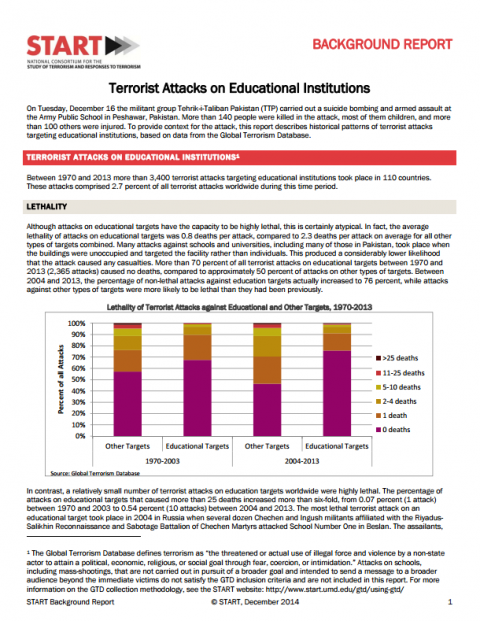 Terrorist Attacks on Educational Institutions Year of publication: 2014 Author: Erin Miller Corporate author: National Consortium for the Study of Terrorism and Responses to Terrorism (START) | Department of Homeland Security Science and Technology The report describes historical patterns of terrorist attacks targeting educations institutions dating back to 1970. Since that year, more than 3,400 terrorist attacks targeting educations institutions took place in 110 countries. These attacks comprised 2.7 percent of all terrorist attacks worldwide during this time period. Terrorist Attacks on Educational Institutions Year of publication: 2014 Author: Erin Miller Corporate author: National Consortium for the Study of Terrorism and Responses to Terrorism (START) | Department of Homeland Security Science and Technology Le rapport revient sur les attaques terroristes qui ont ciblé les institutions éducatives depuis 1970. A partir de cette année, on dénombre plus de 3.400 attaques terroristes qui avaient pour cible les institutions éducatives, dans 110 pays. Ces attaques représentent 2,7 % de l’ensemble des attaques terroristes perpétrées à travers le monde au cours de cette période.
  Disaster reduction and human security: education for sustainable development; case studies and best practices Year of publication: 2005 Corporate author: Kyoto University. Graduate School of Global Environmental Studies Disaster reduction, human security, education and sustainable development are the four key issues, which are considered in the current compilation. A quick glance of the case studies will tell us the varieties of focus areas. WCD R Thematic Cluster 3 (Knowledge, Innovation and Education: To Build a Culture of Safety and Resilience) identifies four themes under the cluster: Education, Research, Public Awareness and Community Empowerment. A majority of case studies focus on community activities, especially on ho w the communities were able to cope with different types of disasters in different socio-economic context. These are all learning processes for the community, especially to enhance the resilience among its members. A number of these studies include public awareness, training and capacity building programmes. Quite a number of case studies focus on professional expertise, like microzonation, mapping, planning, hazard assessment, and development of risk reduction tools. These are all related to education and research. There are some case studies, which focus on formal education at school and colleges, but are linked to practical learning exercise. Distance learning has appeared as one of the possible media to reach the global mass, and to reach the farthest and the most needy group. The link between on-site testing and on-line learning has been emphasized by several case studies. La prévention des catastrophes et de la sécurité humaine: l'éducation pour le développement durable; études de cas et les meilleures pratiques Year of publication: 2005 Corporate author: Kyoto University. Graduate School of Global Environmental Studies La prévention des catastrophes, la sécurité humaine, l'éducation et le développement durable sont les quatre questions clés, qui sont pris en compte dans la compilation actuelle. Un rapide coup d'œil des études de cas va nous dire les variétés de domaines d'intervention. WCD R thématique Cluster 3 (Connaissance, innovation et éducation: construire une culture de la sécurité et la résilience) identifie quatre thèmes du groupe: l'éducation, la recherche, la sensibilisation du public et l'autonomisation des communautés. La majorité des études de cas se concentrent sur les activités communautaires, en particulier sur ho w les communautés ont pu faire face à différents types de catastrophes dans le contexte socio-économique différent. Ce sont tous les processus d'apprentissage pour la communauté, en particulier pour améliorer la résilience parmi ses membres. Un certain nombre de ces études comprennent des programmes de sensibilisation du public, la formation et le renforcement des capacités. Un certain nombre d'études de cas se concentrer sur l'expertise professionnelle, comme microzonage, la cartographie, la planification, l'évaluation des risques, et le développement d'outils de réduction des risques. Ceux-ci sont tous liés à l'éducation et à la recherche. Il y a quelques études de cas, qui mettent l'aCECnt sur l'éducation formelle à l'école et les collèges, mais sont liés à la pratique d'exercice d'apprentissage. L'enseignement à distance est apparu comme l'un des médias possibles pour atteindre la masse globale, et d'atteindre le plus loin et le groupe le plus nécessiteux. Le lien entre les tests sur site et l'apprentissage en ligne a été soulignée par plusieurs études de cas.
  Proceedings of the thematic session on education for sustainable development: towards effective disaster reduction and enhancing human security; cluster 3: knowledge, innovation and education to build a culture of safety and resilience Year of publication: 2005 Author: Rajib Shaw | Badaoui Rouhban Corporate author: Kyoto University. Graduate School of Global Environmental Studies | Global Alliance for Disaster Reduction | Global Open Learning Forum on Risk Education | Disaster Reduction Alliance | International Institute of Earthquake Engineering and Seismology Ten years ago, the city of Kobe and its adjoining areas in Hyogo prefecture of Japan were hit by a strong earthquake, leaving behind a trail of death and destruction. This earthquake was a turning point in disaster reduction initiatives in Japan, resulting in two prominent changes: 1) a blending of technological and social issues in the field of research and application, and 2) an enhanced participation of civil society in disaster reduction Initiatives. Since Japan had long been one of the most developed countries in the field of earthquake engineering, the tragedy in Kobe posed a daunting question: 'how to fill the gap between knowledge and practice?' This question is not only for Japan, but is pertinent to many other countries. With the advancement of technology, the knowledge base is growing, and it is now time to tackle this question in order to save lives and properties from natural disasters. The World Conference on Disaster Reduction (WCDR), at the 10th anniversary of the Kobe earthquake, is therefore of special significance, providing an excellent platform to share experiences, expertise, and lessons from different parts of the world. The year 2005 is also the beginning of the United Nations Decade of Education for Sustainable Development (DESD: 2005-2014) which is led by UNESCO. Compte rendu de la session thématique sur l'éducation pour le développement durable: vers une réduction efficace des catastrophes et le renforcement de la sécurité humaine; groupe 3: la connaissance, l'innovation et l'éducation pour instaurer une culture de la sécurité et de résilience Year of publication: 2005 Author: Rajib Shaw | Badaoui Rouhban Corporate author: Kyoto University. Graduate School of Global Environmental Studies | Global Alliance for Disaster Reduction | Global Open Learning Forum on Risk Education | Disaster Reduction Alliance | International Institute of Earthquake Engineering and Seismology Il y a dix ans, la ville de Kobe et ses zones adjacentes dans la préfecture de Hyogo du Japon ont été touchés par un fort tremblement de terre, laissant derrière lui une traînée de mort et de destruction. Ce tremblement de terre a été un point tournant dans les initiatives de prévention des catastrophes au Japon, ce qui entraîne deux changements importants: 1) un mélange de questions technologiques et sociales dans le domaine de la recherche et de l'application, et 2) une participation accrue de la société civile dans les initiatives de prévention des catastrophes. Depuis que le Japon a longtemps été l'un des pays les plus développés dans le domaine de l'ingénierie des tremblements de terre, la tragédie de Kobe a posé une question de taille:? Comment combler le fossé entre les connaissances et la pratique ' Cette question est non seulement pour le Japon, mais est pertinent pour de nombreux autres pays. Avec l'avancement de la technologie, la base de connaissances est en croissance, et il est maintenant temps d'aborder cette question dans le but de sauver des vies et des propriétés des catastrophes naturelles. La Conférence mondiale sur la prévention des catastrophes (CMPC), au 10e anniversaire du tremblement de terre de Kobe, est donc d'une importance particulière, en fournissant une excellente plateforme pour partager des expériences, des compétences et des leçons de différentes parties du monde. L'année 2005 est aussi le début de la Décennie des Nations Unies pour l'éducation pour le développement durable (DEDD: 2005-2014) qui est dirigé par l'UNESCO.