
Resources
Explore a wide range of valuable resources on GCED to deepen your understanding and enhance your research, advocacy, teaching, and learning.
1,182 Results found
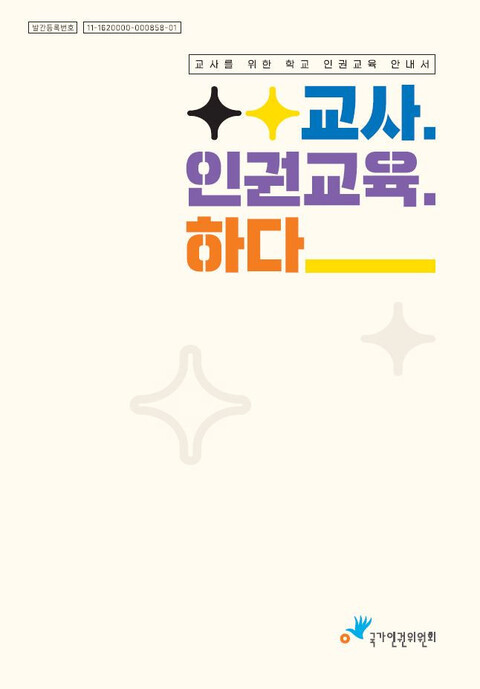 교사. 인권교육. 하다: 교사를 위한 학교 인권교육 안내서 Year of publication: 2021 Corporate author: 국가인권위원회 이 자료는 「초·중등 학교 인권교육 내용 체계화 및 개정 교육과정 적용 방안 연구」 보고서 내용을 바탕으로, 교육 현장에서 인권교육을 실천하고 있거나 해보려는 많은 교사를 위해 학교 인권교육에 관한 이해를 높이고 실천 방법에 대한 유용한 정보를 제공하기 위해 만든 발간물로서 인권 과목의 지향점 및 교육과정 내용 체계 등을 간명하게 보여 줌으로써, 인권 과목을 통한 인권교육을 구체화할 수 있도록 했다. 또한 인권교육을 처음 시도하는 교사들이 부담 없이 접근할 수 있도록 읽을거리, 볼거리, 생각할 거리 등 다양한 자료를 제공한다.
  L’université de paix, ressources pédagogiques Corporate author: L'université de paix L'Université de Paix diffuse des outils pédagogiques et des articles de fond pour apprendre à mieux communiquer et développer des relations plus sereines et constructives.The University of peace distributes teaching tools and in-depth articles to help people learn to communicate better and develop calmer, more constructive relationships.
  Evaluating the Link between Conflict and Education Year of publication: 2005 Author: Lynn Davies Corporate author: SAGE Publishing This paper examines two areas of important evaluation: the impact of education on peace and the impact of education on conflict, and argues that they are not necessarily the same type of evaluation. Evaluating the Link between Conflict and Education Year of publication: 2005 Author: Lynn Davies Corporate author: SAGE Publishing Cet article examine deux domaines importants d’évaluation : l'impact de l'éducation sur la paix et l'impact de l'éducation sur les conflits ; il démontre ensuite que le même type d'évaluation ne s’applique pas nécessairement au deux.
  Education in the twenty‐first century: Conflict, reconstruction and reconciliation1 Year of publication: 2005 Author: Alan Smith Corporate author: Taylor & Francis This paper is an attempt to map out an emerging and increasingly important field of study concerning the relationship between education and conflict. The paper argues that actions through various ‘entry points’ at each of these levels carry the potential to exacerbate or ameliorate conflict and suggests that a systemic analysis of investments in education systems from a conflict perspective should be a routine part of educational planning. Education in the twenty‐first century: Conflict, reconstruction and reconciliation1 Year of publication: 2005 Author: Alan Smith Corporate author: Taylor & Francis Ce papier tente d’établir un nouveau domaine d'étude de plus en plus important portant sur le lien entre l'éducation et les conflits. Le document fait valoir que les actions menées à travers différents « points d’entrée » à chaque niveau ont le potentiel d'exacerber ou bien d’atténuer les conflits. Le papier suggère qu'une analyse systémique des investissements dans les systèmes d'éducation contre les conflits devrait faire partie intégrante de la planification de l'éducation.
 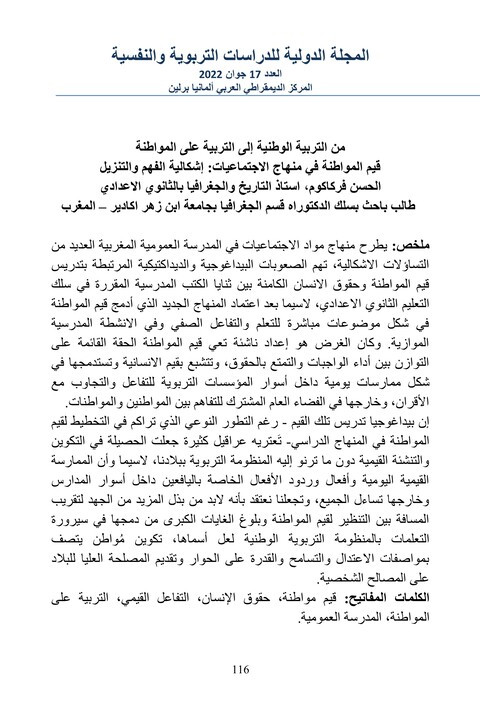 From Civic Education to Citizenship Education: Citizenship Values in the Geography Curriculum; The Problem of Understanding and Downloading (International Journal of Educational and Psychological Studies; vol. 6, no. 17) Year of publication: 2022 Author: Al-Hassan Farkakoum Corporate author: Democratic Arab Center This paper aims to contribute to revealing the extent to which the values of citizenship and human rights are present in the social studies lesson in Moroccan public schools, specifically in the middle school education curriculum. The inclusion of human rights values at this level raises several problems that lead to two complementary trends: The first is related to the didactics of human rights and citizenship education, and the second trend is related to the extent of the learner’s ability to acquire and represent the values of citizenship and transform them into automatic daily behaviors and practices in the school environment and then after that in daily public life and private transactions. من التربية الوطنية إلى التربية على المواطنة قيم المواطنة في منهاج الاجتماعيات: إشكالية الفهم والتنزيل (مجلة الدراسات التربوية والنفسية ;no.17, vol.6) Year of publication: 2022 Author: Al-Hassan Farkakoum Corporate author: Democratic Arab Center تهدف هذه الورقة الإسهام في كشف مدى حضور قيم المواطنة وحقوق اإلنسان في درس الاجتماعيات بالمدرسة العمومية المغربية، وتحديدا في منهاج التعليم الثانوي الإعدادي. إن إدراج قيم حقوق اإلنسان في هذا المستوى يطرح عدة إشكالات تصب في منحيين يكمل بعضهما البعض، الأول مرتبط بديداكتيك مادة حقوق اإلنسان والتربية على المواطنة، والمنحى الثاني له عالقة بمدى قدرة المتعلم على اكتساب قيم المواطنة وتمثلها وتحويلها إلى سلوكات وممارسات تلقائية يومية في الوسط المدرسي ثم بعد ذلك في الحياة العامة اليومية والمعاملات الخاصة.
 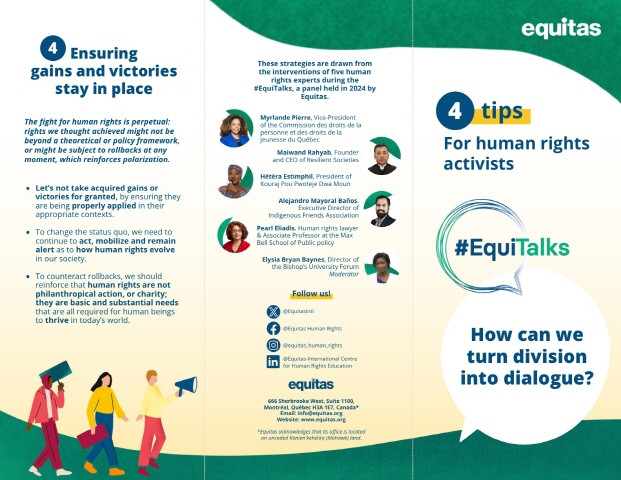 #EquiTalks: How Can We Turn Division into Dialogue? Year of publication: 2024 Corporate author: Equitas This brochure gathers the answers of five human rights defenders during the 2024 #EquiTalks panel discussion, who attempted to answer the question: How can we turn division into dialogue? The brochure suggests potential solutions and tips to counteract the polarization of opinions on human rights. #EquiTalks: Comment transformer la division en dialogue ? Year of publication: 2024 Corporate author: Equitas Ce document rassemble les réponses de cinq défenseurs des droits humains lors du panel de discussion #EquiTalks en 2024, qui ont tenté de répondre à la question suivante : Comment transformer la division en dialogue? Le dépliant offre des pistes de solution et des conseils pour contrer la polarisation des opinions sur les droits humains.