
Resources
Explore a wide range of valuable resources on GCED to deepen your understanding and enhance your research, advocacy, teaching, and learning.
3,436 Results found
 Discussing Terrorism: a pupil-inspired guide to UK counter-terrorism policy implementation in religious education classroom in England Year of publication: 2016 Author: Angela Quartermaine Corporate author: Christian Education | Taylor & Francis L’éducation religieuse en Angleterre est affectée par les idéologies terroristes et le renforcement des liens communautaires. Dans ce contexte, de nombreux professeurs d’éducation religieuse se sentent insuffisamment équipés pour traiter des sujets qui peuvent découler de discussions relatives au terrorisme. Ainsi, une clarification permettrait de soulager leurs inquiétudes et d’offrir des pistes pour mettre en place une pédagogie adaptée.
  PREVENT: creating “radicals” to strengthen anti-Muslim narratives Year of publication: 2015 Author: Asim Qureshi Corporate author: Critical Studies on Terrorism The use of de-radicalization narratives in schools, universities and hospitals has led to the criminalization of large sections of the various Muslim communities in the UK. Based on different experiences we hope to present a view of how an aggressive anti-Muslim narrative that is based on assumptions subverts the political expression/identity of individuals by turning them into potential threats. By understanding the everyday interactions with PREVENT, a picture can be formed of the way that a false presentation of narratives can lead to a person becoming an “extremist” or “terrorist”, while the truth may lie in a completely alternative place. PREVENT: creating “radicals” to strengthen anti-Muslim narratives Year of publication: 2015 Author: Asim Qureshi Corporate author: Critical Studies on Terrorism L'utilisation des récits de déradicalisation dans les écoles, les universités et les hôpitaux a conduit à la criminalisation d’une fraction importante des différentes communautés musulmanes au Royaume-Uni. En se basant sur des expériences différentes, nous espérons montrer comment un récit agressif antimusulman qui se fonde sur des hypothèses bouleverse les opinions /l’identité des individus et les transforment en des menaces potentielles. Chercher à comprendre comment se font les interactions quotidiennes avec PREVENT permet de saisir comment une présentation erronée des récits de vie peut conduire à présenter une personne comme un « extrémiste » ou un « terroriste », alors que la réalité est tout à fait différente.
  It's about us!: reflections on education for active citizenship within the European Union Year of publication: 2013 Author: Milana Marcella, Tarozzi Massimiliano The article is structured in three main parts. Grounded in the scientific literature, the authors unpack the notion of citizenship as key educational concept based on multiple and diverse identities. Then, they outline the major steps undertaken at EU level to formalise and expand citizenship rights and to endorse citizenship education across the Union’s nationals, by showing that citizenship education is promoted more as a strategy for legitimising the Union rather than a participatory practice aimed at fostering democratic processes within Europe. Finally, they discuss the implications of these policy advancements from a social justice perspective, by advancing a critique of their political assumptions and, to some extent, the pedagogical approach they suggest.
  Global Citizenship Education in Canada and the U.S.: From Nation-Centric Multiculturalism to Youth Engagement Year of publication: 2020 Author: Sarah Ranco | Alexis Gilmer | Colleen Loomis Corporate author: Cham Springer This chapter examines the historical and current uses of global citizenship education (GCE) in Canada and the U.S. in public schools from primary through secondary levels, with attention to Canada as well as similarities and differences within and across the two countries. The authors assess how social and political contexts have influenced the definition and operationalization of multiculturalism, civic studies, and global studies in curricula, noting that the neo-liberal perspective has focused on making people an economic powerhouse rather than socially concerned global citizens. In their examination of educational approaches that relate to GCE, the authors present decolonizing pedagogies, the multiculturalism approach in Canada, as well as culturally responsive and anti-racist pedagogies. To illustrate these issues, the authors offer an example in the Canadian context and raise the need to prevent GCE from becoming yet another tool for hegemony by the Global North on the Global South, as dominant groups have long defined citizenship. They conclude by proposing that to realize GCE in these two countries, teacher/practitioner and local, national, and international actors must engage youth, and in doing so, power imbalances that prohibit becoming global citizens will be addressed.
  The Role of Education in Preventing Violent Radicalisation: A Review for Europe (The Journal of Education; No.397, 2022) Year of publication: 2022 Author: Arantxa Azqueta | Adoración Merino-Arribas Corporate author: Spain. Ministry of Education This research analyses government documents addressing the prevention of radicalisation in 16 European countries, differentiated according to the presence or absence of fatalities in attacks. The aim to identify the presence of the attitudes which PISA 2018 identifies as key to define a democratic and interculturally competent citizenry and guide integration-friendly policies: openness, respect, civic awareness, responsibility, self-efficacy and tolerance. A comparative methodology is employed, using a lexicographical content analysis through Iramuteq software together with a critical-interpretative analysis of the texts.
  中小学生课业负担加重的社会 : 教育传导机制与治理路径 (现代教育论丛 第256期) Year of publication: 2024 Author: 刘建银 Corporate author: 华南师范大学 个体社会经济地位的提升越来越依赖学校教育获得,劳动力市场的分割将竞争 集中在普通学校教育体系内的优质资源,社会公平诉求又将选拔标准单一化为书本可测知识 成绩的排名,不可避免出现考试难度越来越大、学习进度越来越超前、时间越来越长、负担 越来越重的后果。过重课业负担对学习韧性和身心健康的影响令人担忧。减轻过重课业负担 是一场持久战,需要继续强化“双减”治理、明确长期可持续学习的价值导向、重构多样化 教育体系以及推动主要劳动力市场选人机制转型,进而走出“治理—恶化—再治理—再恶化” 的莫比乌斯循环。
 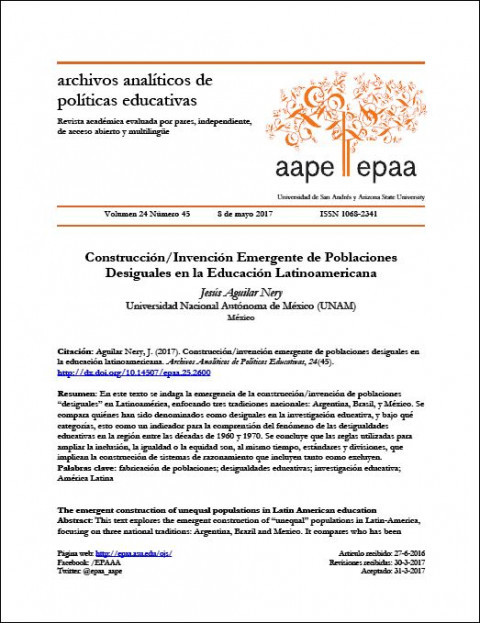 Construction / Emerging Invention of Unequal Populations in Latin American Education Year of publication: 2017 Author: Jesús Aguilar Nery Corporate author: Universidad de San Andrés | Arizona State University This text explores the emergent construction of “unequal” populations in Latin-America, focusing on three national traditions: Argentina, Brazil and Mexico. It compares who has been named as unequal in educational research and under what categories, and treats this comparison as an indicator for understanding the phenomenon of educational inequalities in the region between 1960 and 1970. It is concluded that the rules used to enforce inclusion, equality and equity are, at the same time, standards and divisions that involve the construction of systems of reasoning that also simultaneously include and exclude. Construcción/Invención Emergente de Poblaciones Desiguales en la Educación Latinoamericana Year of publication: 2017 Author: Jesús Aguilar Nery Corporate author: Universidad de San Andrés | Arizona State University En este texto se indaga la emergencia de la construcción/invención de poblaciones “desiguales” en Latinoamérica, enfocando tres tradiciones nacionales: Argentina, Brasil, y México. Se compara quiénes han sido denominados como desiguales en la investigación educativa, y bajo qué categorías, esto como un indicador para la comprensión del fenómeno de las desigualdades educativas en la región entre las décadas de 1960 y 1970. Se concluye que las reglas utilizadas para ampliar la inclusión, la igualdad o la equidad son, al mismo tiempo, estándares y divisiones, que implican la construcción de sistemas de razonamiento que incluyen tanto como excluyen.
 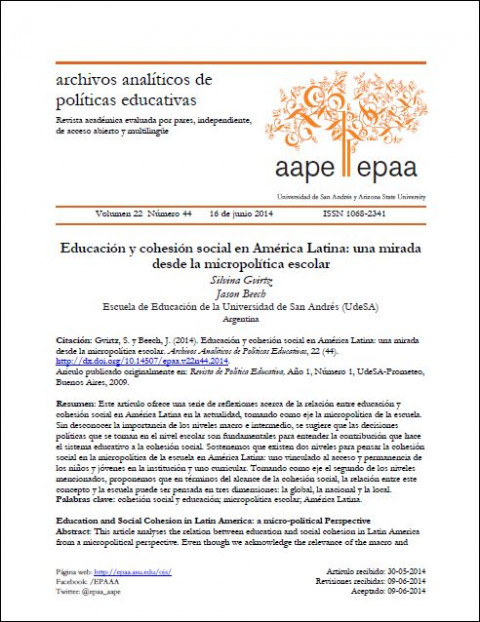 Education and Social Cohesion in Latin America: A Micro-political Perspective Year of publication: 2014 Author: Silvina Gvirtz | Jason Beech Corporate author: Universidad de San Andrés | Arizona State University This article analyses the relation between education and social cohesion in Latin America from a micropolitical perspective. Even though we acknowledge the relevance of the macro and mezzo levels, we argue that the political decisions that are made at the school level are crucial to understand the contribution of educational systems to social cohesion. We suggest that the relation between social cohesion and school micropolitics can be analysed in two dimensions: the first is related to the access and permanence of children in school, while the second is related to the curriculum. The article concentrates on the second level by analysing the relation between the curriculum and social cohesion from a local, a national, and a global perspective.