
Resources
Explore a wide range of valuable resources on GCED to deepen your understanding and enhance your research, advocacy, teaching, and learning.
2,776 Results found
 Address by Irina Bokova, Director-General of UNESCO on the occasion of the Conference on Education for Sustainable Development in Support of Cultural and Biological Diversity; Oman, 24 January 2011 Year of publication: 2011 Corporate author: UNESCO. Director-General, 2009-2017 (Bokova, I.G.) This address was given by Irina Bokova, Director-General of UNESCO on the occasion of the Conference on Education for Sustainable Development in Support of Cultural and Biological Diversity. Discours de Mme Irina Bokova, Directrice générale de l'UNESCO à l'occasion de la Conférence sur l'éducation au service du développement durable à l'appui de la diversité culturelle et biologique; Oman, 24 janvier 2011 Year of publication: 2011 Corporate author: UNESCO. Director-General, 2009-2017 (Bokova, I.G.) Cette allocution a été donnée par Irina Bokova, Directrice générale de l'UNESCO, à l'occasion de la Conférence sur l'éducation au développement durable à l'appui de la diversité culturelle et biologique.
  Education for intercultural understanding Year of publication: 2010 Author: Joy de Leo Corporate author: UNESCO Bangkok The theme of intercultural understanding and respect for cultural diversity falls within the social dimension of peace, equality and human rights, underpinned by the cultural context, within and through which learning occurs, and which forms the basis for inter-linkages between the various sustainability dimensions (i.e., socio-political, environmental and economic). Within the International Implementation Scheme, the value of respect is seen as central to all aspects of sustainable development: respect for self, for others and for all life on earth. L'éducation pour la compréhension interculturelle Year of publication: 2010 Author: Joy de Leo Corporate author: UNESCO Bangkok Le thème de la compréhension interculturelle et le respect de la diversité culturelle relève de la dimension sociale de la paix, l'égalité et les droits de l'homme, sous-tendue par le contexte culturel, à l'intérieur et à travers lequel l'apprentissage se produit, et qui constitue la base des liens entre les différentes dimensions de la durabilité (ie, socio-politique, environnemental et économique). Dans le cadre du programme d'application international, la valeur du respect est considérée comme essentielle à tous les aspects du développement durable: le respect de soi, des autres et de toute vie sur terre. 상호 문화 간 이해 교육 Year of publication: 2010 Author: Joy de Leo Corporate author: UNESCO Bangkok 상호 문화 간 이해와 문화 다양성에 대한 존중이라는 주제는 문화적 맥락에 기반을 둔 인권과 평등 및 평화의 사회적 영역에 속하며 학습 안에서 또한, 그 과정을 통해 이루어지며, 다양한 지속가능한 영역내에서 다양한 문화 간 상호 연계의 기반(즉, 사회·정치적, 환경적, 경제적으로)을 구축한다. 국제 실행계획(International Implementation Scheme)내에서, 존중의 가치는 지속가능한 발전의 모든 측면에서 핵심적인 것으로 간주된다. 곧, 자기 존중, 타인과 지구상의 모든 삶에 대한 존중을 의미한다.
 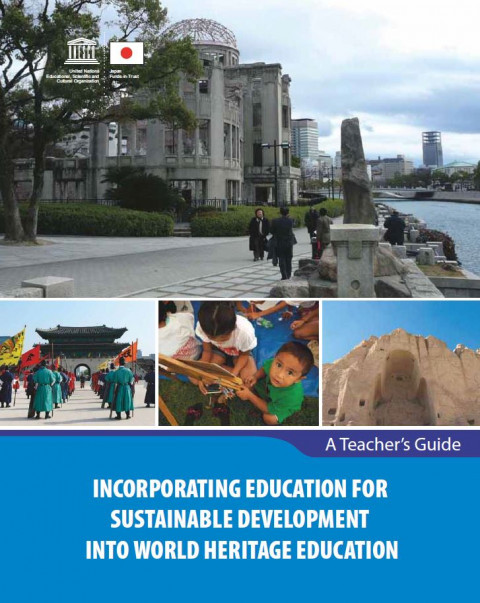 Incorporating education for sustainable development into world heritage education: a teacher's guide Year of publication: 2010 Corporate author: UNESCO Bangkok This publication, A Teacher’s Guide: Incorporating Education for Sustainable Development into World Heritage Education, represents the collective efforts of workshop participants to produce a practical tool for teachers to modify available curricula and incorporate ESD concepts and principles into WHE. It has taken a long time for the guide to be available in print. Nonetheless, the content of the guide remains practical and relevant in incorporating Education for Sustainable Development into World Heritage Education. Intégrer l'éducation au développement durable dans l'éducation au patrimoine mondial: un guide pour l'enseignant Year of publication: 2010 Corporate author: UNESCO Bangkok Cette publication, intitulée Un guide pour les enseignants: intégrer l'éducation au développement durable dans l'éducation au patrimoine mondial, représente les efforts collectifs des participants à l'atelier pour produire un outil pratique pour les enseignants afin de modifier les programmes disponibles. Le guide a mis du temps à être disponible en version imprimée. Néanmoins, le contenu du guide reste pratique et pertinent pour intégrer l'éducation au développement durable dans l'éducation au patrimoine mondial.
  Reimagining Life Skills and Citizenship Education in the Middle East and North Africa: A Four-Dimensional and Systems Approach to 21st Century Skills; Conceptual and Programmatic Framework Year of publication: 2017 Corporate author: UNICEF Middle East and North Africa The situation of learning in MENA calls for a holistic, lifelong and rights-based vision of education that maximizes the potential of all children and youth in the region and better equips them to create meaning out of knowledge and to face the transitions from childhood to adulthood, from education to work, and from unreflective development to responsible and active citizenship. This is what drives the MENA Life Skills and Citizenship Education (LSCE) Initiative, kicked off in 2015 with the aim of supporting the countries of the region – conceptually, programmatically and technically – to improve learning and to better invest such learning in individual, social and economic development.The LSCE Conceptual and Programmatic Framework (CPF) puts forth a roadmap to guide policies, strategies and programmes on life skills and citizenship education supporting the region-wide efforts to provide children and youth with opportunities to learn, transition from childhood to adulthood, move from school to work settings, and become responsible and active citizens of their communities.A set of twelve core life skills for MENA has been identified using the four-dimensional learning model: ‘Learning to Know’ (Cognitive Dimension), ‘Learning to Do’ (Instrumental Dimension), ‘Learning to Be’ (Individual Dimension), and ‘Learning to Live Together’ (Social Dimension). The twelve core life skills are life-long, and they build on evidence that underlines the importance of skills acquisition from an early age. Furthermore, the twelve core life skills are acquired and sustained through all forms of learning in a systems approach that recognizes multiple pathways of learning, formal, non-formal and informal. Réimaginer l’éducation aux compétences de vie et à la citoyenneté au Moyen-Orient et en Afrique du Nord : Une approche à quatre dimensions et systémique des compétences pour le XXIe siècle ; Cadre programmatique et conceptuel Year of publication: 2017 Corporate author: UNICEF Middle East and North Africa L’Initiative pour l’éducation aux compétences de vie et à la citoyenneté de la région MENA (LSCE) représente un effort de collaboration étatique et régional en faveur de la réalisation de l’objectif de développement durable (ODD) 4 – Assurer l’accès de tous à une éducation de qualité, sur un pied d’égalité, et promouvoir les possibilités d’apprentissage tout au long de la vie. Elle cherche à reformuler la compréhension traditionnelle de l’éducation aux compétences de vie et à la citoyenneté dans la région, tout en rappelant les questions fondamentales au sujet du but et du rôle de l’éducation dans le développement sociétal qui sont pertinentes dans le contexte actuel.L’Initiative LSCE se concentre sur trois défis interdépendants :Une société du savoir inaccessible, résultat de la mauvaise qualité de l’éducation, du bas niveau des résultats scolaires et d’une équité et inclusion limitées.Une croissance économique en déclin, résultat d’un manque d’aptitudes à l’employabilité, du haut taux de chômage chez les jeunes, de l’inégalité des sexes face à l’accès au marché du travail, du manque de création d’emplois, et d’un environnement économique faible.Une faible cohésion sociale, résultat de l’escalade de la violence et de la radicalisation tout autant que d’un faible engagement civique.
  Global Education Monitoring Report, 2021, Central and Eastern Europe, Caucasus and Central Asia: Inclusion and Education; All Means All Year of publication: 2021 Corporate author: Global Education Monitoring Report Team | European Agency for Special Needs and Inclusive Education | Network of Education Policy Centers Prepared by the Global Education Monitoring (GEM) Report, in partnership with the European Agency for Special Needs and Inclusive Education and the Network of Education Policy Centers, the regional report on inclusion and education in Central and Eastern Europe, the Caucasus and Central Asia offers a deep dive into the core challenges and key solutions. The region is working hard to overcome a legacy, whereby children with disabilities attended special schools, once wrongly regarded as an effective solution, segregated by type of disability, if not fully excluded from education.The report draws on in-depth profiles of 30 education systems in the region. It also presents the additional risks to inclusion now posed by the COVID-19 pandemic. Building on the 2020 Global Education Monitoring Report, it documents barriers facing learners, particularly where multiple disadvantages intersect. Its recommendations provide a systematic framework for identifying and dismantling these barriers, according to the principle that ‘every learner matters and matters equally’.