
Resources
Explore a wide range of valuable resources on GCED to deepen your understanding and enhance your research, advocacy, teaching, and learning.
2,668 Results found
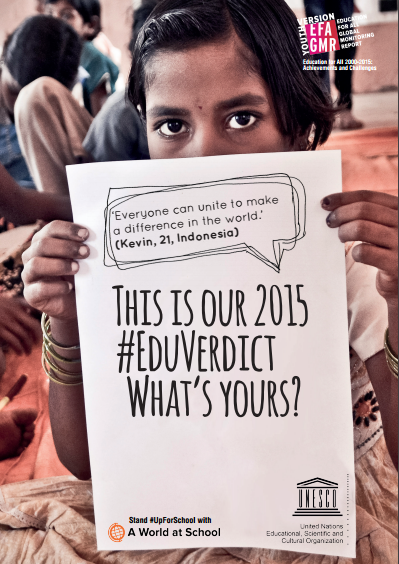 这是我们的2015 教育回望#EduVerdict 你的呢? Year of publication: 2015 Corporate author: 联合国教科文组织 (UNESCO) This report highlights the progress and challenges that countries have faced over 15 years, brining together the voices of young people to show how Education for All (EFA) has affected their lives.
  Contributing to peace and human development in an era of globalization Year of publication: 2002 Corporate author: UNESCO The Medium-Term Strategy (2002-2007) for the countries of the Africa region is an essential programme axis of UNESCO’s new decentralization policy. It forms an integral part of the Organization’s overall strategic objectives defined by the Member States in the UNESCO MediumTerm Strategy for 2002-2007 (31 C/4), which aims to contribute to peace and human development through education, the sciences, culture and communication.
  Teacher Training for Multicultural Education in Favour of Democracy and Sustainable Development: the Territorial Approach Year of publication: 1995 Author: Raúl Galiardi | Paula Bernadini Mosconi Corporate author: UNESCO This publication is part of the book Teacher Training and Multiculturalism: National Studies. This book presents the outcomes concerning the initial training systems of teachers in eight countries at different levels of development in different regions of the world but who are faced with a common challenge to educate for cultural diversity. Both the conclusions of each particular study and the general outcomes demonstrate the complexity of the problems and the benefits of comparative analysis. Overcoming prejudices and stereotypes is not an easy task nor likely to be achieved in the short term. Mentalities change far more slowly than knowledge and, because of this, educational strategies need to be applied in the long term. This study also shows that it is necessary to improve the exchange of experiences as well as contacts between people and institutions who are confronted with the same problems in different contexts. The publication of the initial outcomes of this project is intended to enrich the quality of discussions between specialists and institutions who, in different parts of the world, are concerned by multicultural education as an instrument to promote understanding, respect and dialogue between cultures.
  Non-formal and Informal Programs and Activities that Promote the Acquisition of Knowledge and Skills in Areas of Global Citizenship Education (GCED) and Education for Sustainable Development (ESD) Year of publication: 2016 Author: Ashley Stepanek Lockhart Corporate author: UNESCO This study will examine the nature of, and how, non-formal and informal programs and activities contribute to the acquisition of knowledge and skills for children, adolescents, youth and adults in precise areas of Target 4.7. This will be done by highlighting different definitions, conceptual approaches and history, along with policies of GCED and ESD and non-formal education and informal learning, comparing attempts to operationalize GCED and ESD to indicators for measurement and monitoring and challenges therein, and by identifying relevant sample programs and activities from around the world to analyze and consider using as data sources. How non-formal and informal provision related to GCED and ESD links to formal education will be considered, along with its connection to the larger notion of lifelong learning.
 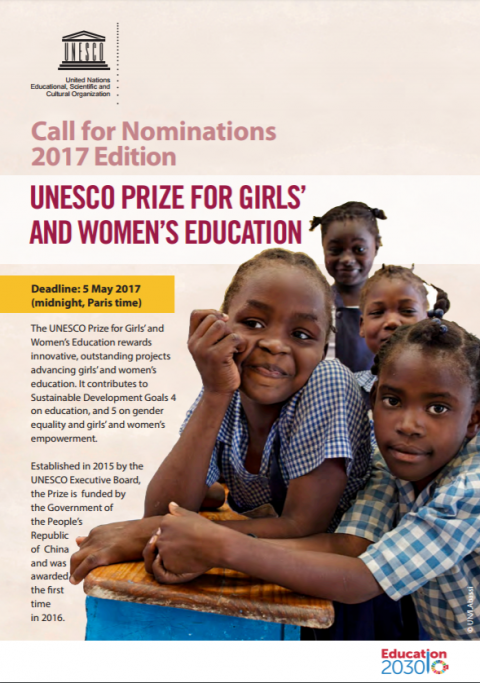 Prix UNESCO pour l'éducation des filles et des femmes, édition 2017: appel à candidatures Year of publication: 2017 Corporate author: Organisation des Nations Unies pour l'éducation, la science et la culture (UNESCO) The UNESCO Prize for Girls’ and Women’s Education rewards innovative, outstanding projects advancing girls’ and women’s education. It contributes to Sustainable Development Goals 4 on education, and 5 on gender equality and girls’ and women’s empowerment. Premio UNESCO de educación de las niñas y las mujeres, edición de 2017: solicitud de candidaturas Year of publication: 2017 Corporate author: Organización de las Naciones Unidas para la Educación, la Ciencia y la Cultura (UNESCO) The UNESCO Prize for Girls’ and Women’s Education rewards innovative, outstanding projects advancing girls’ and women’s education. It contributes to Sustainable Development Goals 4 on education, and 5 on gender equality and girls’ and women’s empowerment. Прием заявок в номинации Конкурс 2017. ПРЕМИЯ ЮНЕСКО ЗА ДОСТИЖЕНИЯ В ОБЛАСТИ ОБРАЗОВАНИЯ ДЕВОЧЕК И ЖЕНЩИН Year of publication: 2017 Corporate author: Организация Объединенных Наций по вопросам образования, науки и культуры (UNESCO) The UNESCO Prize for Girls’ and Women’s Education rewards innovative, outstanding projects advancing girls’ and women’s education. It contributes to Sustainable Development Goals 4 on education, and 5 on gender equality and girls’ and women’s empowerment. 联合国教科文组织女童和妇女教育奖 - 2017年 - 征集提名 Year of publication: 2017 Corporate author: 联合国教科文组织 (UNESCO) The UNESCO Prize for Girls’ and Women’s Education rewards innovative, outstanding projects advancing girls’ and women’s education. It contributes to Sustainable Development Goals 4 on education, and 5 on gender equality and girls’ and women’s empowerment.
  How Does Education About the Holocaust Advance Global Citizenship Education? Year of publication: 2018 Author: E. Doyle Stevick Corporate author: UNESCO Can education about past genocides shape our understanding of how violence occur in today’s world? Can it foster a sense of belonging to a common humanity and empower young people to become active citizens who work globally for peace and human rights? How does learning about such crimes, which profoundly affect the core dignity of human beings, support the objectives of Global Citizenship Education (GCED), a priority of the 2030 Education Agenda?This paper, commissioned by UNESCO, offers an overview of empirical research on teaching and learning about the Holocaust and how such education may impact leaners’ cognitive, socio-emotional and behavioural skills and competencies. It provides insights for educators on how effective lessons about the Holocaust can meet some of the key expected outcomes of Global Citizenship Education (GCED), such as critical thinking skills, attitudes of empathy and solidarity, and motivation to take action to prevent human rights abuses.
  Towards the development of an international module for assessing learning in Global Citizenship Education (GCE) and Education for Sustainable Development (ESD): a critical review of current measurement strategies Year of publication: 2016 Author: Bryony Hoskins Corporate author: UNESCO The aim of the study is to support the development of an indicator for target 4.7 of the UN sustainable development goals (STG). The study provides a conceptual framework for measuring the competences from global citizenship education (GCE) and education for sustainable development (ESD) from a review of the literature and then an audit of the different aspects of these competences. The study establishes the extent that these competences can be measured using existing data. The results of this analysis show that most dimensions of GCE can to some extent be measured by the existing IEA ICCS 2009 and 2016 datasets and an outline of how this data can be used to develop an initial indicator or set of indicators for target 4.7 is given. However, in contrast, the study finds that existing data is much more limited on measuring ESD and the existing data does not provide enough coverage for indicator development at the moment. The study recommends that in order to provide a more comprehensive measure of both these competences it would be necessary to develop a new module on GCE and ESD. After considering the options, it is concluded that the most realistic option is for this module to be attached to the existing IEA ICCS survey. The study concludes that an indicator of all citizens across the whole world is probably unrealistic considering the challenges faced, but what could be achievable is an indicator covering some countries from each region from around the world. To make this a reality considerable political effort and search for funding would be required to engage new regions to the ICCS survey, for example, from Africa and the Middle East