
Resources
Explore a wide range of valuable resources on GCED to deepen your understanding and enhance your research, advocacy, teaching, and learning.
3,797 Results found
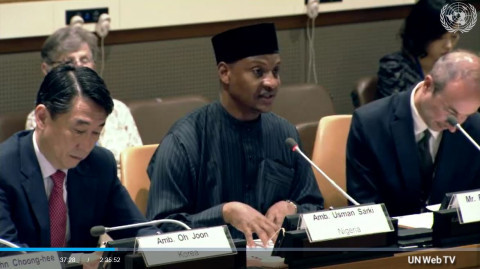 [Video] Global Citizenship Education for a just, peaceful, inclusive and sustainable world: a conceptual framework and its application in the field Year of publication: 2015 Corporate author: United Nations (UN) The Seminar held at UN HQs entitled, "Global Citizenship Education for a Just, Peaceful, Inclusive, and Sustainable world: A Conceptual Framework and its Application in the Field" was co-organized by the Permanent Missions of France, Nigeria, Qatar and the Republic of Korea, the United States Mission and the United Nations Educational, Scientific and Cultural Organization (UNESCO), in support of the Secretary-General’s Global Education First Initiative (GEFI).The panel discussion was moderated by H.E. Ambassador Hahn Choong‐hee of Korea. Some of the speakers for this event included H.E. Ambassador Richard Erdman, Acting Representative to ECOSOC of the Permanent Mission of the United States of America to the United Nations; H.E. Ambassador Usman Sarki, Deputy Permanent Representative of the Permanent Mission of the Federal Republic of Nigeria to the United Nations; Yousef Laram, Deputy Permanent Representative of the State of Qatar to the United Nations; Mr. Francois Gave, Counsellor at the Permanent Mission of France to the United Nations; and Christopher Castle, Chief of UNESCO’s Section of Global Citizenship Education.This event was divided into two segments. In the first, GCED was discussed at the level of concept. How can it strengthen the three pillars of the United Nations and the three pillars of sustainable development in furtherance of a just, peaceful, inclusive and sustainable world. In the second, examples from the field – the local, national and international levels – were presented and discussed as were certain opportunities going forward including the important role of media. [vidéo] Éducation à la Citoyenneté mondiale pour un monde juste, pacifique, inclusive et durable: un cadre conceptuel et son application dans le domaine Year of publication: 2015 Corporate author: United Nations (UN) Le séminaire a eu lieu au Siège de l'ONU intitulé «Éducation Mondiale Citoyenneté pour un monde juste, paisible, inclusive et durable: un cadre conceptuel et son application sur le terrain» a été co-organisée par les Missions permanentes de la France, le Nigeria, le Qatar et les République de Corée, la Mission des États-Unis et l'Organisation de l’ONU pour l'éducation, la science et la culture (UNESCO), à l'appui de First Éducation Mondiale Initiative du Secrétaire général (GEFI).Le débat a été animé par S.E. Ambassadeur Hahn Choong-hee de Corée. Certains des orateurs pour cet événement inclus S.E. Ambassadeur Richard Erdman, représentant par intérim à l'ECOSOC de la Mission permanente des États-Unis d'Amérique auprès de l'Organisation de l’ONU; IL. Ambassadeur Usman Sarki, Représentant permanent adjoint de la Mission permanente de la République fédérale du Nigéria auprès de l’ONU; Yousef LARAM, Représentant permanent adjoint de l'Etat du Qatar auprès de l'Organisation de l’ONU; M. François Gave, Conseiller à la Mission permanente de la France auprès de l’ONU; et Christopher Castle, la Section de l'éducation à la citoyenneté mondiale chef de l'UNESCO. Cet événement a été divisé en deux segments. Dans le premier, ECM a été discuté au niveau du concept. Comment peut-on renforcer les trois piliers de l'Organisation de l’ONU et les trois piliers du développement durable dans la poursuite d'un monde juste, pacifique, inclusif et durable. Dans le second, des exemples sur le terrain - aux niveaux local, national et international - ont été présentées et discutées de même que certaines opportunités à l'avenir, y compris le rôle important des médias.
  Global Citizenship Education in Europe: A Comparative Study on Education Policies across 10 EU Countries Year of publication: 2016 Corporate author: Global Schools | European Union (EU) This research, realised in the framework of the EU-funded project Global Schools, is a comparative qualitative analysis of educational policies of 10 European countries (Austria, Bulgaria, Czech Republic, France, Ireland, Italy, Latvia, Spain, Portugal, England) that support the introduction of Global Citizenship Education (GCE) in primary school curriculum. The analysis focuses on four main topics: 1) identification of key actors and definition of their roles; 2) conceptual and terminology analysis; 3) levels and modes of implementation of GCE in primary school; and 4) identification of barriers to introducing GCE in the primary school system.The research has highlighted that political actors, not only governmental ones, play a crucial role in implementing GCE policies, as well as in promoting GCE more generally, and in facilitating links between different actors, who in some countries may otherwise have little institutional coordination with schools. The conceptual analysis points out that, besides the choice of different wording of GCE national terms, the main topics composing GCE are very similar. The specific terminology often reflects the history, will and political discourse of the organisations promoting GCE in the different countries.
 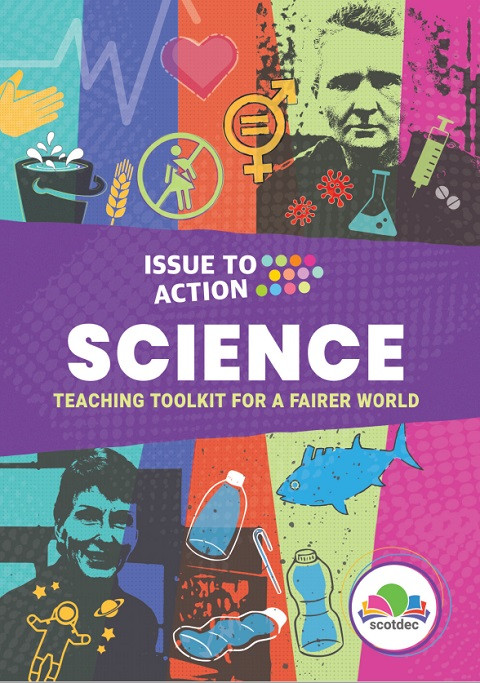 Issue to Action: Science; Teaching Toolkit for a Fairer World Year of publication: 2020 Author: Tracey Shaw | Claire Tatar | Krissie Davis Corporate author: Scotdec | European Union (EU) Global Citizenship Education is essential in enabling young people to access and participate in shaping modern society. All teachers and subjects have a role to play in educating young people to enable them to participate as fully as possible in building a fair and just world for all. Global Citizenship provides a wealth of real-life contexts for learning Science. By using relevant and meaningful topics, young people are more motivated to learn and understand the key role Science plays in driving change for a more sustainable future. The materials in this resource have been written by Science teachers and tested in Scottish classrooms. They focus on sustainability, plastic waste, health and wellbeing and women in Science.
 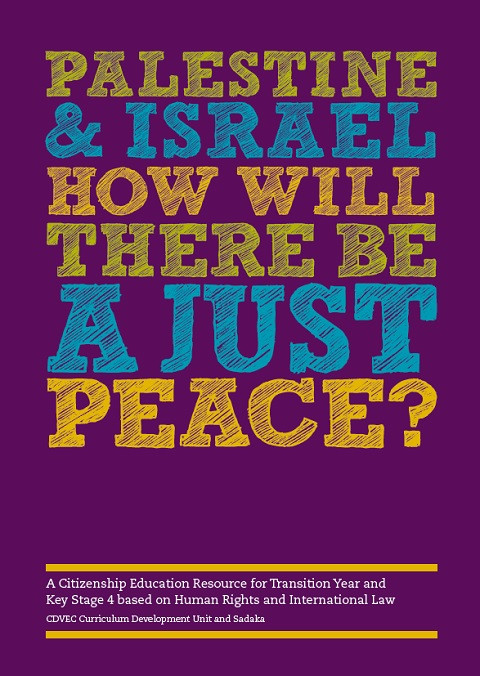 Palestine & Israel: How Will There Be a Just Peace?; A Citizenship Education Resource for Transition Year and Key Stage 4 based on Human Rights and International Law Year of publication: 2012 Author: Mary Gannon | Elaine Murtagh Corporate author: City of Dublin Vocational Education Committee (CDVEC). Curriculum Development Unit | Centre for Cross Border Studies This resource is an important development in helping post-primary students throughout the island of Ireland to explore the Palestinian Israeli situation within the context of Human Rights and International Law.The resource addresses key issues underlying the origins of the conflict and current obstacles to bringing about a just peace.
 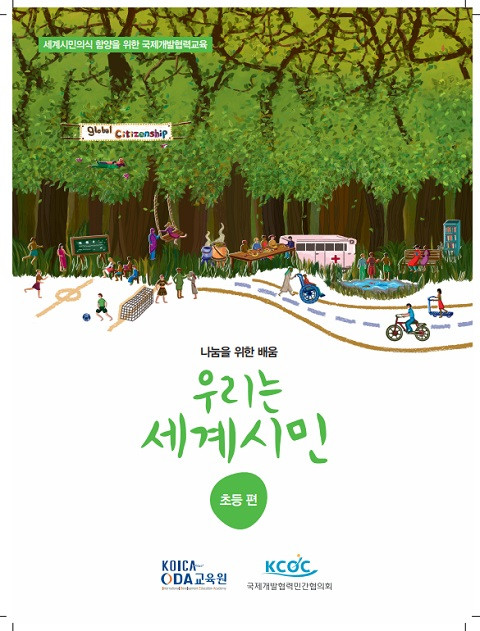 우리는 세계시민: 나눔을 위한 배움; 초등 편 Year of publication: 2013 Author: 고아라 | 고영주 | 김영미 | 성은경 | 홍지영 Corporate author: KOICA ODA 교육원 | 국제개발협력민간협의회 우리는 세계시민(초등편)은 상호연계성, 인권, 빈곤, 국제개발 진로 등 세계시민교육 관련 교사용 교수학습자료로 학생용 워크북이 포함되어 있다.
 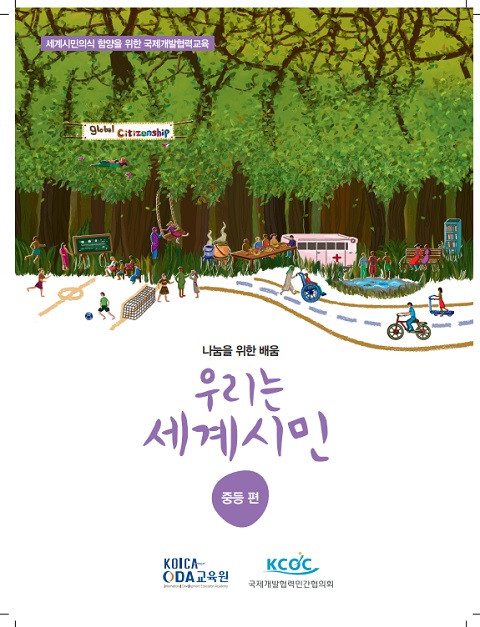 우리는 세계시민: 나눔을 위한 배움; 중등 편 Year of publication: 2013 Author: 고아라 | 고영주 | 김영미 | 성은경 | 홍지영 Corporate author: KOICA ODA 교육원 | 국제개발협력민간협의회 우리는 세계시민(중등편)은 상호연계성, 인권, 빈곤, 국제개발 진로 등을 주제로 한 세계시민교육 교사용 교수학습자료이다. 학생용 워크북 및 선택활동이 포함되어 있다.
 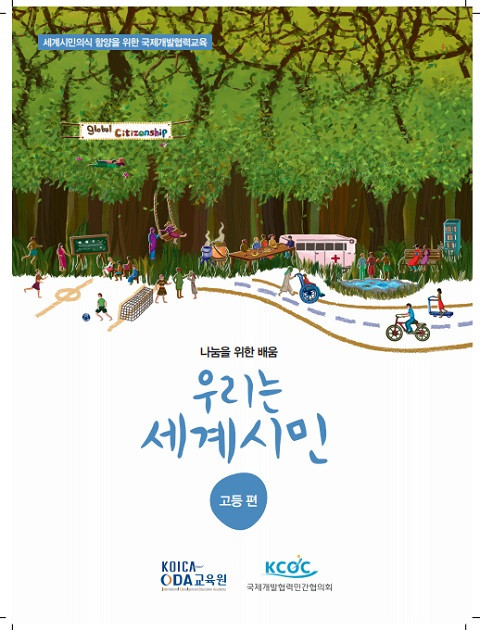 우리는 세계시민: 나눔을 위한 배움; 고등 편 Year of publication: 2013 Author: 고아라 | 고영주 | 김영미 | 성은경 | 홍지영 Corporate author: KOICA ODA 교육원 | 국제개발협력민간협의회 우리는 세계시민(고등편)은 상호연계성, 인권, 빈곤, 국제개발 진로 등을 주제로 한 세계시민교육 교사용 교수학습자료이다. 게임자료 및 선택활동이 포함되어 있다.
  Bank of Actions for Global Citizens Year of publication: 2020 Corporate author: Global Citizens Award The Bank of Actions guide can be used by anyone looking for creative inspiration to take action as global citizens. It is designed as a toolkit for engaging the public in global justice issues in meaningful ways that can help bring about positive change in our world.The Bank of Actions has been designed in the context of returned international volunteers participating in the Global Citizen Award programme.
  Thinkpiece: Are We Changing the World?; Reflections on Development Education, Activism and Social Change Year of publication: 2015 Author: Stephen McCloskey Corporate author: Centre for Global Education (CGE) This article has been published as part of a one year development education project delivered by the Centre for Global Education and funded by Trócaire. It aims to support reflection and debate on how development educators engage the public on international development issues. The article comes on the back of recent research, most notably Oxfam’s Finding Frames report, which suggests that the development sector is struggling to enhance and sustain citizenship engagement on the structural causes of poverty and inequality. The article probes some of the factors that may underpin this lack of engagement both within the development education sector specifically and the wider development sector more generally. It examines some of the challenges involved in engaging learners in actions on global issues. Some of these challenges relate to the sectors and environmental pressures in which development educators operate which can thwart in-depth engagement with learners.