
Resources
Explore a wide range of valuable resources on GCED to deepen your understanding and enhance your research, advocacy, teaching, and learning.
55 Results found
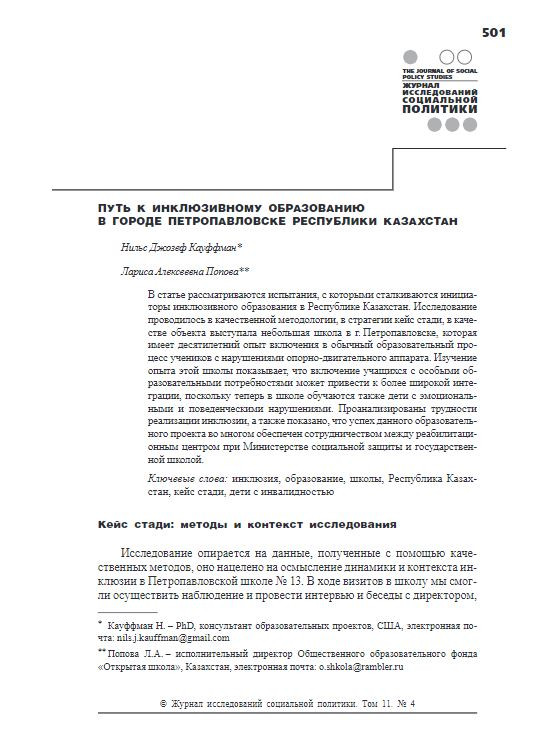 A Path to Inclusive Education in Petropavlovsk, Kazakhstan Year of publication: 2013 Author: Nils Joseph Kauffman | Larisa A. Popova The article examines the challenges faced by initiators of inclusive education in the Republic of Kazakhstan. The research was conducted in qualitative methodology, in a case study strategy, and the object was a small school in Petropavlovsk, which has ten years of experience in including students with motor disabilities in the regular educational process. The study of this school's experience shows that the inclusion of students with special educational needs can lead to broader integration, since children with emotional and behavioral disorders now also study at the school. The difficulties of implementing inclusion are analyzed, and it is shown that the success of this educational project is largely due to the cooperation between the rehabilitation center under the Ministry of Social Protection and the public school. Путь к инклюзивному образованию в городе Петропавловске Республики Казахстан Year of publication: 2013 Author: Nils Joseph Kauffman | Larisa A. Popova В статье рассматриваются испытания, с которыми сталкиваются инициаторы инклюзивного образования в Республике Казахстан. Исследование проводилось в качественной методологии, в стратегии кейс стади, в качестве объекта выступала небольшая школа в г. Петропавловске, которая имеет десятилетний опыт включения в обычный образовательный процесс учеников с нарушениями опорно-двигательного аппарата. Изучение опыта этой школы показывает, что включение учащихся с особыми образовательными потребностями может привести к более широкой интеграции, поскольку теперь в школе обучаются также дети с эмоциональными и поведенческими нарушениями. Проанализированы трудности реализации инклюзии, а также показано, что успех данного образовательного проекта во многом обеспечен сотрудничеством между реабилитационным центром при Министерстве социальной защиты и государственной школой.
 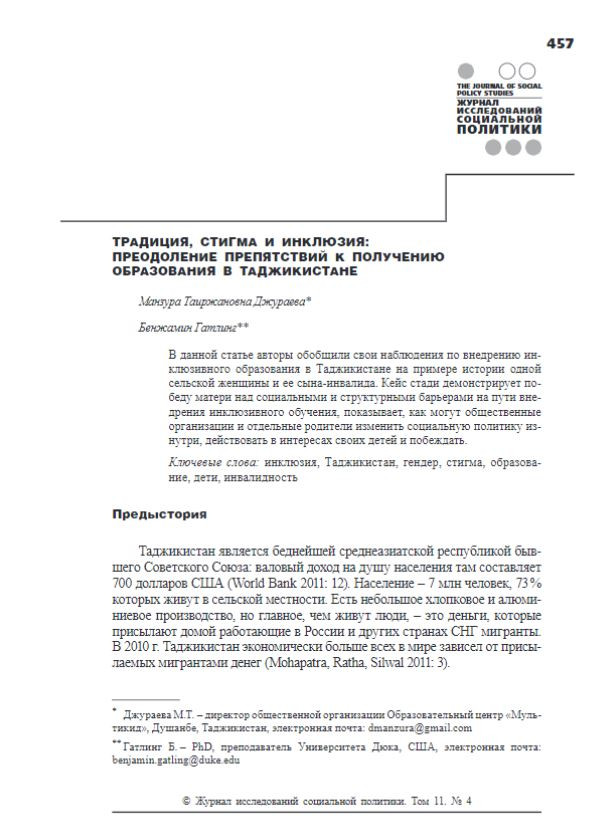 Tradition, Stigma and Inclusion: Overcoming Obstacles to Educational Access in Tajikistan Year of publication: 2013 Author: Manzura T. Juraeva | Benjamin Gatling In this article, the authors summarize their observations on the implementation of inclusive education in Tajikistan through the case study of a rural woman and her disabled son. The case study demonstrates a mother's victory over social and structural barriers to the implementation of inclusive education, and shows how community organizations and individual parents can change social policy from within, act in the best interests of their children, and win. Традиция, стигма и инклюзия: преодоление препятствий к получению образования в Таджикистане Year of publication: 2013 Author: Manzura T. Juraeva | Benjamin Gatling В данной статье авторы обобщили свои наблюдения по внедрению инклюзивного образования в Таджикистане на примере истории одной сельской женщины и ее сына-инвалида. Кейс стади демонстрирует победу матери над социальными и структурными барьерами на пути внедрения инклюзивного обучения, показывает, как могут общественные организации и отдельные родители изменить социальную политику изнутри, действовать в интересах своих детей и побеждать.
  Russian Language in Culture and Politics in Tajikistan (Language. Literature. Culture; no.2) Year of publication: 2011 Author: Usmonov Rustam Ahmadzhonovich Corporate author: Analitika RODIS The article is devoted to the role and place of the Russian language in modern Tajikistan. The history of relations between Russian and Tajik cultures The history of relations between the Russian and Tajik cultures in the linguistic dimension, the role of the Russian language in modernity, the peculiarities of The history of the relationship between Russian and Tajik cultures and the role of the Russian language in today's society are discussed. Русский язык в культуре и политике Таджикистана (Язык. Словесность. Культура; no.2) Year of publication: 2011 Author: Usmonov Rustam Ahmadzhonovich Corporate author: Analitika RODIS Статья посвящена роли и месту русского языка в современном Таджикистане. Рассмотрены история взаимоотношений русской и таджикской культур в языковом измерении, роль русского языка в современности, особенности законодательно закрепленного статуса русского языка.
 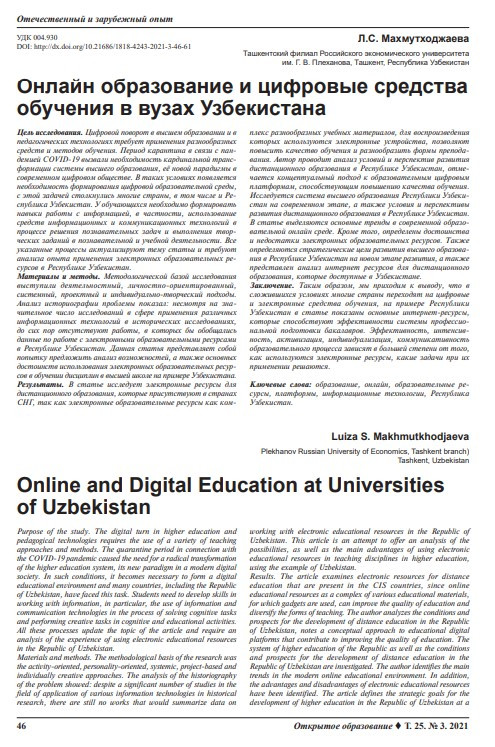 Online and Digital Education at Universities of Uzbekistan (Open Education; vol. 25, no. 3) Year of publication: 2021 Author: Makhmutkhodjaeva L.S. The quarantine period in connection with the COVID-19 pandemic caused the need for a radical transformation of the higher education system, its new paradigm in modern digital society. In such conditions, it becomes necessary to form a digital educational environment, and many countries, including the Republic of Uzbekistan, have faced this task. Students need to develop skills in working with information, in particular, the use of information and communication technologies in the process of solving cognitive tasks and performing creative tasks in cognitive and educational activities. Онлайн образование и цифровые средства обучения в вузах Узбекистана (Открытое образование; vol. 25, no.3) Year of publication: 2021 Author: Makhmutkhodjaeva L.S. Период карантина в связи с пандемией COVID-19 вызвали необходимость кардинальной трансформации системы высшего образования, её новой парадигмы в современном цифровом обществе. В таких условиях появляется необходимость формирования цифровой образовательной среды, с этой задачей столкнулись многие страны, в том числе и Республика Узбекистан. У обучающихся необходимо формировать навыки работы с информацией, в частности, использование средств информационных и коммуникационных технологий в процессе решения познавательных задач и выполнения творческих заданий в познавательной и учебной деятельности.
 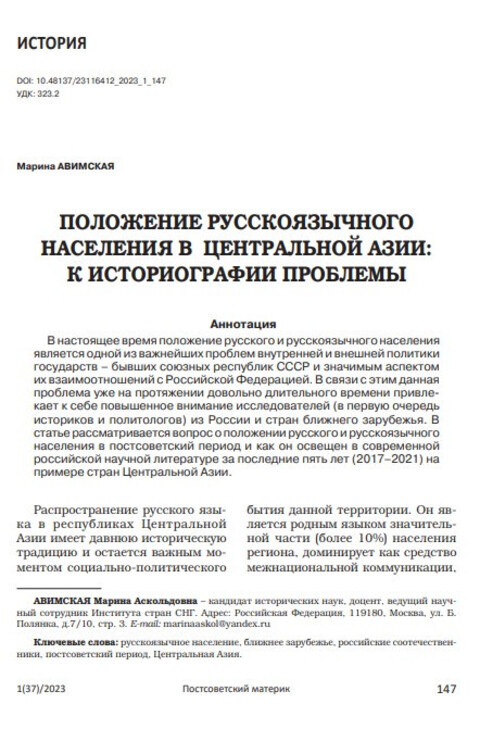 The Situation of the Russian Speaking Population in Central Asia: To the Historiography of the Problem (Post-Soviet Continent; Year of publication: 2023 Author: Марина Авимская Corporate author: ИНСТИТУТ СТРАН СНГ At present, the position of the Russian and Russian-speaking population is one of the most important problems in the domestic and foreign policy of the states - the former Soviet republics of the USSR and a significant aspect of their relationship with the Russian Federation. In this regard, this problem has been attracting increased attention of researchers (primarily historians and political scientists) from Russia and neighboring countries for quite a long time. The article deals with the issue of the situation of the Russian and Russian-speaking population in the post-Soviet period and how it is covered in modern Russian scientific literature over the past five years (2017–2021), using the example of the countries of Central Asia. Положение русскоязычного населения в Центральной Азии: к историографии проблемы (Постсоветский материк; Vol.1, No.37) Year of publication: 2023 Author: Марина Авимская Corporate author: ИНСТИТУТ СТРАН СНГ В настоящее время положение русского и русскоязычного населения является одной из важнейших проблем внутренней и внешней политики государств – бывших союзных республик СССР и значимым аспектом их взаимоотношений с Российской Федерацией. В связи с этим данная проблема уже на протяжении довольно длительного времени привлекает к себе повышенное внимание исследователей (в первую очередь историков и политологов) из России и стран ближнего зарубежья. В статье рассматривается вопрос о положении русского и русскоязычного населения в постсоветский период и как он освещен в современной российской научной литературе за последние пять лет (2017–2021) на примере стран Центральной Азии.