
Resources
Explore a wide range of valuable resources on GCED to deepen your understanding and enhance your research, advocacy, teaching, and learning.
63 Results found
 Conférence internationale: réorienter la politique de l'EFTP vers l'éducation pour le développement durable: rapport final Year of publication: 2010 Corporate author: UNESCO International Centre for Technical and Vocational Education and Training (UNEVOC) | Internationale Weiterbildung und Entwicklung | Colombo Plan Staff College for Technician Education Cette publication rend compte du programme EDD examen sensible et orienté vers l'avenir sur "Réorienter la politique d'EFTP vers l'éducation pour le développement durable», organisé conjointement par le Centre international UNESCO-UNEVOC à Bonn, Allemagne, InWEnt - Capacity Building International, Allemagne et Plan de Colombo Collège du personnel de l'éducation Technicien à Manille, Philippines. International conference: reorienting TVET policy towards education for sustainable development: final report Year of publication: 2010 Corporate author: UNESCO International Centre for Technical and Vocational Education and Training (UNEVOC) | Internationale Weiterbildung und Entwicklung | Colombo Plan Staff College for Technician Education This publication reports on the ESD review-responsive and future-oriented programme on “Reorienting TVET Policy Towards Education for Sustainable Development”, jointly organized by the UNESCO-UNEVOC International Centre in Bonn, Germany, InWEnt – Capacity Building International, Germany and Colombo Plan Staff College for Technician Education in Manila, Philippines.
  UNESCO-UNEVOC Medium-Term Strategy for 2021-2023: Strengthening TVET Capacities and Cooperation in the Member States Year of publication: 2020 Corporate author: UNESCO International Centre for Technical and Vocational Education and Training (UNEVOC) The Medium-Term Strategy for 2021-2023 (MTS-III) sets out how UNESCO-UNEVOC will support TVET institutions to meet the demands of dynamic labour markets and provide quality skills training for a sustainable future of work. MTS-III focuses on developing the capacities of TVET leaders, supporting TVET institutions in implementing change programmes, and facilitating knowledge sharing and peer learning within the UNEVOC Network.
  Media and Information Literacy: A Practical Guidebook for Trainers Year of publication: 2021 Author: Sylvia Braesel | Thorsten Karg Corporate author: DW Akademie Literacy is the ability to read and write. Media and information literacy (MIL) is the ability to understand how the media work and can be used to participate in public debate. MIL includes social media like Facebook, as well as traditional media like books, newspapers, radio and television.Media and information literacy - A practical guidebook for trainers provides MIL trainers with background information, training ideas, methods and worksheets. The book also provides sample training schedules to help you determine the length of time needed to teach individual aspects of media and information literacy.Download the Media and information literacy guidebook for trainers as well as the worksheets and guidelines.DW Akademie defines MIL as a composite of five core competencies:Access: The ability to find and access relevant media and information sources.Analyze: The ability to evaluate the credibility, accuracy and objectivity of media content, for example a news story.Create: The ability to create and produce media and information content, such as photos, texts, or videos.Reflect: The ability to think critically about media habits, experiences, trends, and technologies, and how they impact individuals and society.Act: The ability to use media to achieve specific goals, for example launching a social media campaign about health.Read more about DW Akademie's approach to Media and Information Literacy here.
  UNESCO-UNEVOC regional forum: advancing TVET for youth employability and sustainable development, Latin America and the Caribbean, 27-28 August 2013, San José, Costa Rica; meeting report Year of publication: 2013 Corporate author: UNESCO International Centre for Technical and Vocational Education and Training (UNEVOC) The Regional Forum of UNEVOC centres in Latin America and the Caribbean (LAC) presented in this report was one of a series of activities aiming to strengthen global and regional harmonization for the advancement of TVET transformation through the capacities of UNEVOC’s unique global network of specialized TVET institutions and affiliated partners, following the UNESCO Third International Congress on Technical and Vocational Education and Training (TVET) that took place in China in May 2012. The Forum also provided the opportunity to present evidence on the two priority thematic areas for UNESCO-UNEVOC for 2013, Youth and Skills and Greening TVET. This was achieved through the presentation and discussion of several promising practices in these two areas. UNESCO-UNEVOC forum régional: Promouvoir l'EFTP pour l'employabilité des jeunes et le développement durable, en Amérique latine et dans les Caraïbes, 27-28 Août 2013, San José, Costa Rica; rapport de la réunion Year of publication: 2013 Corporate author: UNESCO International Centre for Technical and Vocational Education and Training (UNEVOC) Le Forum régional des centres UNEVOC en Amérique latine et dans les Caraïbes (ALC), présenté dans le présent rapport fait partie d'une série d'activités visant à renforcer l'harmonisation mondiale et régionale pour la promotion de la transformation de l'EFTP à travers les capacités de réseau mondial unique de UNEVOC de l'EFTP spécialisée institutions et partenaires affiliés, suite à l'UNESCO Troisième Congrès international sur l'enseignement technique et professionnel et de la formation (EFTP) qui a eu lieu en Chine en mai 2012. le Forum a également été l'occasion de présenter des preuves sur les deux domaines thématiques prioritaires pour l'UNESCO-UNEVOC pour 2013, la jeunesse et les compétences et l'écologisation de l'EFTP. Ceci a été réalisé grâce à la présentation et à la discussion de plusieurs pratiques prometteuses dans ces deux domaines.
  التمييز على أساس الجنس.. هل المرأة هي الضحية دوماً؟ Year of publication: 2017 Corporate author: DW TV بعد سنوات طويلة من الصمت أقدمت ممثلات وعارضات أزياء شهيرات على كسر حاجز الخوف وكشفن عن انتهاكات المنتج الشهير هارفي واينستين بحقهن. هذه الفضيحة دفعت بمئات الآلاف من النساء إلى نشر قصصهن المؤلمة في شبكات التواصل. فأين يبدأ التمييز الجنسي؟ وما مدى تفشي هذه الظاهرة في الواقع؟ وهل المرأة هي دائماً الضحية؟ هذه الأسئلة يتم مناقشها في هذا البرنامج. Discrimination on the Basis of Sex.. Is the Woman Always the Victim? Year of publication: 2017 Corporate author: DW TV After many years of silence, famous actresses and models broke the barrier of fear and revealed the violations of the famous producer Harvey Weinstein against them. This scandal prompted hundreds of thousands of women to publish their painful stories in social networks. Where does gender discrimination begin? And how widespread is this phenomenon in reality? Is the woman always the victim? These questions are discussed in this program.
 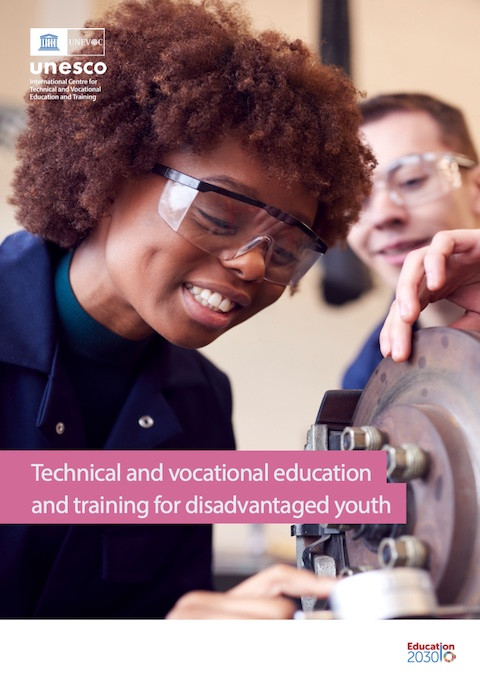 Technical and Vocational Education and Training for Disadvantaged Youth Year of publication: 2021 Corporate author: UNESCO International Centre for Technical and Vocational Education and Training (UNEVOC) Due to its close links to the labour market, technical and vocational education and training (TVET) can play an important role to improve job opportunities and livelihoods for young people, and in particular for disadvantaged youth. However, this potential is not always fully realized, and relatively little research and evidence has been collected about the barriers disadvantaged youth face when accessing to and progressing through TVET.This paper maps some of the main barriers disadvantaged youth face in TVET and examines available evidence on strategies and approaches that are being used or can be used to meet the needs of disadvantaged youth. The paper discusses these barriers using a framework that looks at ‘4As’: availability, accessibility, acceptability, and adaptability. The report is the outcome of a study conducted in collaboration with the University of Nottingham and other members of the UNEVOC Network.
  Education aux médias et à l’information: Un manuel pratique pour formateurs Year of publication: 2018 Author: Sylvia Braesel | Thorsten Karg Corporate author: DW Akademie Le mot anglais « literacy » désigne la capacité de lire et d’écrire. La « media and information literacy » (MIL en abrégé, alors qu’en français on utilise l’acronyme EMI, pour éducation aux médias et à l’information) est la capacité de comprendre comment les médias fonctionnent et comment ils peuvent être utilisés pour participer au débat public. L’EMI inclut les médias sociaux comme Facebook, ainsi que les médias traditionnels comme les livres, les journaux, la radio et la télévision.Education aux médias et à l’information – Un manuel pratique pour formateurs fournit aux formateurs en EMI des informations générales, ainsi que des idées, des méthodes et des feuilles de travail pour leurs formations. Le livre fournit également des exemples de plans de formation pour aider à déterminer le temps nécessaire pour aborder chaque aspect particulier de l’éducation aux médias et à l’information.