
Resources
Explore a wide range of valuable resources on GCED to deepen your understanding and enhance your research, advocacy, teaching, and learning.
124 Results found
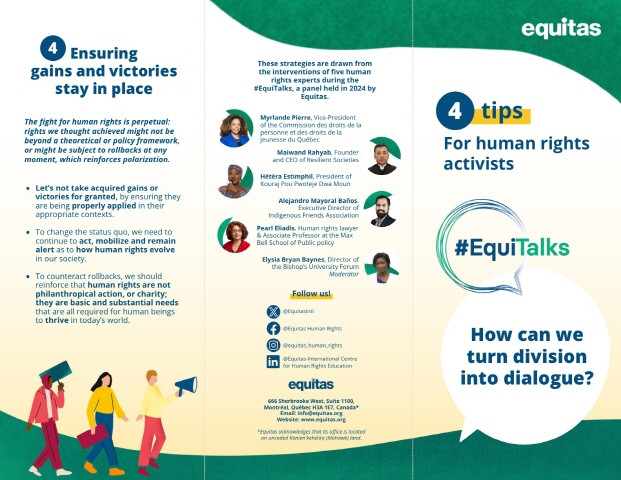 #EquiTalks: Comment transformer la division en dialogue ? Year of publication: 2024 Corporate author: Equitas Ce document rassemble les réponses de cinq défenseurs des droits humains lors du panel de discussion #EquiTalks en 2024, qui ont tenté de répondre à la question suivante : Comment transformer la division en dialogue? Le dépliant offre des pistes de solution et des conseils pour contrer la polarisation des opinions sur les droits humains.
 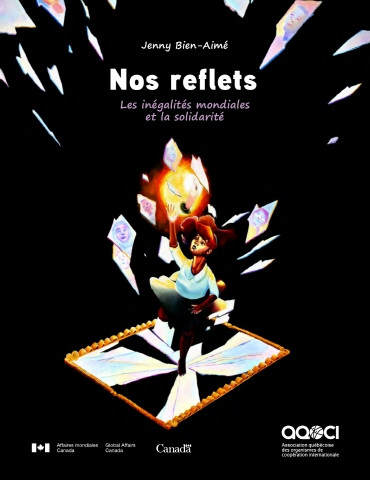 Our Reflections: Global Inequality and Solidarity Year of publication: 2022 Author: Jenny Bien-Aimé Corporate author: Quebec Association of International Cooperation Organizations (AQOCI) In 2022, the SDI took place from February 6 to 12, and the member organizations of AQOCI chose the theme "In the context of the COVID-19 pandemic: calling for the co-construction of a just and united world."With this theme, the public was invited to discuss the persistent global inequalities and injustices and to explore solutions for making our world more just, united, and equitable.For the occasion, the comic book Nos Reflets was created by the artist Jenny Bien-Aimée. Nos reflets: Les inégalités mondiales et la solidarité Year of publication: 2022 Author: Jenny Bien-Aimé Corporate author: Association québécoise des organismes de coopération internationale (AQOCI) En 2022, la SDI s'est déroulée du 6 au 12 février et les organismes membres de l’AQOCI ont choisi comme thématique « Dans le contexte de pandémie de COVID-19 : appeler à la coconstruction d’un monde juste et solidaire ».Avec cette thématique, le public a été convié à échanger sur les inégalités et les injustices persistantes à l’échelle mondiale et à discuter des solutions pour rendre notre monde plus juste, solidaire et équitable.Pour l'occasion, la bande dessinée Nos Reflets a été produite par l'artiste Jenny Bien-Aimée.
  Guidelines for Data Collection to Measure SDG 4.7.4 and 4.7.5 Year of publication: 2021 Author: Andres Sandoval-Hernandez | Maria Magdalena Isac | Diego Carrasco | Daniel Miranda Corporate author: UNESCO Institute for Statistics (UIS) This document provides guidance to apply a recently developed strategy to assess two indicators that embody tolerance, respect and sustainable development, namely:Indicator 4.7.4: Percentage of students in lower secondary education showing adequate understanding of issues relating to global citizenship and sustainabilityIndicator 4.7.5: Percentage of students in lower secondary education showing proficiency in knowledge of environmental science and geoscienceFollowing a thorough review and endorsement by the UIS’ Technical Cooperation Group on the Indicators for SDG 4-Education 2030 (TCG), the measurement strategy has since been applied to the last cycles of TIMSS, PISA and ICCS to produce scores to measure Indicators 4.7.4 and 4.7.5 for 60 countries. While this marks a significant achievement, it is important to acknowledge that two- thirds of UN members have yet to participate in these assessments. To promote wider participation among UN members, this document serves as a robust and easy-to-use set of guidelines offering detailed technical guidance for countries on how to collect the data necessary to produce the information to measure and monitor SDG Indicators 4.7.4 and 4.7.5. Notably, these guidelines will aid in the production of information that is comparable with that of the 60 countries for which this data already exists.
 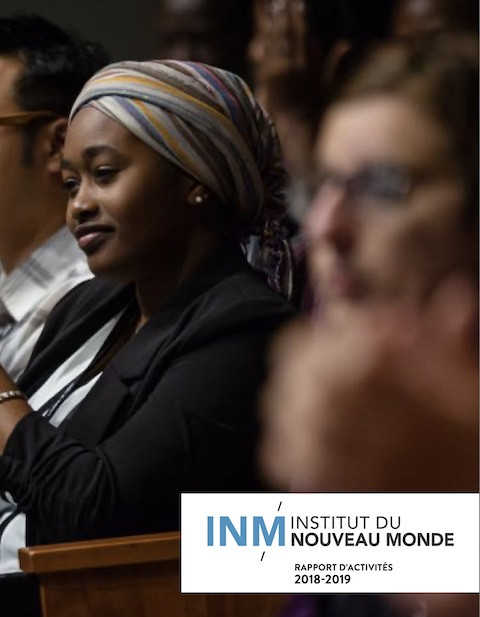 Institut du Nouveau Monde (INM): Rapport d'activités 2018-2019 Year of publication: 2019 Corporate author: Institut du Nouveau Monde (INM) Le 15e anniversaire de l’INM a été une année très occupée. L’équipe à mis la main à la pâte afin de permettre à plus de 20 200 citoyennes et citoyens d’être consultés et de participer à l’une des 266 activités auxquelles l’INM a contribué. En pleine année électorale provinciale et à l’approche des élections fédérale, les activités de l’INM présentées dans ce bilan soutiennent, plus que jamais, que la participation citoyenne renforce la démocratie.
  Media Education and Citizenship: An Analysis of the Quebec Preschool and Elementary Education Program (No. 80) Year of publication: 2018 Author: Normand Landry | Chantal Roussel Corporate author: Lien social et Politiques In Canada, the limited level of knowledge on media education content that is conveyed by academic curricula hinders its critical evaluation. This article presents the ways in which media education is introduced in the Quebec Education Program (QEP) at the preschool and elementary level. More specifically, it highlights the connections at work between media education, childhood and citizenship in the program. Our method tracks and extracts a set of statements related to information and communications technologies (ICTs) and the media, then conducts their automated classification into four principal categories: speech, verbs used that reflect the actions undertaken by categories of actors (school, pupils, teachers), learning objectives and suggestions. A subsequent classification allows for the emergence of verbs and learning objectives associated to the notion of citizenship. The latter are then subject to speech analysis. Our analysis intends to demonstrate the message conveyed by the QEP on media and ICTs. It highlights the roles, tasks and responsibilities of its various actors in relation to the acquisition of knowledge and skill development. In addition, it features the actions taken by these actors to operationalize the academic goals of the program. Our conclusion indicates a low subject implementation of the statements associated to media education and citizenship, relevant content, although thematically limited, along with the conception of students as capable of a reflection and critical thinking process. Articuler éducation aux médias et citoyenneté : Une analyse du Programme de formation de l’école québécoise préscolaire-primaire (nº 80) Year of publication: 2018 Author: Normand Landry | Chantal Roussel Corporate author: Lien social et Politiques Au Canada, le faible niveau de connaissance des contenus en éducation aux médias véhiculés par les curricula scolaires proscrit leur évaluation critique. Cet article présente les façons selon lesquelles l’éducation aux médias est introduite dans le Programme de formation de l’école québécoise (PFEQ) des niveaux préscolaire et primaire. Plus spécifiquement, il témoigne des articulations entre éducation aux médias, enfance et citoyenneté. La méthode utilisée procède au repérage et à l’extraction d’énoncés associés aux technologies de l’information et de la communication (TIC) et aux médias, puis à leur classement en quatre catégories principales : discours, verbes témoignant des actions de chaque catégorie d’acteurs (école, élève, enseignant), objets d’apprentissage et suggestions d’utilisation des TIC. Une classification permet de faire émerger les verbes et les objets d’apprentissage référant à la notion de citoyenneté en utilisant la définition et les composantes associées. Ces derniers sont ensuite soumis à une analyse de discours. Notre analyse fait émerger les discours véhiculés par le PFEQ sur les médias et les TIC. Elle met en exergue les rôles, les tâches et les responsabilités des différents acteurs en lien avec l’acquisition de connaissances et le développement de compétences. En outre, elle présente les actions menées par ces acteurs afin d’opérationnaliser les intentions pédagogiques du programme. La conclusion montre un faible ancrage disciplinaire des énoncés traitant de l’éducation aux médias et à la citoyenneté, des contenus pertinents, mais limités thématiquement, ainsi qu’une représentation de l’élève en tant qu’individu capable de réflexion et de pensée critique.
  Citizen Participation and Participatory Research in the Field of Social Inequalities (Nouvelles pratiques sociales; vol. 30, no. 1) Year of publication: 2018 Author: Baptiste Godrie | Guillaume Ouellet | Robert Bastien | Sylvia Bissonnette | Jean Gagné | Luc Gaudet | Audrey Gonin | Isabelle Laurin | Chrisopher McAll | Geneviève McClure | François Régimbal | Jean-François René | Mireille Tremblay Corporate author: University of Quebec at Montreal This article analyzes the effect of citizen participation on social inequalities, based on research conducted by a multidisciplinary team of researchers and community partners. Citizen participation may ensure comments and knowledge that have been completely or partially left out of the public space to emerge, and can help participants to get rid of a pre-established look towards people living in poverty. The analysis also focuses on power relations build during participatory research processes. Participation citoyenne et recherches participatives dans le champ des inégalités sociales (Nouvelles pratiques sociales; vol. 30, no. 1) Year of publication: 2018 Author: Baptiste Godrie | Guillaume Ouellet | Robert Bastien | Sylvia Bissonnette | Jean Gagné | Luc Gaudet | Audrey Gonin | Isabelle Laurin | Chrisopher McAll | Geneviève McClure | François Régimbal | Jean-François René | Mireille Tremblay Corporate author: University of Quebec at Montreal Cet article analyse les effets de processus de participation citoyenne sur les inégalités sociales à partir de projets de recherche réalisés par les auteurs de l’article, membres d’une équipe multidisciplinaire composée de chercheurs et de partenaires issus de la communauté. La participation citoyenne peut avoir pour effet de lutter contre les inégalités sociales, en particulier d’accès à la parole des groupes les plus exclus, et de conduire les différents participants à se défaire d’un regard préétabli vis-à-vis des populations en situation de pauvreté. L’analyse met également l’accent sur les rapports de pouvoir au cœur des processus participatifs de recherche.
  Rapport de la tournée de consultations autonomes des membres du ROCAJQ dans le cadre des Journées de la jeunesse Year of publication: 2020 Corporate author: Regroupement des organismes communautaires autonomes jeunesse du Québec (ROCAJQ) Véritable levier pour l’action communautaire autonome jeunesse, le Regroupement des organismes communautaires autonomes jeunesse du Québec (ROCAJQ) défend et représente les intérêts de ses quelque 65 membres qui à eux seuls rejoignent chaque année près de 300000 jeunes aux parcours de vie différenciés. Depuis 1991, nous soutenons les organismes qui travaillent en approche globale auprès des jeunes de 12 à 35 ans. Notre mission est de reconnaître le potentiel des jeunes aux parcours de vie différenciés et de porter leurs voix et celles des organismes qui les accompagnent auprès de la population et des instances publiques. Répartis dans 9 régions du Québec, nos membres ont des pratiques diversifiées et complémentaires. Contexte Le ROCAJQ est fier de participer aux consultations du gouvernement dans le cadre du renouvellement de la stratégie jeunesse du Québec et plus particulièrement, de son plan d’action. Trois consultations locales, à Montréal, à Québec et au Saguenay, ont été réalisées dans le but de prendre le pouls de nos membres afin de refléter le plus fidèlement possible leurs enjeux et ceux des jeunes qui les fréquentent. La diversité de pratiques et l’enracinement dans leur communautéet les particularités de celles-ci sont ainsi mis davantage en évidence, ce qui démontre un réseau fort d’un très grand champ d’action pour rejoindre les jeunes aux parcours de vie diversifiés. Nous sommes convaincus que la stratégie jeunesse est l’outil nécessaire pour relever les défis qui attendent ces jeunes au cours des prochaines années. Cependant, nos membres sont d’avis que celle-ci, dans sa forme actuelle, ne s’adresse pas et ne rejoint pas suffisamment les jeunes aux parcours de vie différenciés.En effet, plutôt que de s’attarder aux actions à poser pour assurer une égalité des chances à tous les jeunes, la stratégie semble se concentrer davantage sur les jeunes dont le cheminement est plus typique. Les intervenants des organismes membres du ROCAJQ ont précisé que les enjeux et besoins des jeunes vont au-delà des sept axes tels que proposés dans la stratégie et que, pour y répondre adéquatement, il faut garder en tête les besoins de base de la pyramide de Maslow, à savoir se loger, se nourrir et s’épanouir dans un milieu sécuritaire.De plus, la présentation actuelle ne semble pas inclure suffisamment les jeunes de la diversité ou marginalisés issus de la diversité LGBTQ+,desminorités visibles ni les jeunesvivant avec un handicap. Elle n’est pas présentée et expliquée d’une façon inclusive et les membres du ROCAJQ croient que des ajustements majeurs sont nécessaires. Au ROCAJQ, nous croyons que cette responsabilité doit être partagée, et une co-construction entre les jeunes issus de toutes les sphères socio-économiques et le gouvernement serait de mise. Les organismes membres ont tous d’abord consulté les jeunes qu’ils rejoignent avant de participer aux consultations organisées par le ROCAJQ. Heureux de faire partie des partenaires de choix du gouvernement, nous sommes persuadés qu’ensemble nous pourrons ajuster la stratégie et le nouveau plan d’action de la Politique jeunesse, afin de nous assurer que tous les jeunes, même les plus vulnérables, s’y retrouvent à titre égal et que celle-ci répondeà leurs préoccupations et réalités.