
Resources
Explore a wide range of valuable resources on GCED to deepen your understanding and enhance your research, advocacy, teaching, and learning.
306 Results found
 The Role of Education in Countering Violent Extremism Year of publication: 2013 Corporate author: Center on Global Counterterrorism Cooperation and Hedayah On 18 and 19 September 2013, the Center on Global Counterterrorism Cooperation (CGCC) and Hedayah co-hosted in New York City an expert roundtable on “The Role of Education in Countering Violent Extremism.” The meeting brought together a group of policy-makers, researchers and practitioners to discuss challenges and best practices related to efforts to counter violent extremism through education. The Role of Education in Countering Violent Extremism Year of publication: 2013 Corporate author: Center on Global Counterterrorism Cooperation and Hedayah Les 19 et 20 septembre 2013, le Centre de coopération internationale pour la lutte contre le terrorisme (Center on Global Counterterrorism Cooperation, CGCC) et Hedayah ont accueilli une table ronde d'experts, à New York, sur « le rôle de l'éducation pour lutter contre l'extrémisme violent » (The Role of Edcuation in Countering Violent Extremism). Cet événement a réuni des décideurs politiques, des chercheurs et des praticiens afin de discuter des défis et des meilleures pratiques dans les efforts réalisés pour lutter contre l'extrémisme violent par l'éducation.
 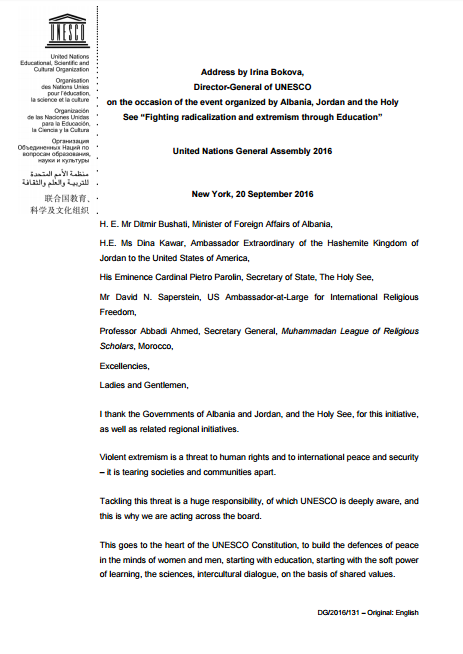 Address by Irina Bokova, Director-General of UNESCO, on the occasion of the event organized by Albania, Jordan and the Holy See: Fighting radicalization and extremism through Education; United Nations General Assembly 2016; New York, 20 September 2016 Year of publication: 2016 Corporate author: UNESCO. Director-General, 2009-2017 (Bokova, I.G.) This address was presented by Irina Bokova, Director-General of UNESCO, on the occasion of the event organized by Albania, Jordan and the Holy See.
  Address by Irina Bokova, Director-General of UNESCO, on the occasion of Senior Official Meeting on the Role of Education and Countering Violent Extremism organized by the International Centre of Excellence for Countering Violent Extremism (Hedayah) Year of publication: 2013 Corporate author: UNESCO. Director-General, 2009-2017 (Bokova, I.G.) This address was presented by Irina Bokova, Director-General of UNESCO, on the occasion of Senior Official Meeting on the Role of Education and Countering Violent Extremism organized by the International Centre of Excellence for Countering Violent Extremism (Hedayah). Address by Irina Bokova, Director-General of UNESCO, on the occasion of Senior Official Meeting on the Role of Education and Countering Violent Extremism organized by the International Centre of Excellence for Countering Violent Extremism (Hedayah) Year of publication: 2013 Corporate author: UNESCO. Director-General, 2009-2017 (Bokova, I.G.) Cette adresse a été présentée par Irina Bokova, Directrice générale de l'UNESCO, à l'occasion de la Réunion des Hauts Fonctionnaires sur le Rôle de l'Éducation et de la Lutte contre l'Extrémisme Violent organisé par le Centre International d'Excellence pour la Lutte contre l'Extrémisme Violent (Hedayah). 폭력적 극단주의(Hedayah) 대응을 위한 국제우수연구센터(International Centre of Excellence)가 주최한 ‘교육의 역할과 폭력적 극단주의의 대응’ 고위급 회의에서 이리나 보코바 유네스코 사무총장의 연설. 2013년 9월 25일, 뉴욕. Year of publication: 2013 Corporate author: UNESCO. Director-General, 2009-2017 (Bokova, I.G.) 이 연설은 폭력적 극단주의(Hedayah)에 대응하기 위한 국제우수연구센터(International Centre of Excellence)가 주최한 ‘교육의 역할과 폭력적 극단주의의 대응’에 관한 고위급 회의에서 이리나 보코바 유네스코 사무총장이 발표한 것이다. Address by Irina Bokova, Director-General of UNESCO, on the occasion of Seminar on Global Citizenship Education, UNHQ; New York, 6 March 2015 Year of publication: 2015 Corporate author: UNESCO. Director-General, 2009-2017 (Bokova, I.G.) This document is an address by Irina Bokova, Director-General of UNESCO on the occasion of "Seminar on Global Citizenship Education" in New York, 6 March 2015. She highlights the importance of GCED for education in the 21st century.
  Beyond COVID-19: A Feminist Plan for Sustainability and Social Justice Year of publication: 2021 Corporate author: United Nations Entity for Gender Equality and the Empowerment of Women (UN Women) As the world learns to live with COVID-19, to emerge from the current crisis, and to “build back better”, UN Women’s new Feminist Plan for Sustainability and Social Justice is a visionary but practical roadmap for putting gender equality, social justice, and sustainability at the centre of the recovery. The Feminist Plan maps the ambitious and transformative policies – on livelihoods, care, and the environment – that are needed to build a more equal and sustainable future. To get there, calls for context-specific policy pathways, tailored political strategies, and financing. The plan identifies key levers that can create change and the actors at global, national, local levels that need to take action to move towards this vision. Au-delà du COVID-19 : Un plan féministe de durabilité et de justice sociale Year of publication: 2021 Corporate author: United Nations Entity for Gender Equality and the Empowerment of Women (UN Women) Alors que le monde apprend à vivre avec le COVID-19, à « reconstruire en mieux » et est mobilisé pour sortir de la crise actuelle, le nouveau « Plan féministe » d’ONU Femmes fournit une feuille de route visionnaire mais concrète visant à placer l’égalité des sexes, la justice sociale et la durabilité au centre de la relance. Le « Plan féministe » cartographie les politiques ambitieuses et transformatrices relatives aux moyens de subsistance, aux soins et à l'environnement qui sont nécessaires pour construire un avenir plus équitable et durable. Pour y parvenir, il appelle à des approches politiques spécifiques au contexte, à des stratégies politiques adaptées et à un financement. Le plan identifie les leviers clés qui peuvent créer un changement ainsi que les actrices et acteurs aux niveaux mondial, national et local qui doivent prendre des mesures pour avancer vers cette vision. Más allá del COVID-19: un plan feminista para la sostenibilidad y la justicia social Year of publication: 2021 Corporate author: United Nations Entity for Gender Equality and the Empowerment of Women (UN Women) En un momento en que el mundo está aprendiendo a vivir con el COVID-19, y busca emerger de la crisis actual y “construir mejor”, el nuevo “Plan feminista” de ONU Mujeres ofrece una hoja de ruta visionaria y práctica para poner la igualdad de género, la justicia social y la sostenibilidad en el centro de la recuperación. En el “Plan feminista” se hace un recuento de las políticas ambiciosas y transformadoras en torno a los medios de vida, los cuidados y el medio ambiente que se necesitan para construir un futuro más igualitario y sostenible. Para llegar ahí, el documento hace un llamado a que se avance en políticas específicas para distintos contextos, estrategias políticas adaptadas y un financiamiento adecuado. Asimismo, se identifican los instrumentos clave que pueden generar el cambio y a los actores que necesitan entrar en acción a los niveles global, nacional y local para poder avanzar hacia esta aspiración.