
Resources
Explore a wide range of valuable resources on GCED to deepen your understanding and enhance your research, advocacy, teaching, and learning.
130 Results found
 Educación Integral de la Sexualidad: Conceptos, Enfoques y Competencias Year of publication: 2014 Corporate author: UNESCO Santiago El objetivo de este documento es comprender que la sexualidad es parte integral de la vida de las personas (en sus diferentes etapas o edades, y en toda su diversidad), y que contribuye al desarrollo de su identidad y por lo tanto, a su desarrollo social. Se trata de capacidades más que de contenidos, las que deben desarrollarse en forma interdisciplinaria y de manera progresiva para que las personas actúen de forma responsable respecto a ellas mismas y con los demás. El documento explica que la educación de la sexualidad está íntimamente relacionada con la comprensión, la reflexión y el discernimiento, y fortalece las bases para el aprendizaje a lo largo de la vida, preparando a los jóvenes para la vida adulta. Es así que el enfoque se centra en alcanzar un desarrollo y bienestar humano sostenible.
 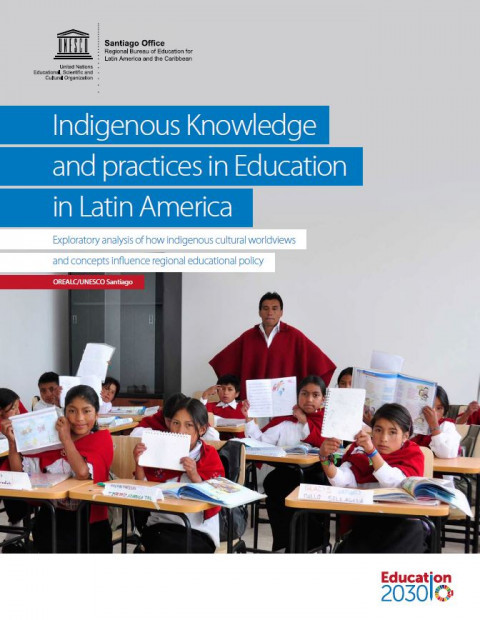 Indigenous Knowledge and practices in Education in Latin America: Exploratory Analysis of How Indigenous Cultural Worldviews and Concepts Influence Regional Educational Policy Year of publication: 2017 Corporate author: UNESCO Santiago This study presents a preliminary exploration of the approaches, processes and tools through which indigenous worldviews and concepts of knowledge and well-being can and have influenced education policies in Latin America. First, it addresses the principal theoretical approaches used in the area of indigenous knowledge and education policies, taking into account the persistence of an “epistemic otherness” and the need for a dialogue between the predominant approaches. Second, it addresses the normative framework and intercultural educational policies, emphasizing how and to what extent the countries in the region take indigenous knowledge into consideration and include it in their education policies and practices. Third, it presents a number of “relevant practices” in terms of dialogue with indigenous knowledge in education policies, taking into account the factors that favour the relevance of education to indigenous views and cultural practices, facilitating their replicability and sustainability. Furthermore, these practices respond to key criteria like recognizing learners as ‘carriers’ and producers of culture, valuing the use of schools as centres of social and cultural activities and favouring the inclusive learning of indigenous and non-indigenous students. Finally, the study unveils challenges for the advancement of the dialogue between indigenous knowledge and education policies, at the same time proposing key concepts to be approached in depth. Conocimiento Indígena y Políticas Educativas en América Latina: Análisis exploratorio de cómo las cosmovisiones y conceptos culturales indígenas de conocimiento inciden, y pueden incidir, en la política educativa en la región Year of publication: 2017 Corporate author: UNESCO Santiago El presente estudio explora la idea de una ‘alternativa epistémica’, construyendo desde el conocimiento y los valores que sustentan las prácticas sociales y educacionales indígenas de la región. En particular, explora cómo estos valores y formas de conocimiento han sido adoptados en las políticas educacionales de tres países de la región andina: Bolivia, Ecuador y Perú, que hace poco atravesaron reformas políticas y constitucionales con el fin de reconocer la composición de sus poblaciones multiculturales, multiétnicas y multilingüísticas. Esta publicación es una invitación a considerar el conocimiento indígena como una fuente legítima de inspiración para las políticas educacionales que puedan contribuir al bienestar de todos y a la sostenibilidad del planeta. Integral Education of Sexuality: Concepts, Approaches and Competencies Year of publication: 2014 Corporate author: UNESCO Santiago The objective of this document is to understand that sexuality is an integral part of people's lives (in their different stages or ages, and in all their diversity), and that it contributes to the development of their identity and, therefore, to their development Social. It is about capacities rather than content, which must be developed in an interdisciplinary way and progressively so that people act responsibly towards themselves and with others. The document explains that the education of sexuality is closely related to understanding, reflection and discernment, and strengthens the bases for lifelong learning, preparing young people for adult life. Thus, the focus is on achieving sustainable human development and well-being.
  Participatory Planning to Achieve Structural Change with Equality: Citizen Participation Strategies in Multi-scale Planning Processes Year of publication: 2015 Author: Alicia Williner | Andrea Sanhueza | Carlos Sandoval Corporate author: United Nations (UN) This manual that ILPES places at the disposal of public officials and non-governmental agents working in the community, has the purpose of sharing a brief theoretical reflection on the current socio-political context through which this manual becomes important; and a set of methodological instruments that will bring the user closer to the social practice of a citizen participation process in the construction of a public management instrument. The manual is divided into two chapters: The first conceptualizes participatory multiscale planning, while also briefly introducing three topics of great importance to be incorporated into any participatory planning process and construction of public management instruments: the perspective of gender, the use of Convention 169 and Principle 10. The second chapter systematizes a set of methodological instruments that describe the stages of a citizen participation strategy to incorporate the multiscale public management instruments. The manual closes with two annexes, the last of which incorporates a set of tools that can be used in the stages of the construction of a citizen participation strategy. La Planificación Participativa para Lograr un Cambio Estructural Con igualdad: Las Estrategias de Participación Ciudadana en los Procesos de Planificación Multiescalar Year of publication: 2015 Author: Alicia Williner | Andrea Sanhueza | Carlos Sandoval Corporate author: United Nations (UN) Este manual que ILPES coloca a disposición de funcionarios públicos y agentes no gubernamentales que trabajan en la comunidad, tiene el propósito de compartir una breve reflexión teórica sobre el contexto socio-político actual por el cual este manual cobra importancia; y un conjunto de instrumentos metodológicos que acercarán al usuario a la práctica social de un proceso de participación ciudadana en la construcción de un instrumento de gestión pública. El manual se estructura en dos capítulos: El primero de ellos conceptualiza la planificación multiescalar participativa, a la vez que realiza una breve introducción a tres temas de suma relevancia a incorporar en todo proceso de planificación participativa y construcción de instrumentos de gestión pública: la perspectiva de género, el uso del Convenio 169 y del Principio 10. El segundo capítulo sistematiza un conjunto de instrumentos metodológicos que describen las etapas de una estrategia de participación ciudadana para incorporar a los instrumentos de gestión pública multiescalar. El manual cierra con dos anexos, el último de los cuales incorpora un conjunto de herramientas que podrán ser utilizadas en las etapas de la construcción de una estrategia de participación ciudadana.
  Education, Development and Citizenship in Latin America: Proposals for the Debate Year of publication: 2011 Author: Alicia Barcena | Narcis Serra Corporate author: Naciones Unidas. Comisión Económica para América Latina y el Caribe (CEPAL) | Centro de Estudios y Documentación Internacionales de Barcelona (CIDOB) Through ADI, an initiative promoted by CIDOB, the Ibero-American General Secretariat (SEGIB) and the Economic Commission for Latin America and the Caribbean (ECLAC), with the support of various sponsoring companies, it is intended to encourage academic debate along with the political debate on diverse issues crucial for the region. Through a rigorous analysis of the social, economic and political reality carried out by academics, public policymakers and other key actors in the development process in Latin America, the aim is to offer recommendations that make economic growth compatible with well-being of the majorities. This publication constitutes the fifth volume of the series and is the result of the willingness of the participating institutions to disseminate, as much as possible, the ideas and discussions that emerged in the seminar. Its reading is a fundamental element to understand the current state of education in the region, as well as the possibilities that exist in this area to continue advancing in inclusion and development. Educación, Desarrollo y Ciudadanía en América Latina: Propuestas para el Debate Year of publication: 2011 Author: Alicia Barcena | Narcis Serra Corporate author: Naciones Unidas. Comisión Económica para América Latina y el Caribe (CEPAL) | Centro de Estudios y Documentación Internacionales de Barcelona (CIDOB) Mediante la ADI, iniciativa impulsada por CIDOB, la Secretaría General Iberoamericana (SEGIB) y la Comisión Económica para América Latina y el Caribe (CEPAL), con el apoyo de diversas empresas patrocinadoras, se pretende alentar el debate académico junto con el debate político en diversos temas cruciales para la región. A través del análisis riguroso de la realidad social, económica y política realizado por los académicos, los encargados de formular políticas públicas y otros actores clave en el proceso de desarrollo de América Latina, se pretende ofrecer recomendaciones que hagan compatible el crecimiento económico y el bienestar de las mayorías. Esta publicación constituye el quinto volumen de la serie y es fruto de la voluntad de las instituciones participantes de difundir, en la mayor medida posible, las ideas y discusiones surgidas en el seminario. Su lectura supone un elemento fundamental para comprender el estado actual de la educación en la región, así como las posibilidades que existen en este ámbito para seguir avanzando en la inclusión y el desarrollo.
 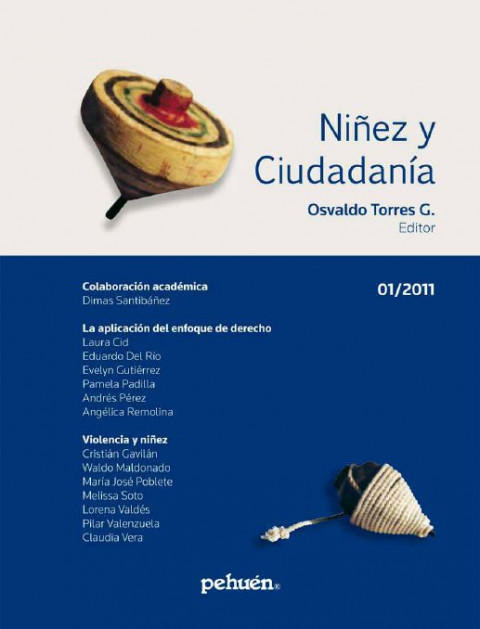 Childhood and Citizenship Year of publication: 2011 Author: Osvaldo Torre G. This publication, Niñez y Ciudadanía, is an effort of the Postgraduate Diploma, "Childhood and Public Policies", taught by the Department of Anthropology of the Faculty of Social Sciences of the University of Chile. This course has been held for 5 years, in partnership with the Chilean Association for the United Nations, ACHNU. This first publication presents a selection of those works developed by students graduated from the Diploma in 2010, in which a subject of interest for the researcher is tested and on which a rights approach is applied, which tends to evaluate the situation of the boys and girls in a different way than traditional childhood views; these works are the product of their dissertations to approve this post-title. Also included are some brief essays on the relationship between childhood and violence, elaborated by some of the students of the 2011 generation, in the idea of making available to the interested public a sample of the different forms that acquire the uses of violence on children. It also incorporates a collaboration requested to the anthropologist Dimas Santibáñez, member of the Academic Committee of the Diploma. Niñez y Ciudadanía Year of publication: 2011 Author: Osvaldo Torre G. Esta publicación, Niñez y Ciudadanía, es un esfuerzo del Diplomado de postítulo, “Niñez y Políticas Públicas”, que imparte el Departamento de Antropología de la Facultad de Ciencias Sociales de la Universidad de Chile. Este curso se realiza desde hace 5 años, en alianza con la Asociación Chilena pro Naciones Unidas, ACHNU. Esta primera publicación presenta una selección de aquellos trabajos desarrollados por estudiantes egresados del Diplomado en el año 2010, en los cuales se ensaya un tema de interés para el investigador y sobre el cual aplica un enfoque de derechos, que tiende a evaluar la situación de los niños y niñas de una forma distinta a como lo hacen las miradas tradicionales sobre la infancia; estos trabajos son el producto de sus tesinas para aprobar este postítulo. También se incluyen algunos breves ensayos sobre la relación entre la niñez y la violencia, elaborados por algunos de los y las estudiantes de la generación 2011, en la idea de poner a disposición del público interesado una muestra de las diversas formas que adquieren los usos de la violencia sobre los niños. También se incorpora una colaboración solicitada al antropólogo Dimas Santibáñez, miembro del Comité Académico del Diplomado.