
Resources
Explore a wide range of valuable resources on GCED to deepen your understanding and enhance your research, advocacy, teaching, and learning.
27 Results found
 The Impact of Short-term Study Abroad on Global Citizenship Identity and Engagement (Journal of Global Citizenship & Equity Education; Vol. 7, No. 1) Year of publication: 2020 Author: Paul Sherman | Brianna Cofield | Neve Connolly Corporate author: Centennial College Higher education has increasingly realized the importance of engaging students in global citizenship learning opportunities to be more globally informed, prepared, responsible, and competent. Study abroad in higher education is rapidly becoming recognized as an effective experiential learning platform for fostering intercultural exchanges. This article reports on research that examined study abroad as a learning platform for integrating classroom-acquired knowledge with real-world experience. The study explored the value of short-term study abroad in the facilitation of students’ global awareness and knowledge, their identification as global citizens and endorsement of prosocial values associated with global citizenship, and their participation as globally engaged citizens. Participation in study abroad was found to significantly strengthen one’s affiliation with global citizenship, endorsement of prosocial values and motivation to engage in global citizenship activities. Our findings have implications for the design and implementation of global citizenship education curricula in higher education.
  Ensuring Inclusive and Equitable Quality Education: Sustainable Development Goal 4 in Canada Year of publication: 2020 Corporate author: Council of Ministers of Education, Canada (CMEC) This report provides a framework to share information at the pan-Canadian and international levels on work underway in Canada to achieve SDG 4. The report builds on SDG 4 data and indicators and includes, where possible, provincial and territorial data.
  The Role of English in Global Citizenship (Journal of Global Citizenship & Equity Education; Vol. 7, No. 1) Year of publication: 2020 Author: Claire Cavanagh Corporate author: Centennial College Despite scholars’ attempts to define and conceptualise global citizenship, the literature tends to ignore the role of English as the global lingua franca. In this paper, the author argues that ignoring English as the global lingua franca is a gross oversight, particularly in internationalised higher education where global citizenship is often presented as an aspiration for students. Websites of two South Korean universities were analysed regarding how the respective institutions intend to develop global citizens. Twenty students enrolled in the universities participated in interviews regarding their conceptualizations of global citizenship and how they frame their relationship with global and Korean identities. The findings reveal that global citizenship is generally conceived in terms of English with a strong adherence to fluency norms and in opposition to Korean identity. This influences how the students position themselves in relation to a global community and affects their conception of national identities. The paper ends with both theoretical and practical recommendations regarding the role of English in global citizenship.
  From Rhetoric to Reality: Identifying Teacher Opportunities and Barriers in Educating for Human Rights (Journal of Global Citizenship & Equity Education; Vol. 7, No. 1) Year of publication: 2020 Author: Wanda Cassidy | Özlem Sensoy | Kumari Beck Corporate author: Centennial College In this paper we report findings from a four-year study into legal literacy that examined educational opportunities and barriers when teaching about legal literacy, citizenship education, and human rights education. Detailed findings are drawn from interviews with eleven teachers who self-identify as valuing and embedding legal literacy and related themes (human rights, identity, citizenship, and ecological sustainability) in their classrooms. Results show that despite deep rhetorical commitments to human rights education, teachers are stymied by perceived barriers to implementing HRE, particularly the action dimension. We name these perceived barriers and examine the case of one of the teachers who seemingly has overcome them, in order to identify potential constructive interventions in teacher education.
 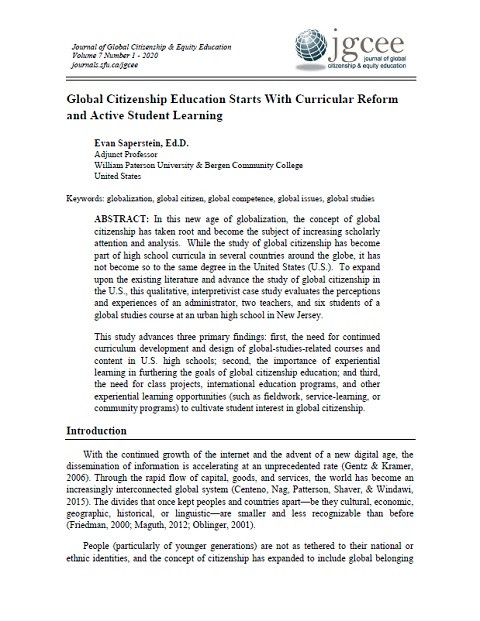 Global Citizenship Education Starts With Curricular Reform and Active Student Learning (Journal of Global Citizenship & Equity Education; Vol. 7, No. 1) Year of publication: 2020 Author: Evan Saperstein Corporate author: Centennial College In this new age of globalization, the concept of global citizenship has taken root and become the subject of increasing scholarly attention and analysis. While the study of global citizenship has become part of high school curricula in several countries across the globe, it has not to the same degree in the United States. To expand upon the existing literature and advance the study of global citizenship in the United States, this qualitative, interpretivist case study evaluates the perceptions and experiences of an administrator, two teachers, and six students of a global studies course at an urban high school in New Jersey. The study included interviews of the participants, as well as analysis of the course curriculum, syllabus, and student assignments.This study advances three primary findings. First, the need for continued curriculum development and design of global studies related courses and content in U.S. high schools. Second, the importance of experiential learning, among other forms of pedagogy and instructional practices, in furthering the goals of global citizenship education. Third, the need for class projects, international education programs, and other experiential learning opportunities (such as fieldwork, service-learning, or community programs) to cultivate student interest in global citizenship. Based on these findings and the prevailing literature, this study is proposing that U.S. high schools offer an elective course on global citizenship with ten units: 1) Introduction to Global Citizenship; 2) Sustainable Development; 3) Poverty and World Hunger; 4) Global Health Issues; 5) Child Mortality; 6) Peace and Conflict; 7) Human Rights and Gender Equality; 8) Universal Education; 9) Liberal Democratic Governance and Rights; 10) Global Citizenship Action Plan.
  Preparing teachers to educate for 21st century global citizenship:envisioning and enacting Year of publication: 2014 Author: Linyuan Guo Corporate author: Centennial College The changing educational landscape in the global context and the increasing interconnectedness and interdependence of the world have placed unprecedented demands on teacher education programs in preparing teachers to educate for 21st century global citizenship in K-12 schools. To chart the course of preparing global educators for an interconnected world, the Faculty of Education at the University of Prince Edward Island (UPEI) and UNICEF Canada have collaboratively developed an undergraduate course, entitled Educating for Global Citizenship. It focuses on preparing educators to teach for 21st century global citizenship and has been integrated into UPEI’s teacher preparation program as a compulsory course. This paper is based on a three-year study examining teacher candidates' experiences in learning to educate for global citizenship, the changes of their perceptions on global citizenship education, and the challenges and achievements they experienced in educational practices. Findings from this study indicate the unique opportunities and challenges teachers face in learning to educate for global citizenship and suggest the necessity of integrating global citizenship education in teacher education programs through a holistic approach.
  Global Education for Ontario Learners: Practical Strategies; A Summary of Research Year of publication: 2018 Author: Caroline Manion | Nadya Weber Corporate author: Ontario (Canada). Ministry of Education This summary report flows from the policy outlined in Ontario’s Strategy for K–12 International Education (OME, 2015). The report highlights current knowledge about good and/or promising practices in global education in order to suggest practical strategies for improved teaching, learning, and achievement. The intended audience for this piece includes all education stakeholders – community members, parents, learners, system leaders, school leaders, and educators – as active agents of change in support of an education strategy designed to integrate global perspectives, cultures, and experiences in the curriculum and learning environment. The purpose is to enable students to develop the competencies they will need to thrive as citizens in an increasingly globalized world.
 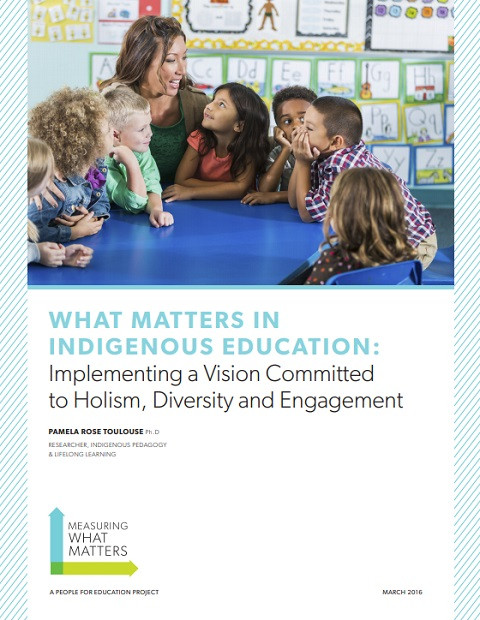 What Matters in Indigenous Education: Implementing a Vision Committed to Holism, Diversity and Engagement Year of publication: 2016 Author: Pamela R.Toulouse Corporate author: Measuring What Matters | People for Education This paper, What Matters In Indigenous Education: Implementing A Vision Committed To Holism, Diversity And Engagement, explores an Indigenous approach to quality learning environments and relevant competencies/skills. It focuses on select work from People for Education and draws out the research, concepts and themes that align with Indigenous determinants of educational success. This paper also expands on this work by offering perspectives and insights that are Indigenous and authentic in nature.
 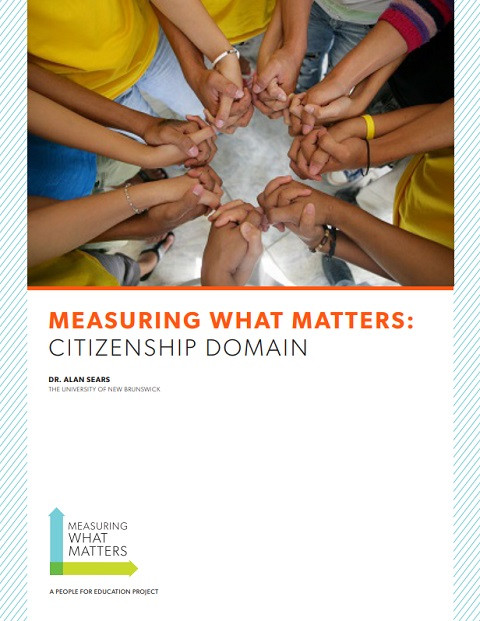 Measuring What Matters: Citizenship Domain Year of publication: 2014 Author: Alan Sears Corporate author: People for Education This report examines why citizenship is a core value for long term success for students and a cohesive, democratic society.
  Interrupting Extremism by Creating Educative Turbulence Year of publication: 2014 Author: Lynn Davies Corporate author: Curriculum Inquiry This article begins from the premise that it is important to explore how people unlearn, as well as learn, specifically in terms of extremist or violent attitudes. Three different country examples are given of intergroup encounters that interrupt rigidities in attitudes: working across ethnic groups in Sri Lanka, tackling religious divides in Northern Ireland through shared classes, and initiatives to prevent violent extremism in the United Kingdom. Pedagogical implications of unlearning involve working with the four Ds of deradicalization, debiasing, disengagement and desistence.