
Resources
Explore a wide range of valuable resources on GCED to deepen your understanding and enhance your research, advocacy, teaching, and learning.
950 Results found
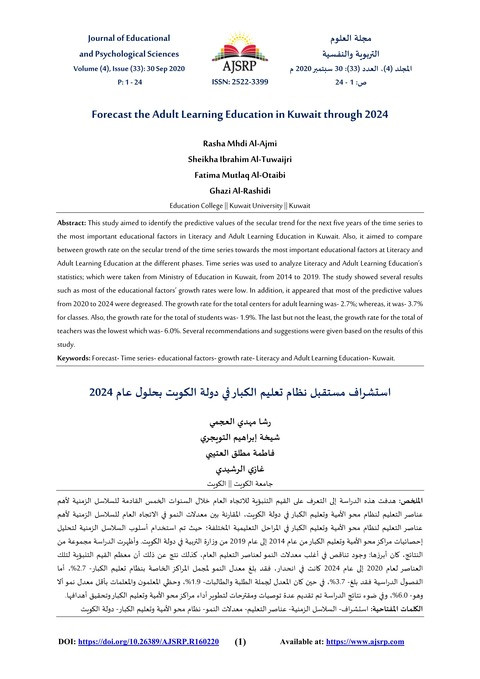 Forecast the Adult Learning Education in Kuwait Through 2024 (Journal of Educational and Psychological Sciences; vol.4, no.33) Year of publication: 2020 Author: Rasha Mhdi Al-Ajmi | Sheikha Ibrahim Al-Tuwaijri | Fatima Mutlaq Al-Otaibi | Ghazi Al-Rashidi Corporate author: Arab Institute of Science and Research Publishing (AISRP) This study aimed to identify the predictive values of the secular trend for the next five years of the time series to the most important educational factors in Literacy and Adult Learning Education in Kuwait. Also, it aimed to compare between growth rate on the secular trend of the time series towards the most important educational factors at Literacy and Adult Learning Education at the different phases. Time series was used to analyze Literacy and Adult Learning Education’s statistics; which were taken from Ministry of Education in Kuwait, from 2014 to 2019. The study showed several results such as most of the educational factors’ growth rates were low. In addition, it appeared that most of the predictive values from 2020 to 2024 were degreased. The growth rate for the total centers for adult learning was- 2.7%; whereas, it was- 3.7% for classes. Also, the growth rate for the total of students was- 1.9%. The last but not the least, the growth rate for the total of teachers was the lowest which was- 6.0%. Several recommendations and suggestions were given based on the results of this study. استشراف مستقبل نظام تعليم الكبار في دولة الكويت بحلول عام 2024 (مجلة العلوم التربوية و النفسية ;no.33, vol.4) Year of publication: 2020 Author: Rasha Mhdi Al-Ajmi | Sheikha Ibrahim Al-Tuwaijri | Fatima Mutlaq Al-Otaibi | Ghazi Al-Rashidi Corporate author: Arab Institute of Science and Research Publishing (AISRP) هدفت هذه الدراسة إلى التعرف على القيم التنبؤية للاتجاه العام خلال السنوات الخمس القادمة للسلاسل الزمنية لأهم عناصر التعليم لنظام محو الأمية وتعليم الكبار في دولة الكويت، المقارنة بين معدلات النمو في الاتجاه العام للسلاسل الزمنية لأهم عناصر التعليم لنظام محو الأمية وتعليم الكبار في المراحل التعليمية المختلفة؛ حيث تم استخدام أسلوب السلاسل الزمنية لتحليل إحصائيات مراكز محو الأمية وتعليم الكبار من عام 2014 إلى عام 2019 من وزارة التربية في دولة الكويت. وأظهرت الدراسة مجموعة من النتائج، كان أبرزها: وجود تناقص في أغلب معدلات النمو لعناصر التعليم العام، كذلك نتج عن ذلك أن معظم القيم التنبؤية لتلك العناصر لعام 2020 إلى عام 2024 كانت في انحدار، فقد بلغ معدل النمو لمجمل المراكز الخاصة بنظام تعليم الكبار- 2.7%، أما الفصول الدراسية فقد بلغ- 3.7%، في حين كان المعدل لجملة الطلبة والطالبات- 1.9%، وحظي المعلمون والمعلمات بأقل معدل نمو ألا وهو- 6.0%، وفي ضوء نتائج الدراسة تم تقديم عدة توصيات ومقترحات لتطوير أداء مراكز محو الأمية وتعليم الكبار وتحقيق أهدافها.
  Comprehensive Societal Integration of People with Disabilities in the Arab and Islamic Society (A Historical-original View) Year of publication: 2012 Author: Ibrahim Alnuqythan Corporate author: Gulf Society for Diability The file is a research paper that discusses the comprehensive integration of persons with disabilities in the Arab and Islamic world. The paper seeks to answer the following questions:- Did the disabled in the Arab-Islamic civilization have a comprehensive integration into society?What are the examples of this integration in the Arab-Islamic civilization?The paper discussed and touched on live models that show the reality of inclusion of persons with disabilities in society. الدمج المجتمعي الشامل لذوي الإعاقة في المجتمع العربي الإسلامي (نظرة تاريخية-تأصيلية) Year of publication: 2012 Author: Ibrahim Alnuqythan Corporate author: Gulf Society for Diability الملف عبارة عن ورقة بحثية تناقش الدمج الشامل للمعوقين في الوطن العربي والإسلامي. وتسعى الورقة للإجابة عن الأسئلة التالية:- هل كان للمعوقين في الحضارة العربية الإسلامية دمج شامل في المجتمع؟- ما النماذج على هذا الدمج في الحضارة العربية الإسلامية؟ولقد ناقشت الورقة وتطرقت لنماذج حية تظهر واقع ادماج المعوقين في المجتمع.
  The role of education and training in sustainable development: social, economic and environmental dimensions Year of publication: 2006 Author: Mohammad Jabir Ali | Abdallah AmboSaeedi | Jilani Lamloumi | Sulieman Sulieman Corporate author: UNESCO Beirut Education, Training and Sustainable Development are three fields for life were selected to be the topic in the Regional Workshop on the Role of Education and Training in Sustainable Development (Manama - Kingdom of Bahrain, 19-21 September 2005), as part of TVET-UNEVOC programme for 2004-2005, and follow-up on Bonn Declaration issued at the end of the International Expert Meeting on “Learning for Work, Citizenship and Sustainability”, Bonn, 25-28 October 2004. Thirty five (35) officials, experts and specialists from thirteen (13) Arab countries, UNESCO Offices in Beirut and Doha, and the International Centre for TVET - Bonn Centre took part in Bahrain Workshop. The Organizing Committee for the Workshop had highlighted the social, economic and enviromental dimensions of sustainable development, according to the plan of action of the UN Decade on Education for Sustainable Development (2005-2014). The main working papers discussed in the Workshop were developed into a reference study in TVET-UNEVOC Searies to reflect on future orientations in the fields related to Sustainable Development in the Arab countries. Le rôle de l'éducation et de la formation dans le développement durable: les dimensions sociales, économiques et environnementales Year of publication: 2006 Author: Mohammad Jabir Ali | Abdallah AmboSaeedi | Jilani Lamloumi | Sulieman Sulieman Corporate author: UNESCO Beirut L’éducation, formation et développement durable sont trois champs pour la vie ont été choisis pour être le sujet à l'atelier régional sur le rôle de l'éducation et de la formation dans le développement durable (Manama - Royaume de Bahreïn, 19-21 Septembre 2005), dans le cadre de TVET- programme UNEVOC pour 2004-2005, et le suivi de la Déclaration de Bonn émis à la fin de la réunion internationale d'experts sur «Apprendre pour le travail, la citoyenneté et la durabilité», Bonn, 25-28 Octobre 2004. Trente-cinq (35) fonctionnaires, experts et des spécialistes de treize (13) pays arabes, Bureaux de l'UNESCO à Beyrouth et à Doha, et le Centre international pour l'EFTP - Centre de Bonn ont pris part à Bahreïn Atelier. Le Comité d'organisation de l'atelier a mis en évidence les dimensions sociales, économiques et Enviromental du développement durable, selon le plan d'action de la Décennie des Nations Unies sur l'éducation pour le développement durable (2005-2014). Les principaux documents de travail abordés dans l'atelier ont été mis au point dans une étude de référence dans l'EFTP-UNEVOC Searies à réfléchir sur les orientations futures dans les domaines liés au développement durable dans les pays arabes.
  Education for Sustainable Development: The Tunisian Experience as an Example Year of publication: 2006 Author: Fatima Al-Tarhouni Corporate author: Federation of the Universities of the Islamic World The author in this article is giving analytical description of education for sustainable development. She uses the Tunisian experience as an example of implementing education for sustainable development. التربية من أجل التنمية المستدامة التجربة التونسية أنموذجا Year of publication: 2006 Author: Fatima Al-Tarhouni Corporate author: Federation of the Universities of the Islamic World يقدم المؤلف في هذه المقالة وصفا تحليليا للتعليم من أجل التنمية المستدامة. تستخدم التجربة التونسية كمثال على تطبيق التعليم من أجل التنمية المستدامة.
  Reinforcing School Health Through The Role Of The Teacher in Establishing The Environmental Education Values For Pupils. A Socio-demographic Study Of Middle School Students Through Teachers' Declaration (vol.11, no.1; Journel of Family and Society) Year of publication: 2023 Author: Khelfaoui Fahima Corporate author: University of Algiers 2 Given the significance of schools, particularly teachers, in environmental preservation, this study aims to explore the role of schools in fostering environmental education values among students. Is there a specific strategy in place for promoting these values? If so, how do teachers take the initiative to implement it for their students? Additionally, suggestions for promoting the concept of an environmental school are provided. تعزيز الصحة المدرسية من خلال دور المعلم في ترسيخ قيم التربية البيئية للمتعلمين - دراسة سوسيوديمغرافية لتلاميذ الطور المتوسط من خلال تصريح المعلمين (vol.11, no.1 مجلة الأسرة والمجتمع) Year of publication: 2023 Author: Khelfaoui Fahima Corporate author: جامعة الجزائر 2 نظرا لأهمية المدرسة و بالأخص المعلم في الحفاظ على البيئة ستحاول الدراسة الاقتراب من المدرسة لمعرفة إلى أي مدى استطاعت أن تساهم في ترسيخ قيم التربية البيئية للمتمدرسين ؟ وهل هناك استراتيجية معتمدة لترسيخ قيم التربية البيئية ؟ و إن كانت ،كيف يبادر المعلم في ترسيخها للتلاميذ ؟ وفي الأخير سنحاول تقديم بعض المقترحات لتفعيل فكرة المدرسة البيئية .