
Resources
Explore a wide range of valuable resources on GCED to deepen your understanding and enhance your research, advocacy, teaching, and learning.
3,433 Results found
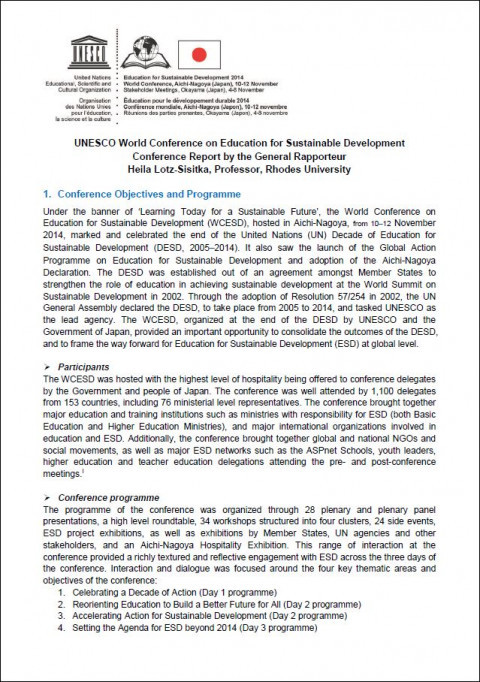 Conférence mondiale de l'UNESCO sur l'éducation au développement durable: rapport de la Conférence établi par la Rapporteure Year of publication: 2015 Author: Heila Lotz-Sisitka Placée sous le thème « Apprendre aujourd'hui pour un avenir viable », la Conférence mondiale sur l’éducation au développement durable s’est tenue à Aichi-Nagoya du 10 au 12 novembre 2014 pour marquer, et célébrer, la fin de la Décennie des Nations Unies pour l'éducation au service du développement durable (DEDD, 2005-2014). La Conférence a également été l’occasion de lancer le Programme d'action global pour l'éducation en vue du développement durable et d’adopter la Déclaration d’Aichi-Nagoya sur l’éducation au développement durable. La DEDD a été proclamée suite au Sommet mondial sur le développement durable de 2002 sur la base d’un accord entre les États membres visant à renforcer le rôle de l’éducation afin de parvenir au développement durable. L'Assemblée générale des Nations Unies a adopté la résolution 57/254 proclamant la DEDD de 2005 à 2014 et chargé l'UNESCO de la coordonner. La Conférence mondiale sur l’éducation au développement durable, organisée au terme de la DEDD par l’UNESCO et le Gouvernement du Japon, a été l’occasion de consolider les résultats de la DEDD et de définir la voie à suivre à l’avenir pour l’éducation au développement durable à l’échelle mondiale. Conferencia Mundial de la UNESCO sobre la Educación para el Desarrollo Sostenible: Informe de la Conferencia elaborado por la Relatora General Year of publication: 2015 Author: Heila Lotz-Sisitka Bajo el título de “Aprender hoy para un futuro sostenible”, la Conferencia Mundial sobre la Educación para el Desarrollo Sostenible, celebrada en Aichi-Nagoya del 10 al 12 de noviembre de 2014, señaló y celebró el final del Decenio de las Naciones Unidas de la Educación para el Desarrollo Sostenible (DEDS, 2005-2014). Asimismo, en la conferencia se puso en marcha el Programa de acción mundial de Educación para el Desarrollo Sostenible y se adoptó la Declaración de Aichi-Nagoya. El DEDS nació de un acuerdo suscrito por los Estados Miembros en 2002 en la Cumbre Mundial sobre Desarrollo Sostenible encaminado a fortalecer la función que desempeña la educación en el logro del desarrollo sostenible. En 2002, mediante la aprobación de la resolución 57/254, la Asamblea General de las Naciones Unidas proclamó el DEDS, que se extendería de 2005 a 2014, y designó a la UNESCO organismo rector del Decenio. La Conferencia Mundial sobre la Educación para el Desarrollo Sostenible, organizada por la UNESCO y el Gobierno del Japón al final del DEDS, brindó una importante oportunidad para consolidar los resultados del DEDS y marcar el camino a seguir en materia de Educación para el Desarrollo Sostenible (EDS) en el plano mundial.
  Address by Irina Bokova, Director-General of UNESCO, on the occasion of the Award Ceremony of the 2017 UNESCO-Japan Prize on Education for Sustainable Development, 39th General Conference; UNESCO, 3 November 2017 Year of publication: 2017 Corporate author: UNESCO. Director-General, 2009-2017 (Bokova, I.G.) This address was delivered by Irina Bokova, Director-General of UNESCO, on the occasion of the Award Ceremony of the 2017 UNESCO-Japan Prize on Education for Sustainable Development at UNESCO Headquarters in Paris, on 3 November.
 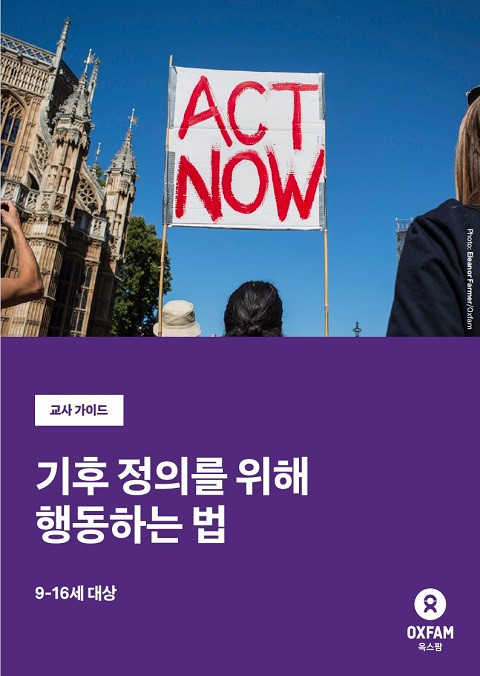 기후 정의를 위해 행동하는 법: 교사 가이드; 9-16세 대상 Year of publication: 2023 Corporate author: 옥스팜 기후 정의란 무엇일까? 우리는 모두 기후위기로부터 영향을 받고 있지만 어떤 특정 지역사회가 다른 지역보다 더 큰 영향을 받고 있다. 그리고 가장 큰 고통을 받고 있는 사람들은 기후위기 발생에 거의 기여하지 않은 사람들이다. 이러한 불공정한 기후위기 영향에 대해 알고, 이를 바꾸기 위해 기꺼이 행동하는 것이 바로 기후 정의이다. 이번 교육자료는 행동하는 것이 기후 정의 달성에 얼마나 중요한 지에 대한 내용을 다루고 있다. 특히 청소년들이 기후위기를 위해 행동하는 것은 사람과 지구의 삶을 개선하는 아주 중요한 변화를 가져오는 한 주체가 되는 경험이 될 것이다.
 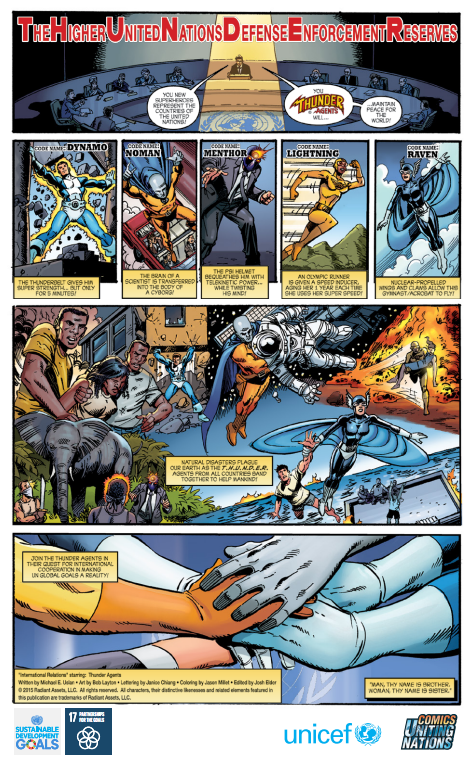 T.H.U.N.D.E.R. Agents Year of publication: 2015 Author: Michael E. Ulsan | Bob Layton | Janic Chiang | Jason Millet | Josh Elder Corporate author: Radiant Assets | LLC | United Nations Children's Fund (UNICEF) T.H.U.N.D.E.R. -- The Higher United Nations Defense Enforcement Reserves -- are UN Superheroes tasked with promoting global cooperation to make the world a better place. The T.H.U.N.D.E.R. Agentswas a comic originally created in the 1960s and is set to be made into a major motion picture in 2018.
 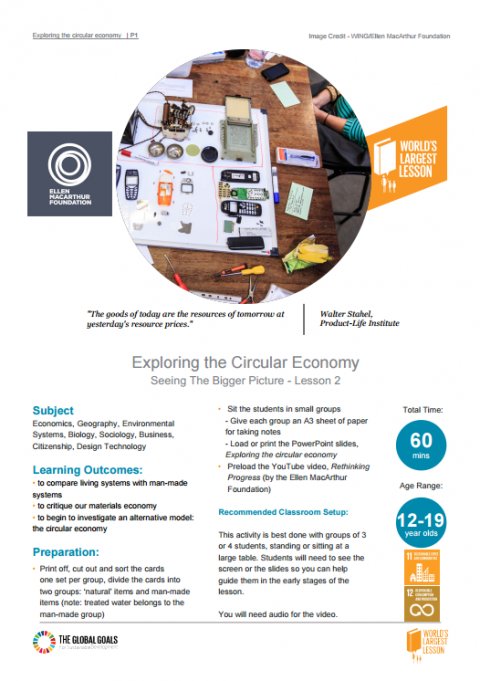 Exploring the Circular Economy: Seeing The Bigger Picture - Lesson 2 Corporate author: United Nations Children's Fund (UNICEF) World’s Largest Lesson is a collaborative education project to support the announcement of the United Nations Global Goals for Sustainable Development. Learning outcomes of the project: • to compare living systems with man-made systems • to critique our materials economy • to begin to investigate an alternative model: the circular economy
 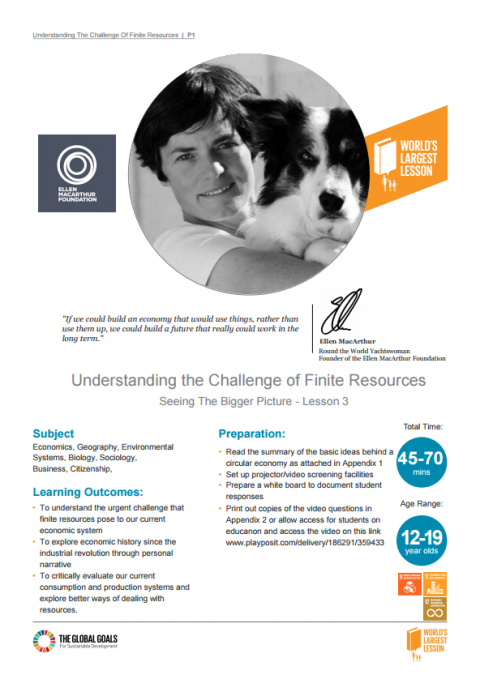 Understanding the Challenge of Finite Resources: Seeing The Bigger Picture - Lesson 3 Corporate author: United Nations Children's Fund (UNICEF) World’s Largest Lesson is a collaborative education project to support the announcement of the United Nations Global Goals for Sustainable Development. Learning outcomes of the project: • To understand and the urgent challenge that finite resources pose to our current economic system • To explore economic history since the industrial revolution through personal narrative • To critically evaluate our current consumption and production systems and explore better ways of dealing with resources.
 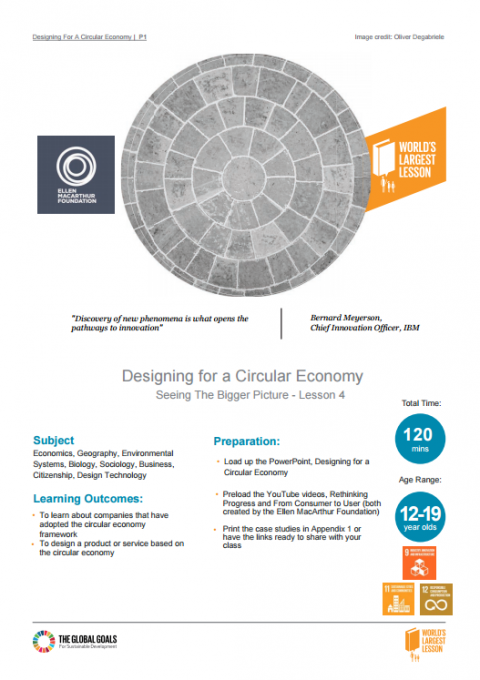 Designing for a Circular Economy: Seeing The Bigger Picture - Lesson 4 Corporate author: United Nations Children's Fund (UNICEF) World’s Largest Lesson is a collaborative education project to support the announcement of the United Nations Global Goals for Sustainable Development. Learning outcomes of the project: • To learn about companies that have adopted the circular economy framework • To design a product or service based on the circular economy
 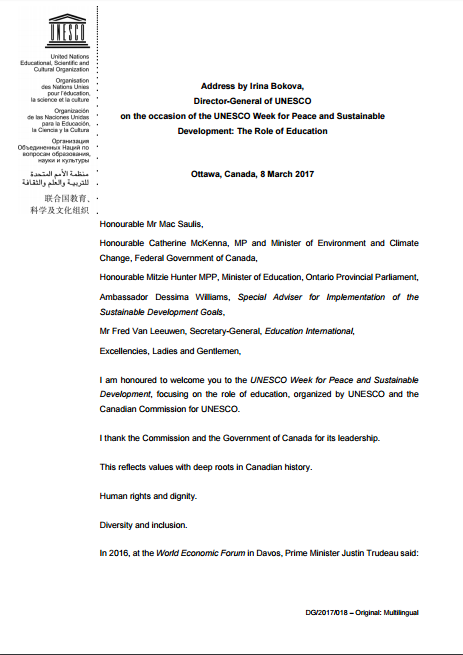 Address by Irina Bokova, Director-General of UNESCO, on the occasion of the UNESCO Week for Peace and Sustainable Development: The Role of Education; Ottawa, Canada, 8 March 2017 Year of publication: 2017 Corporate author: UNESCO. Director-General, 2009-2017 (Bokova, I.G.) This address was presented by Irina Bokova, Director-General of UNESCO on the occasion of the UNESCO Week for Peace and Sustainable Development. She highlights on the role of education.
 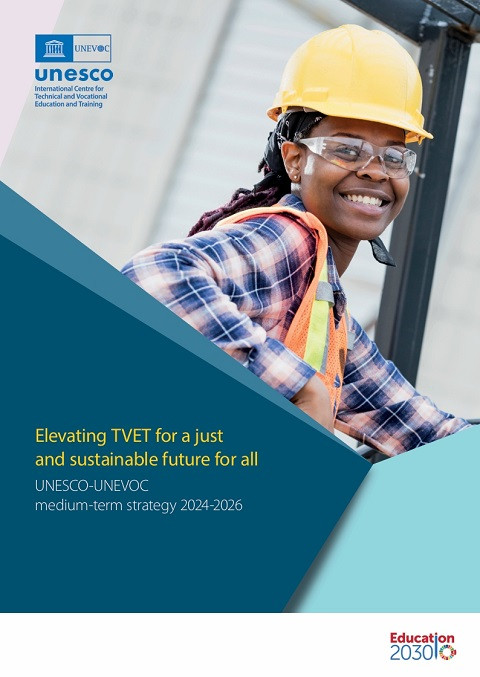 Elevating TVET for a Just and Sustainable Future for All: UNESCO-UNEVOC Medium-term Strategy 2024-2026 Year of publication: 2024 Corporate author: UNESCO International Centre for Technical and Vocational Education and Training (UNEVOC) The UNESCO-UNEVOC medium-term strategy for 2024 to 2026 sets out a roadmap to elevate technical and vocational education and training (TVET) for a just and sustainable future and empower TVET institutions to address the demands of digital, green and inclusive societies and economies. In alignment with the 2030 Agenda for Sustainable Development and the UNESCO strategy for TVET 2022-2029, UNESCO-UNEVOC will support Member States to upgrade their TVET systems and equip all youth and adults with skills for employment, decent work, entrepreneurship and lifelong learning. By working alongside international organizations, governments, UNEVOC Centres and partners, UNESCO-UNEVOC will implement a transformative TVET agenda focused on building flexible pathways for individuals to learn, work and live in a world that demands innovative solutions to complex, interconnected challenges.