
Resources
Explore a wide range of valuable resources on GCED to deepen your understanding and enhance your research, advocacy, teaching, and learning.
684 Results found
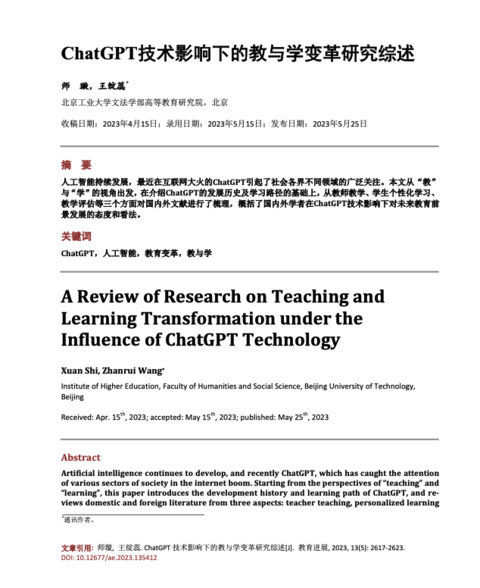 A Review of Research on Teaching and Learning Transformation under the Influence of ChatGPT Technology (Advances in Education; Vol.13, No.5) Year of publication: 2023 Author: 师璇 | 王绽蕊 Artificial intelligence continues to develop, and recently ChatGPT, which has caught the attention of various sectors of society in the internet boom. Starting from the perspectives of “teaching” and “learning”, this paper introduces the development history and learning path of ChatGPT, and reviews domestic and foreign literature from three aspects: teacher teaching, personalized learning for students, and teaching evaluation. It summarizes the attitudes and views of domestic and foreign scholars on the future development of education under the influence of ChatGPT technology. ChatGPT技术影响下的教与学变革研究综述 (教育进展; Vol.13, No.5) Year of publication: 2023 Author: 师璇 | 王绽蕊 人工智能持续发展,最近在互联网大火的ChatGPT引起了社会各界不同领域的广泛关注。本文从“教”与“学”的视角出发,在介绍ChatGPT的发展历史及学习路径的基础上,从教师教学、学生个性化学习、教学评估等三个方面对国内外文献进行了梳理,概括了国内外学者在ChatGPT技术影响下对未来教育前景发展的态度和看法。
  Digital Citizenship: Guide for Parents Year of publication: 2017 Corporate author: Gouvernement of Canada | MediaSmarts The Digital Citizenship Guide for Parents is designed to prepare parents and guardians for the conversations they should have with their children when they first start using digital devices. Guide de civilité en ligne à l’intention des parents Year of publication: 2017 Corporate author: Gouvernement of Canada | MediaSmarts Le Guide de civilité en ligne à l’intention des parents vise à préparer les parents et les gardiens aux conversations qu’ils devraient avoir avec leurs enfants lorsque ces derniers commencent à utiliser des appareils numériques.
  Helping Our Kids Deal With Cyberbullying: A TELUS Wise Parent’s Guide Year of publication: 2018 Corporate author: TELUS Wise | MediaSmarts This parent guide provides information about cyberbullying, and includes practical tips on how to help prevent or reduce the impact of cyberbullying, what you should do if your child is targeted or if your child is cyberbullying someone, and how you can help your child stand up to cyberbullying. Aider nos enfants à composer avec la cyberintimidation: Guide à l’intention des parents Year of publication: 2018 Corporate author: TELUS Wise | MediaSmarts Ce guide contient de l’information sur la cyberintimidation et comment puis-je aider à prévenir ou à réduire l’impact de la cyberintimidation, que faire si votre enfant est victime de cyberintimidation ou est un cyberintimidateur, et comment aider votre enfant à résister à la cyberintimidation?
  Digital Education Action Plan 2021-2027: Resetting Education and Training for the Digital Age Year of publication: 2020 Corporate author: European Union (EU) The Digital Education Action Plan (2021-2027) outlines the European Commission’s vision for high quality, inclusive and accessible digital education in Europe.It is a call to action for stronger cooperation at European level to learn from the COVID-19 crisis during which technology is being used at a scale never seen before in education and training make education and training systems fit for the digital age
  Teaching Media Literacy in Europe: Evidence of Effective School Practices in Primary and Secondary Education; Analytical Report Year of publication: 2018 Author: Julian McDougall | Marketa Zezulkova | Barry van Driel | Dalibor Sternadel Corporate author: NESET II | European Union (EU) This report is aimed at policymakers, practitioners and researchers in the fields of school education, media and digital policies. It reviews relevant European and international research to better understand how teaching and learning practices can support students’ media literacy in primary and secondary education. It also aims to understand how media literacy education in schools can help address the challenges related to the spread of disinformation and ‘fake news’.
  Sexual Violence and the News Media: Issues, Challenges and Guidelines for Journalists in India Year of publication: 2021 Author: Chindu Sreedharan | Einar Thorsen Corporate author: UNESCO New Delhi This report presents the findings of a multilingual national study on the news reporting of sexual violence in India. Drawing on a content analysis of 10 newspapers covering six languages, and semi-structured interviews with 257 journalists working across 14 languages, it provides comparative insights into the routines journalists follow and the challenges they face when they cover sexual violence.The report evidences how news outlets tend to disproportionately publish unusual cases, such as those involving extreme brutality; focus on rape in urban areas; and rely heavily on police sources. Journalists rarely undertake in-depth inquiries into the cases they cover. The challenges they face include safety issues while newsgathering, difficulties in accessing key sources, and distress from the requirements of their assignments. Overall, nearly 20% of our respondents experienced psychological challenges while reporting on sexual violence, and 55% of women journalists reported workplace sexual harassment or violence.Based on the evidence, the report presents seven national and 10 organisational recommendations. It concludes by offering guidelines that individual journalists and media houses can adapt to suit their news routines.
  Media Literacy Education to Counter Truth Decay: An Implementation and Evaluation Framework Year of publication: 2021 Author: Alice Huguet | John F. Pane | Garrett Baker | Laura S. Hamilton | Susannah Faxon-Mills Corporate author: RAND Corporation Media literacy (ML) education has emerged as a promising approach to slowing the spread of Truth Decay, described as the diminishing role that facts, data, and analysis play in political and civil discourse. Several factors contribute to Truth Decay, including a rapidly evolving information ecosystem and overburdened educational institutions. Many teachers believe their students lack the complex skills that are necessary to navigate today’s information- saturated world. This gap—between students’ existing competencies and those required to engage responsibly in a fast-paced media environment— could lead to negative consequences for individuals and society writ large.However, teachers report a lack of guidance around promoting ML education in their practice, and rigorous research about what kinds of ML educationwork best, and in what conditions, remains limited. This report presents a framework for implementing and evaluating ML educational efforts. Following an introduction to the framework, the authors discuss six steps of ML implementation and evaluation: setting ML learning expectations; identifying conditions that can influence ML instructional efforts; exploring instructional resources; identifying measures of ML competencies; monitoring progress; and finally, measuring the summative impacts of ML education on student learning. By bringing this information together for implementors—such as district decisionmakers and teachers—as well as evaluators, the authors emphasize the important connections between these too often separate groups.