
Resources
Explore a wide range of valuable resources on GCED to deepen your understanding and enhance your research, advocacy, teaching, and learning.
1,180 Results found
 Education in the twenty‐first century: Conflict, reconstruction and reconciliation1 Year of publication: 2005 Author: Alan Smith Corporate author: Taylor & Francis This paper is an attempt to map out an emerging and increasingly important field of study concerning the relationship between education and conflict. The paper argues that actions through various ‘entry points’ at each of these levels carry the potential to exacerbate or ameliorate conflict and suggests that a systemic analysis of investments in education systems from a conflict perspective should be a routine part of educational planning. Education in the twenty‐first century: Conflict, reconstruction and reconciliation1 Year of publication: 2005 Author: Alan Smith Corporate author: Taylor & Francis Ce papier tente d’établir un nouveau domaine d'étude de plus en plus important portant sur le lien entre l'éducation et les conflits. Le document fait valoir que les actions menées à travers différents « points d’entrée » à chaque niveau ont le potentiel d'exacerber ou bien d’atténuer les conflits. Le papier suggère qu'une analyse systémique des investissements dans les systèmes d'éducation contre les conflits devrait faire partie intégrante de la planification de l'éducation.
  From Civic Education to Citizenship Education: Citizenship Values in the Geography Curriculum; The Problem of Understanding and Downloading (International Journal of Educational and Psychological Studies; vol. 6, no. 17) Year of publication: 2022 Author: Al-Hassan Farkakoum Corporate author: Democratic Arab Center This paper aims to contribute to revealing the extent to which the values of citizenship and human rights are present in the social studies lesson in Moroccan public schools, specifically in the middle school education curriculum. The inclusion of human rights values at this level raises several problems that lead to two complementary trends: The first is related to the didactics of human rights and citizenship education, and the second trend is related to the extent of the learner’s ability to acquire and represent the values of citizenship and transform them into automatic daily behaviors and practices in the school environment and then after that in daily public life and private transactions. من التربية الوطنية إلى التربية على المواطنة قيم المواطنة في منهاج الاجتماعيات: إشكالية الفهم والتنزيل (مجلة الدراسات التربوية والنفسية ;no.17, vol.6) Year of publication: 2022 Author: Al-Hassan Farkakoum Corporate author: Democratic Arab Center تهدف هذه الورقة الإسهام في كشف مدى حضور قيم المواطنة وحقوق اإلنسان في درس الاجتماعيات بالمدرسة العمومية المغربية، وتحديدا في منهاج التعليم الثانوي الإعدادي. إن إدراج قيم حقوق اإلنسان في هذا المستوى يطرح عدة إشكالات تصب في منحيين يكمل بعضهما البعض، الأول مرتبط بديداكتيك مادة حقوق اإلنسان والتربية على المواطنة، والمنحى الثاني له عالقة بمدى قدرة المتعلم على اكتساب قيم المواطنة وتمثلها وتحويلها إلى سلوكات وممارسات تلقائية يومية في الوسط المدرسي ثم بعد ذلك في الحياة العامة اليومية والمعاملات الخاصة.
 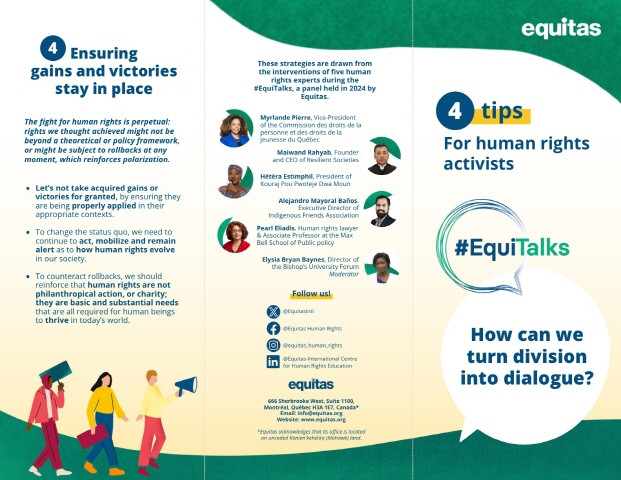 #EquiTalks: How Can We Turn Division into Dialogue? Year of publication: 2024 Corporate author: Equitas This brochure gathers the answers of five human rights defenders during the 2024 #EquiTalks panel discussion, who attempted to answer the question: How can we turn division into dialogue? The brochure suggests potential solutions and tips to counteract the polarization of opinions on human rights. #EquiTalks: Comment transformer la division en dialogue ? Year of publication: 2024 Corporate author: Equitas Ce document rassemble les réponses de cinq défenseurs des droits humains lors du panel de discussion #EquiTalks en 2024, qui ont tenté de répondre à la question suivante : Comment transformer la division en dialogue? Le dépliant offre des pistes de solution et des conseils pour contrer la polarisation des opinions sur les droits humains.
  I International Congress: Good Training Practices for the Professional Development of Teachers 2023 Year of publication: 2023 Corporate author: Chile. Ministry of Education | Organization of Ibero-American States for Education, Science and Culture (OEI) This book is the result of the First International Congress of Good Training Practices for the Professional Development of Teachers, held on December 5 and 6, 2023 at the Center for Improvement, Experimentation and Pedagogical Research (CPEIP) of the Ministry of Education of Chile (Mineduc), in conjunction with the Organization of Ibero-American States (OEI). It includes practices for training with a focus on rights and for sustainable development. I Congreso Internacional: Buenas prácticas formativas para el desarrollo profesional docente 2023 Year of publication: 2023 Corporate author: Chile. Ministry of Education | Organización de Estados Iberoamericanos para la Educación, la Ciencia y la Cultura (OEI) Este libro es el resultado del Primer Congreso Internacional de Buenas Prácticas Formativas para el Desarrollo Profesional Docente, desarrollado los días 5 y 6 de diciembre del 2023 en dependencias del Centro de Perfeccionamiento, Experimentación e Investigaciones Pedagógicas (CPEIP) del Ministerio de Educación de Chile (Mineduc), en conjunto con la Organización de Estados Iberoamericanos (OEI). Incluye prácticas para la formación con enfoque de derechos y para el desarrollo sostenible.
  How Are Vocational Institutions Innovating, Evolving and Changing as a Result of COVID-19?: A Study of Practice and Perspectives in Five Countries Year of publication: 2021 Corporate author: British Council As an international problem, Covid-19 requires international cooperation. The social, economic and educational recovery from the pandemic can be enhanced by knowledge transfer and exchange. This research brought together 15 technical and vocational education and training (TVET) institutions from the five countries in the British Council’s I-WORK Programme (Improving Work Opportunities - Relaying Knowledge) to explore innovation, evolution and change stemming from the pandemic. TVET practitioners and leaders from Ghana, India, Malaysia, South Africa and the UK were asked to reflect on five key questions: How are institutional policy and structures likely to change to reflect the changing situation? Is this different for private institutions? What changes are proposed to the curriculum/ occupational areas to reflect the rapidly changing demand and how are they identifying this demand? How will learners get the practical and work-based experience they need and what changes to work- based learning and apprenticeships are needed? What changes are needed to the skills and type of staff in the teaching institution? How can new delivery models and ways of working promote more inclusive practice? The research took place as institutions approached almost a year of adapting their teaching, learning and support to localised lockdowns and the restrictions of the pandemic. The national policy context may have been different in each country, but the research findings pointed to a single conclusion: that across the board, the move to digital learning and teaching had brought benefits, opportunities and challenges that might not otherwise have been realised.
  Education Sector Analysis: Methodological Guidelines (Vol. 3) Year of publication: 2021 Corporate author: UNESCO International Institute for Educational Planning (IIEP) | United Nations Children's Fund (UNICEF) | Global Partnership for Education (GPE) | Foreign, Commonwealth & Development Office (UK) This present volume is the third in a series of education sector analysis (ESA) guidelines following two volumes published in 2014. The series provides methodologies and applied examples for diagnosing education systems and informing national education policies and plans. This volume proposes guidelines to strengthen national capacities in analyzing education systems in four areas: inclusive education system for children with disabilities, risk analysis for resilient education systems, functioning and effectiveness of the educational administration, and stakeholder mapping and problem-driven analysis (governance and political economy).