
Resources
Explore a wide range of valuable resources on GCED to deepen your understanding and enhance your research, advocacy, teaching, and learning.
3,446 Results found
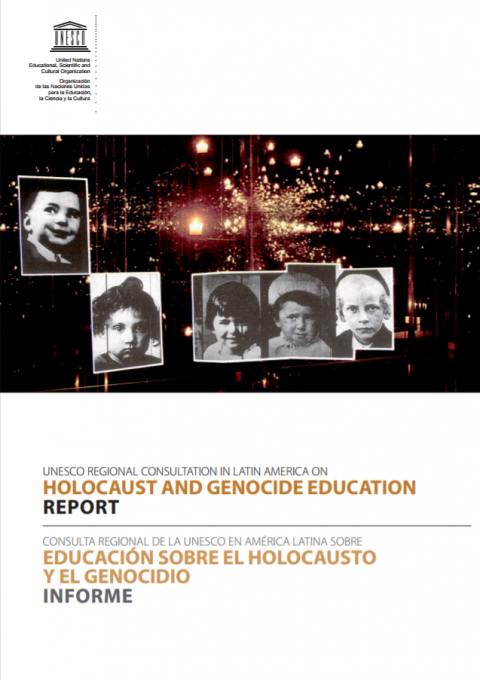 UNESCO regional consultation in Latin America on Holocaust and genocide education: report Year of publication: 2014 Corporate author: UNESCO Santiago This consultation with Latin American Member States sought to raise awareness amongst policymakers and education specialists of the region about the history of the Holocaust, as it can contribute to the prevention of genocide, following United Nations General Assembly resolution 60/7 on Holocaust remembrance. The meeting also aimed at fostering concrete cooperation between UNESCO and Member States on education about the history of genocide and mass atrocities, notably the Holocaust, with a view of introducing the subject in the curriculum and of developing relevant educational programmes in the region. The overall objectives of the project were as follows:▶ Strengthen educational leaders’ awareness and support for Holocaust remembrance and education about the history of genocide and mass atrocities, in line with regional efforts to foster education for peace and human rights.▶ Increase the implementation of education programmes about the history of the Holocaust and other genocides, and support interested Ministries of Education to introduce these subjects in the curriculum.▶ Foster regional exchanges about this topic and facilitate access to good practices regarding Holocaust and genocide related issues and peace education.
  Responsibility Education in the View of Citizen Year of publication: 2017 Author: Feng Jianjun | Fang Duo Corporate author: Ohio State University Press The modern western citizen is the entitled citizen oriented by the liberalism, who has an excessive pursuit for self-interest, resulting in the public crisis. Contemporary citizenship is moving from the entitled citizen to the responsible citizen. Civic responsibility is the essential requirement of the responsible citizen. Civic responsibility points to the interests of the civic community, which is the responsibility of the civic public life. The mission of the contemporary civic responsibility education is to cultivate the strong sense of civic responsibility, to stimulate the positive civic emotion, and to improve the civic ability to participate actively. According to the civic responsibility relations, civic responsibility education covers education on the responsibility to others, the responsibility to the society, the responsibility to the country and the responsibility to the whole world. 公民视野中的责任教育 Year of publication: 2017 Author: Feng Jianjun | Fang Duo Corporate author: Ohio State University Press 近代西方公民是以自由主义为主导的权利公民,权利公民过分追求自我利益,导致公民公共性的危机,当代公民身份正在从权利公民走向责任公民。公民责任是责任公民的本质要求,公民责任指向公民共同体的利益,是为公民公共生活而必须承担的责任。当代公民责任教育的使命是培养公民强烈的责任意识,激发公民积极的责任情感,提高公民主动参与的能力。基于公民的责任关系,公民责任教育的内容包括对他人的责任、对社会的责任、对国家的责任和对全球的责任教育。
  An Analysis of the Cultural Position of Educational Reform in the Context of Multiculturalism Year of publication: 2019 Author: Xu Zusheng | Yang Zhaoshan Corporate author: Theory Monthly In the context of the multicultural era, education reforms based on the requirements of political and economic development and reform also need to pay attention to attitudes and tendencies toward different cultures. Upholding the main position of Chinese culture and properly handling relationships with Western cultures are the prerequisites for successful education reform. The cultural standpoint of China’s educational reform has undergone nearly a hundred years of historical evolution, and finally precipitated the cultural position of China’s educational reform: we must adhere to the cultural position of opening to the outside world, the cultural standpoint of Marxist guidance, and the cultural position of Chinese educational subjectivity. To establish the cultural standpoint of China’s educational reform, it is necessary to take “Ma Xue as the soul, middle school as the body and western learning as the method” as the correct path for the cultural position of China’s educational reform. 多元文化背景下教育改革的文化立场分析 Year of publication: 2019 Author: Xu Zusheng | Yang Zhaoshan Corporate author: Theory Monthly 在多元文化的时代背景下,基于政治经济发展变革要求的教育改革也需要关注对待不 同文化的态度和倾向性,秉持中国文化的主体立场处理好与西方文化的关系,是教育改革取得成 功的前提。我国教育改革的文化立场经历了近百年的历史演变,最终沉淀出中国教育改革的文 化立场:要坚持对外开放的文化立场、坚持马克思主义指导的文化立场、坚持中国教育主体性的 文化立场。确立中国教育改革的文化立场需要将“马学为魂、中学为体、西学为用”作为中国教育 改革文化立场选择的正确道路。
  Modern Context and Education Choice of Multi-culture Year of publication: 2019 Author: Yuanmei | Sun Jieyuan Corporate author: Contemporary Education and Culture Multi-culture is a generic term for diverse cultures existing in a society, country or nation, which is a nation that reflexes differences in value standards, thoughts and ideas, and behaviors and actions among varied people. Multi-culture, in modern context, is to face cultural differences hold that different groups of people have basic rights and that people with different classes and cultures should all be accepted and understood, and highlight the main role, relatively and complementary of all quality, education fairness, a balanced education as well as educational dynamism. Therefore, we should create multicultural teachers. Besides, we should implement multicultural courses and positively foster more multicultural teaching, adopt diverse assessment and evaluation methods and promote appropriate and efficient multicultural education, thus addressing the problems of unbalanced and inadequate educational development, creation more dynamic education environment and delivering more fair and quality education. 多元文化的现代语境与教育选择 Year of publication: 2019 Author: Yuanmei | Sun Jieyuan Corporate author: Contemporary Education and Culture 多元文化指在一个社会、国家或民族中所存在的多种文化的总称,反映了人类不同群体之间价值规范、思 想观念乃至行为方式上的差异。现代意义上的多元文化正视文化差异,坚持不同团体都拥有基本的权利,不 同 阶 层、 不同文化的人都应被接受、被理解,强调文化的主体性、相对性与互补性。现代多元文化教育具有积极的价值,有助 于提升教育质量、促进教育公平、推进教育均衡、增强教育活力。因此,需要通过创建多元文化校园环境、深入开发 多元文化课程、自觉培养多元文化教师、积极实施多元文化教学、采取多样化的考核评价等方式,积极推进合理有效 的多元文化教育,以促进教育发展不平衡不充分问题的解决,创造充满活力的教育和提供公平优质的教育。
 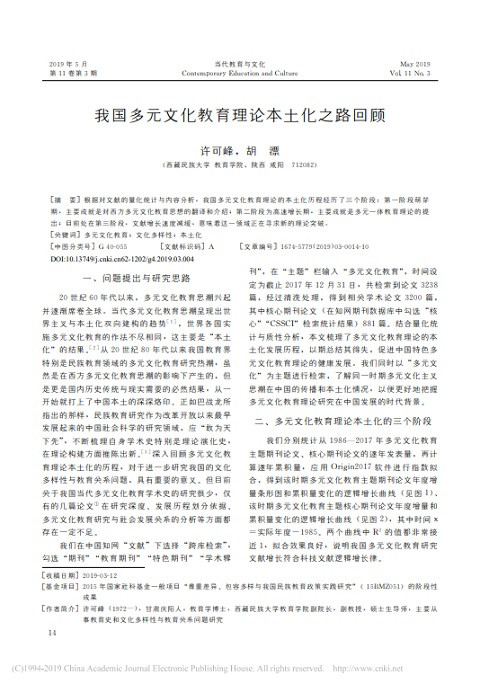 Review on the Localization of Multicultural Education Theory in China Year of publication: 2019 Author: Xu Kefeng | Hupaio Corporate author: Contemporary Education and Culture According to the quantitative statistics and content analysis of the literature, the localization of the multicultural education theory in China has gone through three stages: the main achievement is the translation and introduction of the western multicultural education thought; the second stage is the high-speed growth period, the main achievement is the multicultural education theory. At present, it is in the third stage and the growth rate of literature slows down, which means that new theoretical breakthroughs are being sought in this field. 我国多元文化教育理论本土化之路回顾 Year of publication: 2019 Author: Xu Kefeng | Hupaio Corporate author: Contemporary Education and Culture 根据对文献的量化统计与内容分析,我国多元文化教育理论的本土化历程经历了三个阶段:第 一 阶 段 萌 芽 期,主要成就是对西方多元文化教育思想的翻译和介绍;第二阶段为高速增长期,主要成就是多元一体教育理论的提 出;目前处在第三阶段,文献增长速度减缓,意味着这一领域正在寻求新的理论突破。
  Fostering national and global citizenship: an example from South Africa (Social Studies and the Young Learner, vol 21, no. 1, september/october 2008) Year of publication: 2008 Author: Omiunota Nelly Ukpokodu Corporate author: National Council for the Social Studies Multicultural and global scholars urge that we prepare the young for national and global democratic citizenship given the increasing interdependence and challenging realities for today. Young people desire to be a part of the solution to global problems, but they must be educated about what those problems are and how solutions can be arrived at. As has been seen in the U.S. presidential campaign, young people care about their communities, country, and planet, and they are volunteering and voting at record rates. We must take responsibility to plant the seeds of critical citizenship if we are to foster a more sustainable, peaceful, just, and prosperous world. Educator Sheldon Berman sums it up by writing: It is important for teachers to tell young people about the success stories of others, students who have reclaimed forests, cleaned up rivers, improved their school environment, helped the homeless. They need to hear about the Mother Teresas and the Martin Luther Kings, of course, but also about the people who live down the street who are doing what they can to improve the neighbourhood and about the many organizations that make a difference in our communities. We must put students in touch with these people and organizations so that they can see how deeply people care about their world and how worthwhile it is to participate in creating change.