
Resources
Explore a wide range of valuable resources on GCED to deepen your understanding and enhance your research, advocacy, teaching, and learning.
3,229 Results found
 Second UNESCO Forum on Global Citizenship Education: building peaceful and sustainable societies: final report Year of publication: 2015 Corporate author: Organisation des Nations Unies pour l'éducation, la science et la culture (UNESCO) Le deuxième Forum de l'UNESCO sur l'éducation à la citoyenneté mondiale (ECM) a été organisé à Paris du 28 au 30 Janvier 2015 sous le thème général «Construire des sociétés pacifiques et durables: préparer l'après-2015». Le Forum a été organisé à l'appui d’Éducation Globale Première Initiative du Secrétaire général de l'ONU (EGPI) et à l'occasion du 70e anniversaire de l'UNESCO. Le Forum a été organisé par la Division de l'enseignement, l'apprentissage et du contenu, Secteur Educatio, l'UNESCO, avec le soutien de l'Autriche, le Sultanat d'Oman et la République de Corée. D'autres partenaires comprenaient également ’Éducation Globale Première Initiative du Secrétaire général du Secrétaire général de l’ONU (EGPI), Mahatma Gandhi Institute de l'UNESCO de l'éducation pour la paix et le développement durable (MGIEP), Asie-Pacifique Centre de l'UNESCO de l'éducation pour la compréhension internationale (APCEIU), le roi Abdallah Bin Abdulaziz Centre international pour le dialogue interreligieux et interculturel (KAICIID) et le Groupe de travail Matrice d'apprentissage. Quelque 250 participants de 61 pays de toutes les régions du monde ont participé au Forum. ceci inclut décisions et les décideurs politiques, les praticiens, les enseignants, les partenaires de développement, des universitaires, le secteur privé, les représentants de la société civile (niveau national, régional et international), ainsi que les apprenants et les représentants de la jeunesse.Le Forum a été organisé autour de trois sessions plénières et 20 sessions simultanées. Sujets à l'étude comprenaient, entre autres, ECM dans l'agenda de l'éducation post-2015, la mesure des résultats ECM d'apprentissage, les pratiques d'enseignement, éducation à la paix et les droits de l'homme, le respect de la diversité et de l'éducation inter-religieux, la lutte contre la discrimination et la violence, l'éducation pour le développement durable, la participation des jeunes, l'utilisation des TIC et des médias sociaux, et d'autres. Pour un aperçu du programme, s'il vous plaît voir l'annexe I.
  Second UNESCO Forum on Global Citizenship Education video Year of publication: 2015 Corporate author: UNESCO Highlights of the Second UNESCO Forum on Global Citizenship Education (GCED) Building peaceful and sustainable societies: preparing for post-2015 (28-30 January 2015, UNESCO HQs, Paris). The Forum was organized by the Division for Teaching, Learning and Content, Education Sector, UNESCO, with the support of Austria, the Sultanate of Oman and the Republic of Korea, and the UN Secretary-General's Global Education First Initiative (GEFI). Second UNESCO Forum on Global Citizenship Education video Year of publication: 2015 Corporate author: Organisation des Nations Unies pour l'éducation, la science et la culture (UNESCO) Faits saillants du deuxième Forum de l'UNESCO sur l’éducation à la citoyenneté mondiale (ECM) Construire des sociétés pacifiques et durables: la préparation pour l'après-2015 (28-30 Janvier 2015, Siège de l'UNESCO, Paris). Le Forum a été organisé par la Division de l'enseignement, l'apprentissage et du contenu, Secteur de l'éducation, l'UNESCO, avec le soutien de l'Autriche, le Sultanat d'Oman et la République de Corée, et Première Éducation Mondiale Initiative du Secrétaire Général de l'ONU (PISG).
 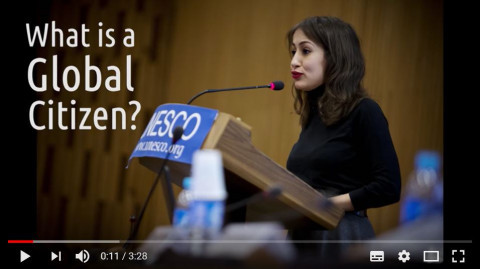 [Video] Global citizenship is ... Year of publication: 2015 Corporate author: UNESCO Participants of the Second UNESCO Forum on Global Citizenship Education (GCED) Building peaceful and sustainable societies: preparing for post-2015 (28-30 January 2015,UNESCO HQ, Paris) reflect on what Global Citizenship is. The Forum was organized by the Division for Teaching, Learning and Content, Education Sector, UNESCO, with the support of Austria, the Sultanate of Oman and the Republic of Korea, and the UN Secretary-General’s Global Education First Initiative (GEFI). La citoyenneté mondiale est ... Year of publication: 2015 Corporate author: Organisation des Nations Unies pour l'éducation, la science et la culture (UNESCO) Les participants du deuxième Forum de l'UNESCO sur l’éducation à la citoyenneté mondiale (ECM) Construire des sociétés pacifiques et durables: la préparation pour l'après-2015 (28-30 Janvier 2015, Siège de l'UNESCO, Paris) à réfléchir sur ce que la citoyenneté mondiale est. Le Forum a été organisé par la Division de l'enseignement, l'apprentissage et du contenu, Secteur de l'éducation, l'UNESCO, avec le soutien de l'Autriche, le Sultanat d'Oman et la République de Corée, et First Éducation Mondiale Initiative du Secrétaire général de l'ONU (GEFI).
  글로벌시민교육: 21세기 새로운 인재 기르기 Year of publication: 2014 Corporate author: 유네스코 이 보고서는 글로벌시민교육을 주제로 열렸던 두 차례의 국제회의 - 글로벌시민교육 전문가회의(2013년 9월 9-10일, 대한민국 서울)와 제1차 유네스코 글로벌시민교육 포럼(2013년 12월 2-4일, 태국 방콕) - 결과를 토대로 교육정책 입안자, 교육 실천가, 시민사회단체 및 청소년 리더들을 위해 만들어졌다. 글로벌시민교육을 처음 접하거나 이미 실천하고 있는 모든 독자들에게 유용한 지침서가 될 것이다. 머리말감사의 말약어개요배경1. 글로시민교육의 기본 개념과 논의 1.1 글로벌시민교육이란 무엇인가 1.2 글로벌시민교육의 개념을 둘러싼 갈등 1.3 글로벌시민교육을 가능케 하는 요소2. 글로벌시민교육의 실제 2.1 교과과정을 통한 접근 2.2 정보통신기술의 활용 2.3 스포츠나 예술에 기초한 접근법 2.4 공동체에 기초한 접근법 2.5 교사 훈련 2.6 청소년 주도의 창의적 활동 2.7 글로벌시민교육 모니터링과 측정3. 앞으로의 과제 참고문헌
  Global Citizenship Education: An Emerging Perspective Year of publication: 2014 Corporate author: UNESCO This document draws on inputs to, and common perspectives emerging from, a Technical Consultation on Global Citizenship Education organized by UNESCO and the Republic of Korea (i.e., the Ministries of Foreign Affairs and of Education, and the Asia-Pacific Centre of Education for International Understanding) in Seoul on 9-10 September 2013 . Informing this draft document are: a) responses from the expert participants to a questionnaire circulated by UNESCO in advance of the consultation; b) presentations from experts during the consultation; c) discussions during the consultation; and d) reference material contributing to, and prepared for, the consultation. The final draft of this document was prepared by UNESCO’s Division of Education for Peace and Sustainable Development at Headquarters in Paris, with the assistance of a drafting team. Éducation à la Citoyenneté Mondiale:Nouveaux sujets de discussions éducatifs Year of publication: 2014 Corporate author: Organisation des Nations Unies pour l'éducation, la science et la culture (UNESCO) Ce document se fonde sur les entrées et les perspectives communes qui sortent d'une Consultation Technique sur l'Éducation à la Citoyenneté Mondiale organisée par l'UNESCO et la République de Corée (ie, les Ministères des Affaires Étrangères et de l'Éducation, et le Centre Asie-Pacifique de l'Éducation pour la Comprendre) à Séoul les 9-10 Septembre 2013. Informer ce projet de document sont: a) les réponses des participants d'experts à un questionnaire diffusé par l'UNESCO à l'avance de la consultation; b) des présentations d'experts lors de la consultation; c) des discussions au cours de la consultation; et matériel d) de référence contribuant à, et préparé pour la consultation. La version finale de ce document a été préparé par la Division de l'Éducation pour la Paix et le Développement Durable au Siège de l'UNESCO à Paris, avec l'aide d'une équipe de rédaction.
  A Decade of progress on education for sustainable development: reflections from the UNESCO Chairs Programme Year of publication: 2017 Author: Michelsen, Gerd | Wells, Peter J. Corporate author: Organisation des Nations Unies pour l'éducation, la science et la culture (UNESCO) The UNITWIN/UNESCO Chairs Programme, launched in 1992, today forms an extensive network of inter-university cooperation involving more than 700 higher education institutions in 128 countries worldwide. Through knowledge sharing and collaborative research in the priority areas of UNESCO’s work in education, the natural and social sciences, culture, communication and information, the Chairs provide a vital contribution to the Organization’s mission. The current volume focuses on the activities undertaken by UNESCO Chairs dedicated to the field of Education for Sustainable Development (ESD) within the context of the UN Decade of ESD which culminated in the UNESCO World Conference on ESD, held in AichiNagoya, Japan, 2014. The case studies included, showcase the good practices, applied research and curricula innovations pioneered by the individual UNESCO Chairs, as well as highlighting the challenges and lessons learned both for the new follow-up Global Action Programme (GAP) on ESD and the wider Education 2030 Agenda. Repensar l'educacio: vers un bé comú mundial? Year of publication: 2015 Corporate author: UNESCO The changes in the world today are characterized by new levels of complexity and contradiction. These changes generate tensions for which education is expected to prepare individuals and communities by giving them the capability to adapt and to respond. This publication contributes to rethinking education and learning in this context. It builds on one of UNESCO’s main tasks as a global observatory of social transformation with the objective of stimulating public policy debate. It is a call for dialogue among all stakeholders. It is inspired by a humanistic vision of education and development, based on respect for life and human dignity, equal rights, social justice, cultural diversity, international solidarity, and shared responsibility for a sustainable future. These are the fundamentals of our common humanity. This book enhances the vision provided by the two landmark UNESCO publications: Learning to Be: The world of education today and tomorrow (1972), the ‘Faure Report’, and Learning: The treasure within (1996), the ‘Delors Report’.