
Resources
Explore a wide range of valuable resources on GCED to deepen your understanding and enhance your research, advocacy, teaching, and learning.
2,775 Results found
 La citoyenneté mondiale est ... Year of publication: 2015 Corporate author: UNESCO Les participants du deuxième Forum de l'UNESCO sur l’éducation à la citoyenneté mondiale (ECM) Construire des sociétés pacifiques et durables: la préparation pour l'après-2015 (28-30 Janvier 2015, Siège de l'UNESCO, Paris) à réfléchir sur ce que la citoyenneté mondiale est. Le Forum a été organisé par la Division de l'enseignement, l'apprentissage et du contenu, Secteur de l'éducation, l'UNESCO, avec le soutien de l'Autriche, le Sultanat d'Oman et la République de Corée, et First Éducation Mondiale Initiative du Secrétaire général de l'ONU (GEFI).
  글로벌시민교육: 21세기 새로운 인재 기르기 Year of publication: 2014 Corporate author: 유네스코 이 보고서는 글로벌시민교육을 주제로 열렸던 두 차례의 국제회의 - 글로벌시민교육 전문가회의(2013년 9월 9-10일, 대한민국 서울)와 제1차 유네스코 글로벌시민교육 포럼(2013년 12월 2-4일, 태국 방콕) - 결과를 토대로 교육정책 입안자, 교육 실천가, 시민사회단체 및 청소년 리더들을 위해 만들어졌다. 글로벌시민교육을 처음 접하거나 이미 실천하고 있는 모든 독자들에게 유용한 지침서가 될 것이다. 머리말감사의 말약어개요배경1. 글로시민교육의 기본 개념과 논의 1.1 글로벌시민교육이란 무엇인가 1.2 글로벌시민교육의 개념을 둘러싼 갈등 1.3 글로벌시민교육을 가능케 하는 요소2. 글로벌시민교육의 실제 2.1 교과과정을 통한 접근 2.2 정보통신기술의 활용 2.3 스포츠나 예술에 기초한 접근법 2.4 공동체에 기초한 접근법 2.5 교사 훈련 2.6 청소년 주도의 창의적 활동 2.7 글로벌시민교육 모니터링과 측정3. 앞으로의 과제 참고문헌
  Global Citizenship Education: An Emerging Perspective Year of publication: 2014 Corporate author: UNESCO This document draws on inputs to, and common perspectives emerging from, a Technical Consultation on Global Citizenship Education organized by UNESCO and the Republic of Korea (i.e., the Ministries of Foreign Affairs and of Education, and the Asia-Pacific Centre of Education for International Understanding) in Seoul on 9-10 September 2013 . Informing this draft document are: a) responses from the expert participants to a questionnaire circulated by UNESCO in advance of the consultation; b) presentations from experts during the consultation; c) discussions during the consultation; and d) reference material contributing to, and prepared for, the consultation. The final draft of this document was prepared by UNESCO’s Division of Education for Peace and Sustainable Development at Headquarters in Paris, with the assistance of a drafting team. Éducation à la Citoyenneté Mondiale:Nouveaux sujets de discussions éducatifs Year of publication: 2014 Corporate author: UNESCO Ce document se fonde sur les entrées et les perspectives communes qui sortent d'une Consultation Technique sur l'Éducation à la Citoyenneté Mondiale organisée par l'UNESCO et la République de Corée (ie, les Ministères des Affaires Étrangères et de l'Éducation, et le Centre Asie-Pacifique de l'Éducation pour la Comprendre) à Séoul les 9-10 Septembre 2013. Informer ce projet de document sont: a) les réponses des participants d'experts à un questionnaire diffusé par l'UNESCO à l'avance de la consultation; b) des présentations d'experts lors de la consultation; c) des discussions au cours de la consultation; et matériel d) de référence contribuant à, et préparé pour la consultation. La version finale de ce document a été préparé par la Division de l'Éducation pour la Paix et le Développement Durable au Siège de l'UNESCO à Paris, avec l'aide d'une équipe de rédaction.
 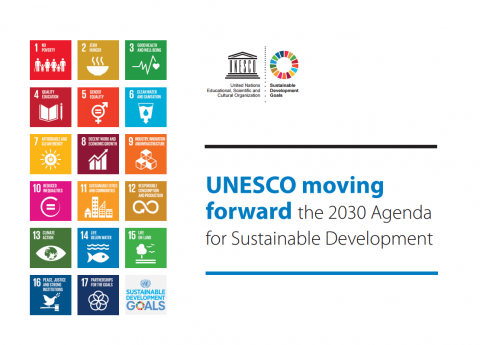 La UNESCO avanza la Agenda 2030 para el Desarrollo Sostenible Year of publication: 2017 Corporate author: Organización de las Naciones Unidas para la Educación, la Ciencia y la Cultura (UNESCO) The United Nations 2030 Agenda for Sustainable Development, with its 17 Sustainable Development Goals, sets forth a bold new framework for development cooperation over the next 15 years. This agenda aspires to ensure prosperity and well-being for all women and men, while protecting our planet and strengthening the foundations for peace. ЮНЕСКО: работа по осуществлению Повестки дня в области устойчивого развития на период до 2030 г. Year of publication: 2017 Corporate author: Организация Объединенных Наций по вопросам образования, науки и культуры (UNESCO) The United Nations 2030 Agenda for Sustainable Development, with its 17 Sustainable Development Goals, sets forth a bold new framework for development cooperation over the next 15 years. This agenda aspires to ensure prosperity and well-being for all women and men, while protecting our planet and strengthening the foundations for peace. 教科文组织助力 《2030年可持续发展议程》 Year of publication: 2017 Corporate author: 联合国教科文组织 (UNESCO) The United Nations 2030 Agenda for Sustainable Development, with its 17 Sustainable Development Goals, sets forth a bold new framework for development cooperation over the next 15 years. This agenda aspires to ensure prosperity and well-being for all women and men, while protecting our planet and strengthening the foundations for peace.
  Intégrer l'ODD 4-Education 2030 dans les politiques et la planification sectorielles: directives techniques à l'intention des bureaux hors Siège de l'UNESCO Year of publication: 2016 Corporate author: Organisation des Nations Unies pour l'éducation, la science et la culture (UNESCO) Mainstreaming SDG4-Education 2030 in sector-wide policy and planning offers technical guidelines for UNESCO field offices to ensure adequate technical support to national authorities. The guidelines take into account the different profiles of countries’ need and capacities, thus avoiding a one-size-fits-all approach. The document contains resources and pointers that can be combined and tailored to fit the particular context of each country. In all cases, UNESCO is expected to ensure that all the relevant information about SDG4-Education 2030 is properly disseminated in these guidelines. Field staff will adapt the guidelines provided here to the country they are serving to ensure that UNESCO plays its role as the leading United Nations agency in the field. Integración del ODS 4-Educación 2030 en la formulación de políticas y planeamiento para todo el sector: directrices técnicas para las oficinas de la UNESCO fuera de la Sede Year of publication: 2016 Corporate author: Organización de las Naciones Unidas para la Educación, la Ciencia y la Cultura (UNESCO) Mainstreaming SDG4-Education 2030 in sector-wide policy and planning offers technical guidelines for UNESCO field offices to ensure adequate technical support to national authorities. The guidelines take into account the different profiles of countries’ need and capacities, thus avoiding a one-size-fits-all approach. The document contains resources and pointers that can be combined and tailored to fit the particular context of each country. In all cases, UNESCO is expected to ensure that all the relevant information about SDG4-Education 2030 is properly disseminated in these guidelines. Field staff will adapt the guidelines provided here to the country they are serving to ensure that UNESCO plays its role as the leading United Nations agency in the field.
  Study on challenges in the development of local equality indicators: a human-rights-centred model; Commitment 2 of the Ten-Point Plan of Action Year of publication: 2010 Author: Klaus Starl | Jennifer Pinno Corporate author: UNESCO | European Training and Research Centre for Human Rights and Democracy (Austria) The study aims at: Providing a theoretical fundament of ECCAR Indicators to measure racism or (in)equality1 and to evaluate municipal anti-discrimination policies (framework concept), and Discussing related legal and practical issues such as legality and reliability of available ‘ethnic’ data (legal and practical preconditions) in the context of ECCAR’s endeavours to set up an ECCAR-wide applicable system of monitoring racism, discrimination, equality and respective municipal policies. The study is structured in three parts. In the first part, preliminary questions concerning legality and practical feasibility of ‘ethnic’ data collection as a prerequisite for the development of and work with adequate indicators will be discussed. The second part deals with the conceptualization of human rights law as the constructing principle of ECCAR Indicators. It includes the discussion of the proposed model of the ECCAR-ADIX. The third part of the study describes practical examples of indicator use in selected ECCAR member cities. The section shows various approaches and gives evidence on different attempts by municipalities to set up fact-based anti-racism policies but also highlights the variety of methods, data, measurement topics, goals, etc.