
Resources
Explore a wide range of valuable resources on GCED to deepen your understanding and enhance your research, advocacy, teaching, and learning.
2,775 Results found
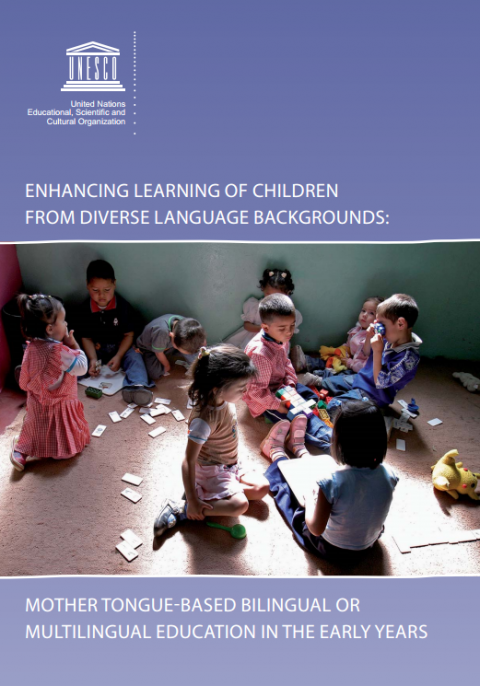 Enhancing learning of children from diverse language backgrounds: mother tongue-based bilingual or multilingual education in the early years Year of publication: 2011 Author: Jessica Ball Corporate author: UNESCO This literature review discusses mother tongue based bilingual or multilingual education for children starting in early childhood. The report: (1) informs policy-makers of existing research and practices in mother-tongue instruction in early childhood and early primary school years; and (2) raises awareness of the value of maintaining the world’s languages and cultures by promoting and resourcing mother tongue-based education for young children. This analysis of current literature is framed within UNESCO’s mandate and strong commitment to quality education for all and to cultural and linguistic diversity in education (UNESCO, 2003a). This discussion is especially timely, given the slow and uneven progress (UNESCO, 2000) in meeting international targets for universal education articulated in the Education for All Goals 1 (ECCE), Goal 2 (Primary Education), and Goal 6 (Quality of Education) (World Declaration on Education for All, 1990).1 Impetus for the current report is provided by the UNESCO (2008a) ‘Global Monitoring Report on Education for All: Will we make it?’ The 2008 GMR report calls for unwavering political will to ensure that education from early childhood onwards is a priority of national governments, civil society and the private sector in order to ensure educational inclusion for the 72 million children out of school and to reduce the numbers of young learners who leave school without acquiring essential skills and knowledge. The report calls for increased investments in the provision of pre-primary education for children aged 3 and above, and for policy measures to provide care and education to children below age 3. UNESCO (2007a) emphasizes the role of early childhood care and development in laying the foundation for learning and setting the stage for successful engagement in formal education. UNESCO has encouraged mother tongue instruction in early childhood and primary education since 1953 (UNESCO, 1953). Yet, monolingualism in official or dominant languages is still the norm around the world (Arnold, Bartlett, Gowani, & Merali, 2006; Wolff & Ekkehard, 2000). In its report, ‘Strong Foundations: Early Childhood Care and Education’, UNESCO (2007a) points out the overlooked advantages of multilingual education in the early years. When children are offered opportunities to learn in their mother tongue, they are more likely to enrol and succeed in school (Kosonen, 2005) and their parents are more likely to communicate with teachers and participate in their children’s learning (Benson, 2002). Mother tongue based education especially benefits disadvantaged groups, including children from rural communities (Hovens, 2002), and girls, who tend to have less exposure to an official language and tend to stay in school longer, achieve better, and repeat grades less oft en when they are taught in their mother tongue (UNESCO Bangkok, 2005). Renforcer l'apprentissage des enfants issus de milieux linguistiques diverses: basée sur la promotion de l'enseignement en langue maternelle ou de l'éducation bilingue multilingue Year of publication: 2011 Author: Jessica Ball Corporate author: UNESCO Cette revue de la littérature aborde la langue maternelle basée éducation bilingue ou multilingue pour les enfants à partir de la petite enfance. Le rapport: (1) informe les décideurs de la recherche et des pratiques en enseignement en langue maternelle dans la petite enfance et les premières années de l'école primaire existante; et (2) soulève conscience de la valeur du maintien des langues et des cultures du monde par la promotion et de ressourcement mère éducation fondée sur la langue, pour les jeunes enfants. Cette analyse de la littérature actuelle est encadrée au sein de l'UNESCO mandat et engagement fort à l'éducation de qualité pour tous et à la diversité culturelle et linguistique dans l'éducation (UNESCO, 2003a). Cette discussion est particulièrement opportune, compte tenu des progrès lents et inégaux (UNESCO, 2000) pour atteindre les objectifs internationaux pour l'Éducation Universelle énoncée dans l'Éducation Pour Tous les Objectifs 1, Objectifs 2 (enseignement primaire), et Objectifs 6 (qualité de l'éducation ) (déclaration mondiale sur l'éducation pour tous, 1990) .1 Impetus pour le rapport actuel est fourni par l'UNESCO (2008a) «Rapport mondial de suivi sur l'éducation pour tous: Allons-nous faire?» le rapport GMR 2008 appelle à une volonté politique sans faille veiller à ce que l'éducation de la petite enfance est en avant une priorité des gouvernements nationaux, la société civile et le secteur privé afin d'assurer l'insertion scolaire pour les 72 millions d'enfants de l'école et de réduire le nombre de jeunes apprenants qui quittent l'école sans avoir acquis les compétences essentielles et de la connaissance.
  Dialogue interculturel: impliquer les jeunes dans le monde entier Year of publication: 2010 Author: Elizabeth Khawajkie Corporate author: UNESCO | DAIMLER It is hoped that this review will help to highlight why there is a persistent call for the continuation of such endeavors, like Mondialogo, which promoted dialogue among cultures and people, mutual respect and understanding so effectively. The Mondialogo journey, begun as an exploratory exercise, ended with compelling and often moving experiences.
 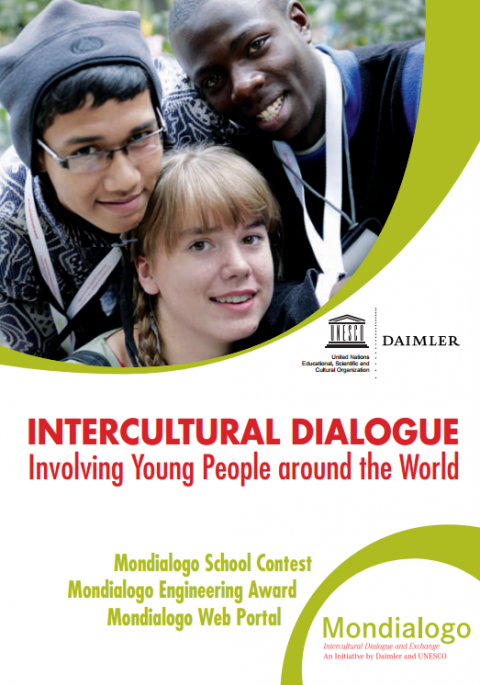 Intercultural dialogue: involving young people around the world Year of publication: 2010 Author: Elizabeth Khawajkie Corporate author: UNESCO | DAIMLER It is hoped that this review will help to highlight why there is a persistent call for the continuation of such endeavors, like Mondialogo, which promoted dialogue among cultures and people, mutual respect and understanding so effectively. The Mondialogo journey, begun as an exploratory exercise, ended with compelling and often moving experiences. Le dialogue interculturel: la participation des jeunes à travers le monde Year of publication: 2010 Author: Elizabeth Khawajkie Corporate author: UNESCO | DAIMLER Il est à espérer que cet examen permettra de mettre en évidence la raison pour laquelle il y a un appel persistant pour la poursuite de ces efforts, comme Mondialogo, qui a favorisé de manière efficace le dialogue entre les cultures et les peuples, le respect mutuel et la compréhension. Le voyage Mondialogo, commencé comme un exercice exploratoire, a pris fin avec des expériences convaincantes et souvent en mouvement. Rapport relatif à l'enquête sur la mise en oeuvre de la Feuille de route pour l'éducation artistique Year of publication: 2010 Corporate author: UNESCO The Road Map for Arts Education is a reference document that aims to explore the role of arts education in meeting the need for creativity and cultural awareness in the 21st Century, while placing emphasis on the strategies required to introduce or promote arts education in the learning environment. Within this conceptual framework, all UNESCO Member States interested in initiating or developing arts education practices can mould their own national policy guidelines, adapted to their socio-cultural specificities. With the Road Map, UNESCO advocates the essential role of arts education within societies, to create a common ground of understanding for all stakeholders. The development of the Road Map for Arts Education was a lengthy and comprehensive consultation process. The document was first elaborated by a group of experts and UNESCO, then presented at the First World Conference on Arts Education (Lisbon, 2006) and later revised and updated, following recommendations from NGOs and Member States. The Road Map was finally distributed to the UNESCO Member States in November 2007 in English and French and then translated into Spanish and Russian following popular demand. More than a year after this distribution, UNESCO launched a wide-ranging survey in order to assess the implementation of the Road Map in its 193 Member States. Through its National Commissions, the Organization relayed this document to Ministries of both Education and Culture. The aim of this exercise was threefold: to learn whether the Road Map was being applied and to what extent it was influencing policy decisions at national level; to act as a reminder of the importance of the UNESCO reference document and encourage its use; finally, to assess the situation of arts education in the responding countries. Thus, this survey not only acted as a catalyst for the implementation of the Road Map, but also provided precious knowledge on arts education around the world. The Member States’ responses also contributed greatly to the Second World Conference on Arts Education (Seoul, May 2010), inspiring one of its main themes and the topics for a number of workshops. They also encouraged a more integral participation of these States in the conference through preparatory consultations. Report on the survey on the implementation of the road map for arts education Year of publication: 2010 Corporate author: UNESCO The Road Map for Arts Education is a reference document that aims to explore the role of arts education in meeting the need for creativity and cultural awareness in the 21st Century, while placing emphasis on the strategies required to introduce or promote arts education in the learning environment. Within this conceptual framework, all UNESCO Member States interested in initiating or developing arts education practices can mould their own national policy guidelines, adapted to their socio-cultural specificities. With the Road Map, UNESCO advocates the essential role of arts education within societies, to create a common ground of understanding for all stakeholders. The development of the Road Map for Arts Education was a lengthy and comprehensive consultation process. The document was first elaborated by a group of experts and UNESCO, then presented at the First World Conference on Arts Education (Lisbon, 2006) and later revised and updated, following recommendations from NGOs and Member States. The Road Map was finally distributed to the UNESCO Member States in November 2007 in English and French and then translated into Spanish and Russian following popular demand. More than a year after this distribution, UNESCO launched a wide-ranging survey in order to assess the implementation of the Road Map in its 193 Member States. Through its National Commissions, the Organization relayed this document to Ministries of both Education and Culture. The aim of this exercise was threefold: to learn whether the Road Map was being applied and to what extent it was influencing policy decisions at national level; to act as a reminder of the importance of the UNESCO reference document and encourage its use; finally, to assess the situation of arts education in the responding countries. Thus, this survey not only acted as a catalyst for the implementation of the Road Map, but also provided precious knowledge on arts education around the world. The Member States’ responses also contributed greatly to the Second World Conference on Arts Education (Seoul, May 2010), inspiring one of its main themes and the topics for a number of workshops. They also encouraged a more integral participation of these States in the conference through preparatory consultations.
  Considerations on the follow-up of the United Nations International Year for the Rapprochement of Cultures with regard to implementation of the Kyiv Statement towards Mutual Understanding and Dialogue Year of publication: 2011 Corporate author: UNESCO As one of the co-initiators of the International Year for the Rapprochement of Cultures, Ukraine proposed to initiate a general discussion regarding the protection of monuments and sites with religious or spiritual meaning (hereinafter referred to as religious2 and sacred3 properties) at the international level. This discussion was timely and in line with one of the four themes, selected to build an action plan for the Year in the fields of UNESCO’s competence, namely to promote reciprocal knowledge of cultural, ethnic, linguistic and religious diversity. 2. This initiative, having constituted one of the essential elements of the International Year of Rapprochement of Cultures, is aimed at enhancing protection and management of religious properties. It stems from the appeal of the Ukrainian authorities, launched at the 35th session of the UNESCO General Conference (2009), inviting all Member States to participate in the International Seminar “The Role of religious communities in the management of World Heritage properties” (2-5 November 2010). This announcement was welcomed by UNESCO within the framework of the Year. Numerous Member States expressing their support for the proposal designated representatives to participate in this Seminar. The elaboration of the Kyiv Statement (as one of the main outcomes of the Seminar) and its adoption in close cooperation with representatives of religious communities contributes to the creation of a culture of dialogue. Considérations sur le Suivi de l'Année Internationale du Rapprochement des Cultures Proclamée par les Nations Unies, Relatives à la mise en Oeuvre de la Déclaration de Kiev en vue de la Compréhension Mutuelle et du Dialogues Year of publication: 2011 Corporate author: Organisation des Nations Unies pour l'éducation, la science et la culture (UNESCO) En tant que l’un des co-initiateurs de l’Année internationale du rapprochement des cultures, l’Ukraine a proposé d’engager un débat général sur la protection des monuments et des sites possédant une signification religieuse ou spirituelle (ci-après désignés comme biens religieux2 et sacrés3) au niveau international. Ce débat intervenait en temps opportun et correspondait à l’un des quatre thèmes retenus pour l’élaboration d’un plan d’action pour l’Année dans les domaines de compétence de l’UNESCO, à savoir la promotion d’une connaissance réciproque de la diversité culturelle, ethnique, linguistique et religieuse. ПЕРЕКЛИКАЮЩИЕСЯ ГОЛОСА: Десятая годовщина принятия Всеобщей декларации ЮНЕСКО о культурном разнообразии Year of publication: 2011 Corporate author: Организация Объединенных Наций по вопросам образования, науки и культуры (UNESCO) This founding text was the first to acknowledge cultural diversity as “the common heritage of humanity”. It is with great pride that UNESCO is commemorating the 10th anniversary of the Declaration. Commemorate – from the Latin cum memorare – means quite literally “to remember together” or “to remember with”. This collection is compiled the voices of all those who have contributed to the heightening of human awareness by throwing into relief the inestimable value of cultural diversity. These excerpts from books, articles and statements by global intellectual and political leaders, artists and Nobel Prize-winners all call for the safeguarding of cultural diversity, which is inseparable from respect for human dignity. Their voices resound in bearing witness to the strength of cultural diversity and to its capacity to enlighten the minds of women and men. We are duty-bound to ensure that it is central to public policies and a resource for development and dialogue among nations. The United Nations was born of the determination of men and women “to save succeeding generations from the scourge of war...”. In accordance with that principle, UNESCO was established on a key idea, expressed at the very beginning of its Constitution: “... since wars begin in the minds of men, it is in the minds of men that the defences of peace must be constructed”. In the world today, globalized, connected and interdependent as never before, this mission is more vital than ever. The rapprochement of peoples and cultures requires a commensurately global awareness. Cultural diversity has always been at the heart of international relations. It is also, increasingly, a feature of the contemporary mixed and plural societies in which we live. In view of this reality, we must formulate appropriate public policies and rethink the mechanisms of social cohesion and civic participation. How can we build common ground on the basis of such diversity? How can we construct genuine moral and intellectual solidarity of humanity? Any new vision of humanism must be grounded itself in the dynamism and diversity of cultural heritage. It is a source of inspiration and knowledge to be shared and a means of broadening our horizons. The goal of the UNESCO Universal Declaration on Cultural Diversity is to provide keys and benchmarks for capitalizing on this wealth. There can be no sustainable governance if cultural diversity is not acknowledged. There can be no economic and social development if specific features of every culture are belittled and ignored.