
Resources
Explore a wide range of valuable resources on GCED to deepen your understanding and enhance your research, advocacy, teaching, and learning.
2,193 Results found
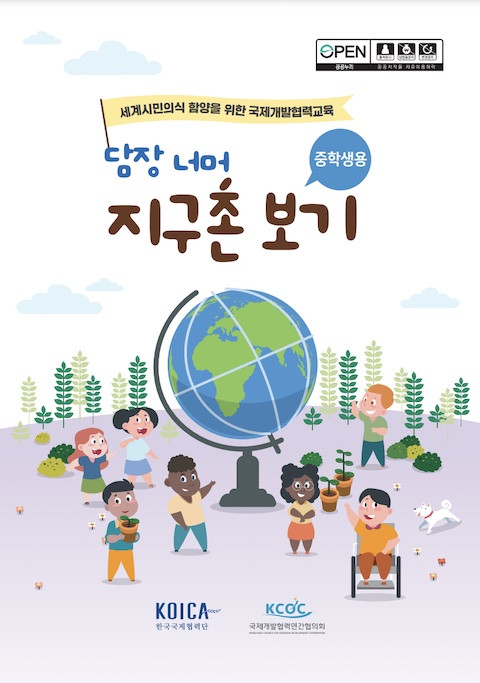 담장 너머 지구촌 보기: 세계시민의식 함양을 위한 국제개발협력교육; 중학생용 Year of publication: 2021 Author: 이태주 | 김다원 | 김현주 Corporate author: 한국국제협력단 | 국제개발협력민간협의회 세계화, 문화다양성, 지속가능발전, 평화 등을 주제로 한 중학생용 세계시민교육 교수학습자료로 다양한 모둠별 학습활동지를 담고 있다.본 자료는 한국국제협력단과 국제개발협력민간협의회에서 2021년 작성하여 공공누리 제4유형으로 개방한 ‘담장 너머 지구촌 보기: 세계시민의식 함양을 위한 국제개발협력교육; 중학생용’ 을 이용하였으며 국제개발협력민간협의회 홈페이지(http://www.ngokcoc.or.kr)에서 다운로드 하실 수 있습니다.
 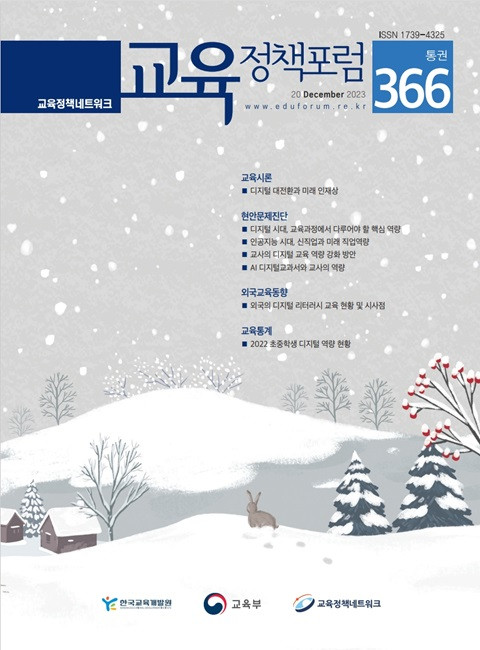 디지털 대전환과 미래 인재상 (교육정책포럼; 2023년 12월, Vol. 366) Year of publication: 2023 Corporate author: 한국교육개발원 교육시론ㅁ 디지털 대전환과 미래 인재상 현안문제진단ㅁ 디지털 시대, 교육과정에서 다루어야 할 핵심 역량ㅁ 인공지능 시대, 신직업과 미래 직업역량ㅁ 교사의 디지털 교육 역량 강화 방안ㅁ AI 디지털교과서와 교사의 역량 외국교육동향ㅁ 외국의 디지털 리터러시 교육 현황 및 시사점 교육통계ㅁ 2022 초중학생 디지털 역량 현황
 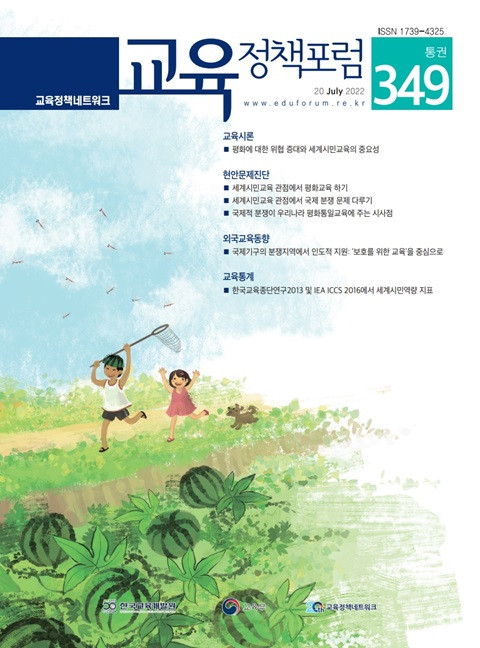 평화에 대한 위협 증대와 세계시민교육의 중요성 (교육정책포럼; 2022년 7월, Vol. 349) Year of publication: 2022 Corporate author: 한국교육개발원 교육시론ㅁ 평화에 대한 위협 증대와 세계시민교육의 중요성 현안문제진단ㅁ 세계시민교육 관점에서 평화교육 하기ㅁ 세계시민교육 관점에서 국제 분쟁 문제 다루기ㅁ 국제적 분쟁이 우리나라 평화통일교육에 주는 시사점 외국교육동향ㅁ [국제기구] 분쟁지역에서 인도적 지원: ‘보호를 위한 교육’을 중심으로 교육통계ㅁ 한국교육종단연구2013 및 IEA ICCS 2016에서 세계시민역량 지표
 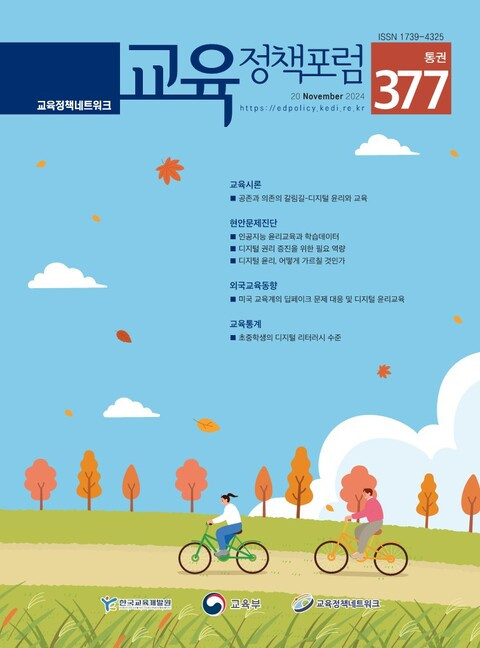 공존과 의존의 갈림길-디지털 윤리와 교육(교육정책포럼; 2024년 11월, Vol. 377) Year of publication: 2024 Corporate author: 한국교육개발원 교육시론■ 공존과 의존의 갈림길-디지털 윤리와 교육 현안문제진단■ 인공지능 윤리교육과 학습데이터■ 디지털 권리 증진을 위한 필요 역량■ 디지털 윤리, 어떻게 가르칠 것인가 외국교육동향■ 미국 교육계의 딥페이크 문제 대응 및 디지털 윤리교육 교육통계■ 초중학생의 디지털 리터러시 수준
 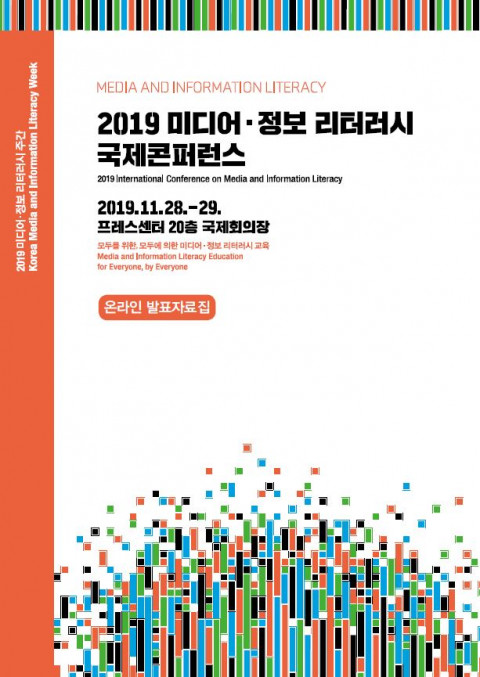 2019 미디어·정보 리터러시 국제콘퍼런스: 온라인 발표자료집 Year of publication: 2020 Author: Julian Sefton-Green | Matthew Johnson | Jagtar Singh | Jaehee Cho | Benjamin Thull | Jungim Ahn | Seojoong Kim | Dokyung Lee | Jaeyoung Chung | Cheungmoon Cho | Hyungtae Kim | Ohyeon Kweon | Eunryung Chong | Dayyoung Oh | Junehee Jung | Jerry Jacques | Hyeonseon Jeong | Jérémy Grosman | Anne-Sophie Collard | Maxime Verbesselt | Valentine François | Kyeong Hur | Amie Kim | Yeonju Oh | Gwanghee Kim | Minyoung Choi | Seungku Jung | Jisu Kim | Eunmi Hwang | Seongcheol Lee | Yeonju Choi Corporate author: 시청자미디어재단 | 전국미디어센터협의회 | 한국방송공사 | 한국정보화진흥원 | 유네스코한국위원회 | 한국교육학술정보원 2019년 미디어·정보 리터러시 주간 행사로 11월 28~29일 개최되었던 미디어·정보 리터러시 국제콘퍼런스의 온라인 발표자료집으로 미디어리터러시, 디지털리터러시, 미디어 교육의 현황과 과제 및 디지털 사회에 맞는 새로운 디지털 리터러시 모델의 필요성에 대해서 논의 하였다.
  사이버 미학 01 : 정보 윤리 주제 인성 교육 자료 초5-6 Year of publication: 2021 Author: 차우규 | 신호재 | 김아영 | 홍아름 | 김홍일 | 김영환 | 김택한 | 신민철 | 심성호 | 표가영 Corporate author: 한국과학창의재단 | 대한민국 교육부 『사이버 미학1』는 컴퓨터 사용량이 급격히 늘어나는 초등학교 5-6학년을 대상으로 한 정보윤리 주제 인성교육 프로그램으로서, 사이버 공간에서의 윤리적인 문제들을 다루고자 하였다. 본 자료에서 사이버 공간을 이용하는 학생들의 인성 함양과 민주시민성 강화를 위한 여러 교육 프로그램을 제시하였다.
  사이버미학 02: 정보 윤리 주제 인성 교육 자료 중1-3 Year of publication: 2021 Author: 차우규 | 신호재 | 김아영 | 민혜정 | 김수영 | 김역 | 이수빈 | 최명진 Corporate author: 한국과학창의재단 | 대한민국 교육부 『사이버 미학2』는 컴퓨터 사용량이 급격히 늘어나는 중학교 1-3학년을 대상으로 한 정보윤리 주제 인성교육 프로그램으로서, 사이버 공간에서의 윤리적인 문제들을 다루고자 하였다. 본 자료에서 사이버 공간을 이용하는 학생들의 인성 함양과 민주시민성 강화를 위한 여러 교육 프로그램을 제시하였다. 자료 구성에서 중점적으로 눈여겨 볼 사항은 아래와 같다.내용의 일관성과 중복을 피하여 자료를 구상하고, 교과 수업 시간에 정보윤리 주제 인성교육 프로그램을 운영할 수 있도록 관련 성취기준을 제시하였다.각 차시별 수업 활용도를 높이기 위해 주체별 차시를 모듈형으로 구성하고 교사용 PPT를 함께 개발하였다.차시별 프로그램은 교사용 수업 지원 자료와 학생 활동지 및 학생 도움자료로 구성 되었으며 교과 및 창의적 체험활동 시간을 다양하게 활용할 수 있도록 하였다.비대면 수업 상황에서 정보윤리 주제 인성 교육 수업이 가능하도록 다양한 온라인 플랫폼에 기 반한 자료를 개발하였다.
 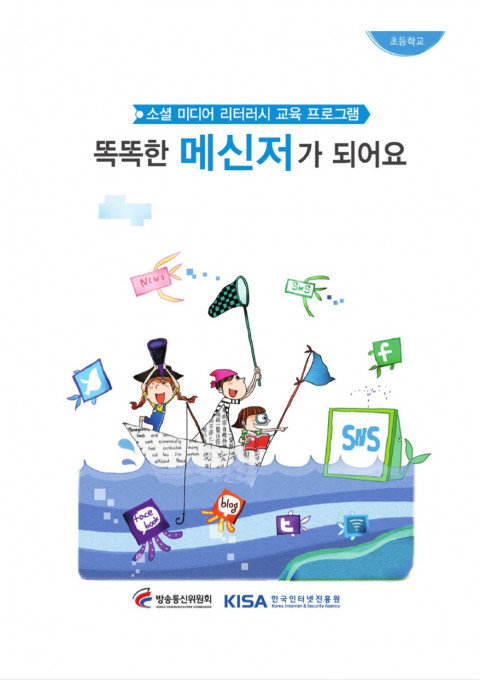 똑똑한 메신저가 되어요: 소셜 미디어 리터러시 교육 프로그램; 초등학교 Year of publication: 2012 Author: 김양은 | 박한철 | 배은주 | 정연실 | 심성호 Corporate author: 한국인터넷진흥원 본 자료는 스마트 시대에 수많은 정보와 지식 가운데서 유용하고 필요한 정보를 구분해 내고 책임있게 전달하게 할 수 있도록 도와주는 활동을 담고 있다.본 저작물은 한국인터넷진흥원에서 2012년 작성하여 공공누리 제 4유형으로 개방한 ‘똑똑한 메신저가 되어요: 소셜 미디어 리터러시 교육 프로그램(김양은 외)’을 이용하였으며 해당 저작물은 방송통신위원회·한국지능정보사회진흥원, 아름다운 인터넷 세상 홈페이지(www.아인세.kr)에서 무료로 다운받으실 수 있습니다.
 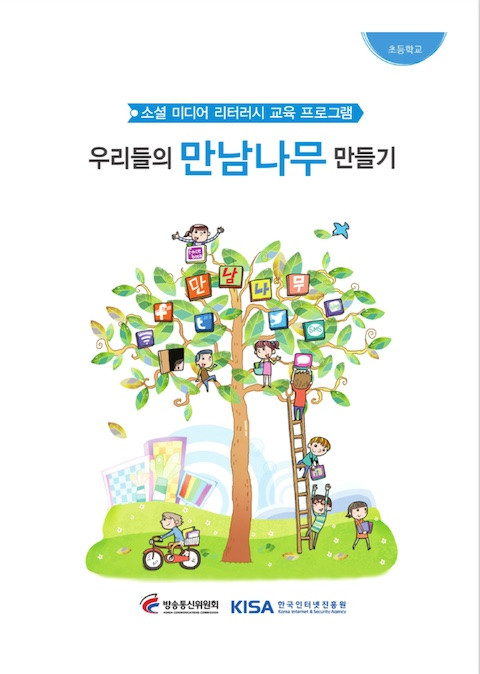 우리들의 만남나무 만들기: 소셜 미디어 리터러시 교육 프로그램; 초등학교 Year of publication: 2012 Author: 김양은 | 박한철 | 배은주 | 정연실 | 심성호 Corporate author: 한국인터넷진흥원 본 자료는 SNS의 특징을 이해하고 소셜미디어를 통해 건강하고 다양한 관계를 만들기 위해 어떤 노력을 해야 할 지 생각해 보는 활동으로 구성하였다.본 저작물은 한국인터넷진흥원에서 2012년 작성하여 공공누리 제 4유형으로 개방한 ‘우리들의 만남나무 만들기: 소셜 미디어 리터러시 교육 프로그램 (김양은 외)’을 이용하였으며 해당 저작물은 방송통신위원회·한국지능정보사회진흥원, 아름다운 인터넷 세상 홈페이지(www.아인세.kr)에서 무료로 다운받으실 수 있습니다.
 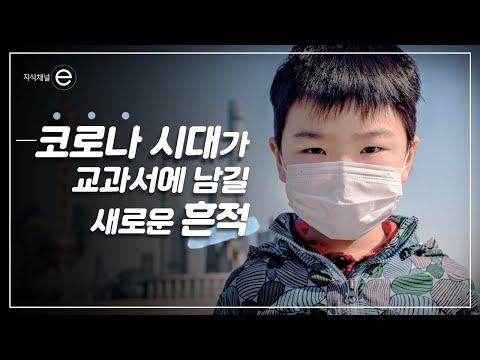 교과서 너머의 이야기: 코로나 시대가 교과서에 남길 새로운 흔적 Year of publication: 2020 Corporate author: 한국교육방송공사 | 서울특별시교육청 본 자료는 코로나19이후 대안교육으로서 중요성이 부각되고 있는 세계시민성 함양 교육을 위해 학교 및 기관에서 적극 활용할 수 있도록 서울시교육청과 EBS가 공동으로 제작하고 방영한 지식채널e 세계시민교육 영상이다.