
Resources
Explore a wide range of valuable resources on GCED to deepen your understanding and enhance your research, advocacy, teaching, and learning.
2,775 Results found
 Meeting on Learning to Live Sustainably in Cities in Latin America and the Caribbean, Villa María, Argentina (26-28 April 2017): Meeting Report Year of publication: 2017 Corporate author: UNESCO Villa Maríia, the first Argentinian city to join the UNESCO Global Network of Learning Cities (GNLC), co-hosted the first GNLC meeting in the region, titled ‘Learning to live sustainably in cities in Latin America and the Caribbean’. This three-day event was a joint effort of the City of Villa Maríia, the UNESCO Institute for Lifelong Learning (UIL), UNESCO Headquarters, and the UNESCO Regional Bureau for Education in Latin America and the Caribbean (OREALC/UNESCO Santiago). Participants explored new ways to implement sustainable solutions at the local level, as well as increase awareness and training related to Education for Sustainable Development (ESD). More than 170 city representatives from over 40 cities and 20 countries (including mayors and deputy mayors, experts, authorities and practitioners) were welcomed by the host city. The first day of the meeting was composed of plenary sessions; the second day consisted of two parallel workshop sessions: (1) a regional workshop on the Global Action Programme (GAP) on ESD and Cities, and (2) a regional workshop on learning cities. Aprender a Vivir de Manera Sostenible en Ciudades de América Latina y el Caribe, Villa María (Argentina), 26-28 de abril de 2017: informe de la reunión Year of publication: 2017 Corporate author: UNESCO Villa Maríia, la primera ciudad argentina que entróo a formar parte de la Red Mundial de Ciudades del Aprendizaje de la UNESCO, fue una de las organizadoras de la primera reunióon de esta Red en la regióon, titulada “Aprender a vivir de manera sostenible en ciudades en Améerica Latina y el Caribe”. Este acto, de tres díias de duracióon, fue una iniciativa conjunta de la ciudad de Villa Maríia, el Instituto de la UNESCO para el Aprendizaje a lo Largo de Toda la Vida (IUAL), la Sede de la UNESCO y la Oficina Regional de Educacióon de la UNESCO para Améerica Latina y el Caribe (OREALC/UNESCO Santiago). Los participantes estudiaron nuevas formas de poner en práactica soluciones sostenibles a escala local, asíi como de fomentar una mayor sensibilizacióon y formacióon en materia de educacióon para el desarrollo sostenible (EDS). Villa Maríia acogióo a máas de 170 representantes de máas de 40 ciudades y 20 paíises, entre los que se encontraban alcaldes y tenientes de alcalde, expertos, autoridades y profesionales. Durante la primera jornada de la reunióon tuvieron lugar reuniones plenarias y la segunda jornada se dividióo en dos sesiones paralelas de talleres: 1) un taller regional sobre el Programa de Accióon Mundial de EDS y las ciudades, y 2) un taller regional sobre las ciudades del aprendizaje.
  Accountability in Education: Meeting our Commitments; Global Education Monitoring Report, Youth Version, 2017/8 Year of publication: 2017 Corporate author: UNESCO This Youth Report, based on findings and conclusions from the 2017/8 Global Education Monitoring report, asks how young people are involved in the process of accountability in education. As students, what are we responsible for in our education and how are we held accountable? How can we make sure other actors – like schools, universities and governments – are held accountable for their responsibilities? These are critical questions, because we know that there’s a long way to go before all young people around the world have access to a quality education: absent teachers, overcrowded classrooms, illegitimate diplomas, unregulated private schools and truancy are all issues that education systems are struggling to overcome.It’s sometimes tempting to say that these problems aren’t ours to fix, that the responsibility lies with the government or with an older generation. But this simply isn’t true: education is a shared responsibility, and young people have an important role to play. In this Report, you’ll hear the stories of young people around the world who have stood up for the right to education in their communities and who have been integral in triggering change. You’ll also read about how you can become involved in our campaign to make sure governments can be held to account for education. This means making sure that citizens can take their governments to court if they are not meeting their education responsibilities. From creating video clips to holding awareness-raising events, there is a range of ways to make your voice heard. Your involvement is integral in making sure the world is on the right path to meeting our education goals. Rendir cuentas en el ámbito de la educación: cumplir nuestros compromisos; Informe de seguimiento de la educación en el mundo, versión para los jóvenes, 2017/8 Year of publication: 2017 Corporate author: Organización de las Naciones Unidas para la Educación, la Ciencia y la Cultura (UNESCO) Esta versión para los jóvenes del Informe GEM, que se basa en los resultados y conclusiones del Informe de Seguimiento de la Educación en el Mundo 2017-2018, se cuestiona acerca de la manera en que los jóvenes participan en el proceso de rendición de cuentas en la educación. En tanto que alumnos, ¿de qué somos responsables en nuestra educación, y cómo se nos responsabiliza? ¿Cómo podemos asegurarnos de que se responsabilice a otros interesados, como las escuelas, las universidades y los gobiernos, por lo que deben hacer? Estas son preguntas fundamentales, porque sabemos que quedan aún muchas cuestiones por resolver para que todos los jóvenes del mundo tengan acceso a una educación de calidad. El ausentismo de los docentes, el hacinamiento de las aulas, los diplomas ilícitos, las escuelas privadas no reglamentadas y el ausentismo de los alumnos son cuestiones que los sistemas educativos se esfuerzan por superar.Sería fácil afirmar que la resolución de esos problemas no está en nuestras manos, y que la responsabilidad es del gobierno o de una generación anterior. Pero esto simplemente no es cierto; la educación es una responsabilidad compartida, y los jóvenes desempeñan en ese sentido un papel importante. En este informe conocerá las historias de jóvenes de todo el mundo que han defendido el derecho a la educación en sus comunidades, y que han contribuido a motivar un cambio. También leerá sobre las maneras en que podrá participar en nuestra campaña para garantizar que se responsabilice a los gobiernos por la educación. Esto significa asegurarse de que los ciudadanos puedan llevar a sus gobiernos ante la justicia si no cumplen sus responsabilidades en materia de educación. Desde grabar vídeos hasta organizar actos de sensibilización, son muchas las maneras de hacerse escuchar. Su participación es indispensable para garantizar que el mundo transite por la vía correcta para alcanzar nuestros objetivos sobre la educación.
  [Summary] Investing in Cultural Diversity and Intercultural Dialogue: UNESCO World Report; Executive Summary Year of publication: 2009 Corporate author: UNESCO Cultural diversity has emerged as a key concern at the turn of a new century. Yet the meanings attached to this catch-all term are as varied as they are shifting. Some see cultural diversity as inherently positive, insofar as it points to a sharing of the wealth embodied in each of the world’s cultures and, accordingly, to the links uniting us all in processes of exchange and dialogue. For others, cultural differences are what cause us to lose sight of our common humanity and are therefore at the root of numerous conflicts.This second diagnosis is today all the more plausible since globalization has increased the points of interaction and friction between cultures, giving rise to identity-linked tensions, withdrawals and claims, particularly of a religious nature, which can become potential sources of dispute. The essential challenge, therefore, would be to propose a coherent vision of cultural diversity and thereby to clarify how, far from being a threat, it can become beneficial to the action of the international community. This is the essential purpose of the present report.
  Global Citizenship Education: Topics and Learning Objectives Year of publication: 2015 Corporate author: UNESCO This publication, titled Global Citizenship Education: Topics and learning objectives, is the first pedagogical guidance from UNESCO on global citizenship education. It is the result of an extensive research and consultation process with experts from different parts of the world. This guidance draws on the UNESCO publication Global Citizenship Education: Preparing learners for the challenges of the 21st century and the outcomes of three key UNESCO events on global citizenship education: the Technical Consultation on Global Citizenship Education (September 2013), as well as the First and Second UNESCO Fora on Global Citizenship Education, organized in December 2013 and January 2015 respectively. Before it was finalized, the guidance was field-tested by education stakeholders in selected countries in all regions to ensure its relevance in different geographical and socio-cultural contexts. Following the foundational work of UNESCO to clarify the conceptual underpinnings of global citizenship education and provide policy and programmatic directions, this document has been developed in response to the needs of Member States for overall guidance on integrating global citizenship education in their education systems. It presents suggestions for translating global citizenship education concepts into practical and age-specific topics and learning objectives in a way that allows for adaptation to local contexts. It is intended as a resource for educators, curriculum developers, trainers as well as policy-makers, but it will also be useful for other education stakeholders working in non-formal and informal settings.
  Éducation à la citoyenneté mondiale: thèmes et objectifs d'apprentissage Year of publication: 2015 Corporate author: UNESCO Le présent ouvrage, intitulé Éducation à la citoyenneté mondiale : Thèmes et objectifs d’apprentissage, est le premier guide pédagogique de l’UNESCO sur l’éducation à la citoyenneté mondiale. Il est le fruit d’un processus approfondi de recherche et de consultation avec des spécialistes de différentes régions du monde. Ce guide s’inspire de la publication de l’UNESCO intitulée Éducation à la citoyenneté mondiale : Préparer les apprenants aux défis du XXIe siècle ainsi que des résultats de trois événements clés de l’UNESCO sur l’éducation à la citoyenneté mondiale : la Consultation technique sur l’éducation à la citoyenneté mondiale (septembre 2013) et les premier et deuxième Forums de l’UNESCO sur l’éducation à la citoyenneté mondiale, organisés en décembre 2013 et en janvier 2015. Avant sa finalisation, le guide a été expérimenté sur le terrain par des acteurs de l’éducation dans différents pays de chaque région, afin de veiller à ce qu’il soit adapté à des contextes géographiques et socioculturels divers. Inspirée des travaux de base de l’UNESCO visant à clarifier les fondements conceptuels de l’éducation à la citoyenneté mondiale, et à fournir des orientations politiques et programmatiques, cette publication a été élaborée pour répondre aux besoins des États membres, en leur donnant des indications générales sur l’intégration de l’éducation à la citoyenneté mondiale dans leurs systèmes éducatifs. Elle propose des moyens de transposer l’éducation à la citoyenneté mondiale dans des thèmes et des objectifs d’apprentissage pratiques et tenant compte de l’âge de l’apprenant, qui puissent être adaptés aux contextes locaux. Cette publication a été conçue pour servir de document de référence aux éducateurs, aux concepteurs de programmes éducatifs, aux formateurs et aux décideurs, mais elle sera également utile à d’autres acteurs de l’éducation travaillant dans des contextes non formels et informels.
  Educación para la ciudadanía mundial: temas y objetivos de aprendizaje Year of publication: 2015 Corporate author: UNESCO La educación para la ciudadanía mundial aspira a ser un factor de transformación, inculcando los conocimientos, las habilidades, los valores y las actitudes que los educandos necesitan para poder contribuir a un mundo más inclusivo, justo y pacífico.La presente publicación, titulada Educación para la ciudadanía mundial: Temas y objetivos de aprendizaje, es la primera guía de la UNESCO al respecto. Se presentan sugerencias para plasmar los conceptos de la educación para la ciudadanía mundial en temas y objetivos de aprendizaje específicos para cada grupo de edad de un modo que facilita su adaptación a las circunstancias locales. Es un recurso para los educadores, los responsables de la elaboración de programas de estudios, los instructores y los encargados de la formulación de políticas, pero también será de utilidad para otros copartícipes en la educación que trabajan en contextos no formales e informales.
 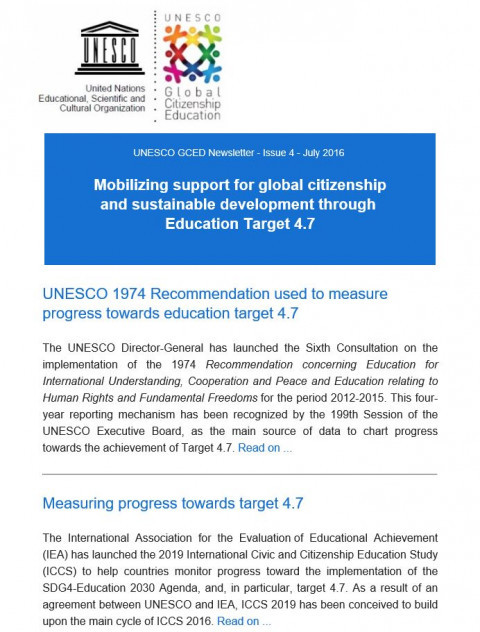 UNESCO GCED eNewsletter Issue 4 Year of publication: 2016 Corporate author: UNESCO Feature: Mobilizing support for global citizenship and sustainable development through Education Target 4.7 UNESCO 1974 Recommendation used to measure progress towards education target 4.7 Measuring progress towards 4.7 Gyeongju Action Plan: NGOs join UNESCO Global capacity-building workshop on GCED organized by APCEIU Southern Africa Regional Meeting on GCED convened in Johannesburg, South Africa UNESCO launches Teacher's Guide on the Prevention of Violent Extremism Expert meeting on the Prevention of Violent Extremism through Education European ministers back education for democracy to counter extremism and racaism UN discusses innovative solutions to prevent violent extremism through education UNESCO's YESPeace Network taps the power of youth worldwide to change the future GCED Topics and Learning Objectives available in seven languages.
 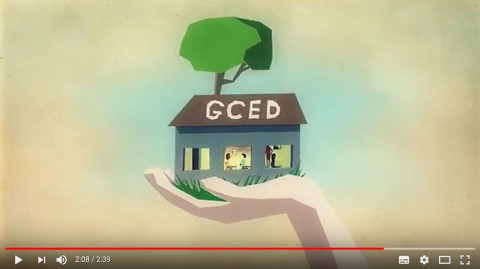 [Video] Learning to live together in peace through Global Citizenship Education Year of publication: 2016 Corporate author: UNESCO The UNESCO video on “Learning to live together in peace through Global Citizenship Education” explains the importance of Global Citizenship Education (GCED) in a globalized and increasingly interconnected and interdependent world. GCED is key to understand the interconnections between the local and the global and nurture a sense of belonging to a common humanity. It builds motivation to assume active roles to contribute to a more just, peaceful, tolerant and sustainable world. The video also illustrates how GCED can be delivered in and outside of schools.