
Resources
Explore a wide range of valuable resources on GCED to deepen your understanding and enhance your research, advocacy, teaching, and learning.
3,229 Results found
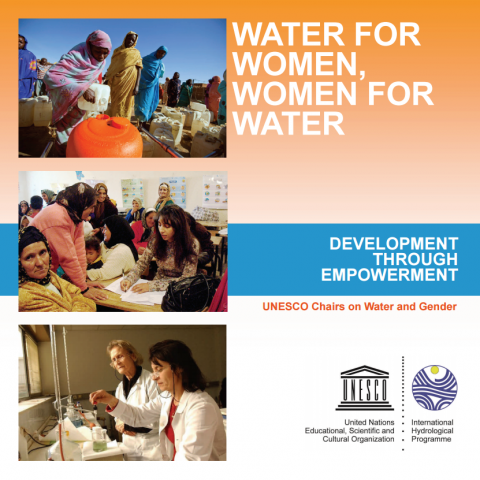 Water for Women, Women for Water: UNESCO's Chairs on Water and Gender Year of publication: 2014 Corporate author: منظمة الأمم المتحدة للتربية والعلم والثقافة (UNESCO) The access to sufficient, safe and affordable water is a basic human right. It calls for governments, institutions, corporations and public and private organizations involved in the water sector to eliminate various forms of discrimination in the access, management and decision‐making processes involving water resources. Within the framework of the UNITWIN/UNESCO Chairs Programme, UNESCO has established five Chairs seeking to promote the engagement of women in sustainable development and water resource management. These Chairs integrate the UNESCO Water Family, consisting of the International Hydrological Programme (IHP), water‐related Centers’, the UNESCO‐IHE Institute for Water Education, the World Water Assessment Programme (WWAP), and a total of 35 UNESCO Chairs and UNITWIN Networks.Located in Brazil, Côte d’Ivoire, Morocco, Togo and the Dominican Republic, the Chairs are based in institutions of research and higher education, working actively to develop human resources, build solutions, and share scientific and practical knowledge. They work in partnership with other academic institutions, as well as public and private organizations. They also pave the way for the research and higher education communities to join forces with UNESCO in an effort to achieve internationally agreed Development Goals and targets. With a high appreciation for the Chairs’ great potential for impact, IHP has strongly encouraged their projects and initiatives, as well their involvement in other focal areas of the Eighth Phase of IHP, in order to strengthen water security, enhance tertiary and technical water education and respond to the needs of communities, with a special focus on women’s needs. With their inception in 2006, the UNESCO Chairs on Water and Gender have built a remarkable combination of knowledge and experience in their area of expertise. Through their actions, the Chairs have successfully fostered cooperation and exchange of information among different institutions of higher education; conducted research and training activities on gender‐related issues, water and natural sciences; established networks between professionals, governmental, non‐governmental and private organizations; created new approaches to deal with the water‐related needs of local communities and succeeded in increasing participation, leadership and the role of women in the water sector.As a general goal, the Chairs strive to enhance women’s capacities through motivation, engagement, development of skills and education. They have been active in organizing learning courses, training sessions, workshops, conferences and a diverse range of research and community projects. The following pages present a detailed overview of the five Chairs and their goals, activities, and initiatives.
 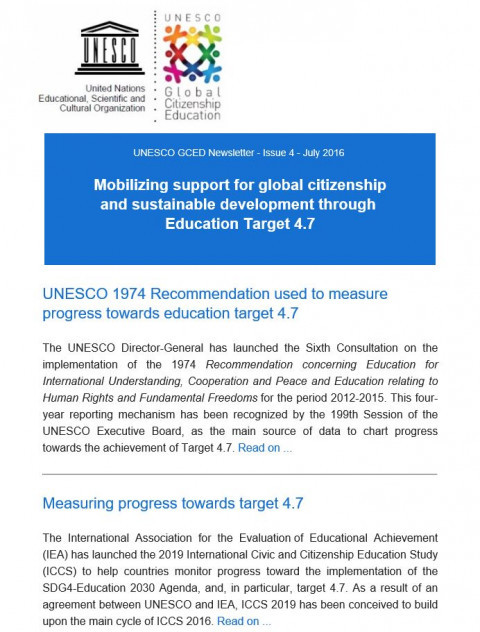 UNESCO GCED eNewsletter Issue 4 Year of publication: 2016 Corporate author: UNESCO Feature: Mobilizing support for global citizenship and sustainable development through Education Target 4.7 UNESCO 1974 Recommendation used to measure progress towards education target 4.7 Measuring progress towards 4.7 Gyeongju Action Plan: NGOs join UNESCO Global capacity-building workshop on GCED organized by APCEIU Southern Africa Regional Meeting on GCED convened in Johannesburg, South Africa UNESCO launches Teacher's Guide on the Prevention of Violent Extremism Expert meeting on the Prevention of Violent Extremism through Education European ministers back education for democracy to counter extremism and racaism UN discusses innovative solutions to prevent violent extremism through education UNESCO's YESPeace Network taps the power of youth worldwide to change the future GCED Topics and Learning Objectives available in seven languages.
  [Video] Learning to live together in peace through Global Citizenship Education Year of publication: 2016 Corporate author: UNESCO The UNESCO video on “Learning to live together in peace through Global Citizenship Education” explains the importance of Global Citizenship Education (GCED) in a globalized and increasingly interconnected and interdependent world. GCED is key to understand the interconnections between the local and the global and nurture a sense of belonging to a common humanity. It builds motivation to assume active roles to contribute to a more just, peaceful, tolerant and sustainable world. The video also illustrates how GCED can be delivered in and outside of schools. [Vidéo] Apprendre à vivre ensemble dans la paix par l’éducation à la citoyenneté mondiale Year of publication: 2016 Corporate author: Organisation des Nations Unies pour l'éducation, la science et la culture (UNESCO) La vidéo de l'UNESCO sur le thème "Apprendre à vivre ensemble dans la paix par l’Éducation à la Citoyenneté Mondiale", explique l'importance de l'Éducation à la Citoyenneté Mondiale (ECM) dans un monde globalisé et de plus en plus interconnecté et interdépendant. ECM est essentiel de comprendre les interconnexions entre le local et le global et à favoriser un sentiment d'appartenance à une humanité commune. Il construit la motivation à assumer un rôle actif pour contribuer à un monde plus juste, pacifique, tolérante et durable. La vidéo montre également comment ECM peut être livré dans et à l'extérieur des écoles.
 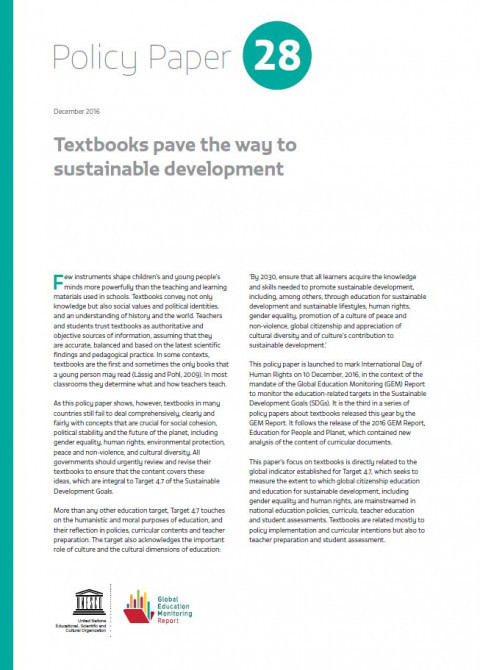 Textbooks pave the way to sustainable development (Policy paper 28) Year of publication: 2016 Corporate author: UNESCO This paper’s focus on textbooks is directly related to the global indicator established for Target 4.7, which seeks to measure the extent to which global citizenship education and education for sustainable development, including gender equality and human rights, are mainstreamed in national education policies, curricula, teacher education and student assessments. Textbooks are related mostly to policy implementation and curricular intentions but also to teacher preparation and student assessment. Rapport mondial de suivi sur l'éducation: document d'orientation Year of publication: 2016 Corporate author: Organisation des Nations Unies pour l'éducation, la science et la culture (UNESCO) This paper’s focus on textbooks is directly related to the global indicator established for Target 4.7, which seeks to measure the extent to which global citizenship education and education for sustainable development, including gender equality and human rights, are mainstreamed in national education policies, curricula, teacher education and student assessments. Textbooks are related mostly to policy implementation and curricular intentions but also to teacher preparation and student assessment. Informe de seguimiento de la educatión en el mundo: documento de política Year of publication: 2016 Corporate author: Organización de las Naciones Unidas para la Educación, la Ciencia y la Cultura (UNESCO) This paper’s focus on textbooks is directly related to the global indicator established for Target 4.7, which seeks to measure the extent to which global citizenship education and education for sustainable development, including gender equality and human rights, are mainstreamed in national education policies, curricula, teacher education and student assessments. Textbooks are related mostly to policy implementation and curricular intentions but also to teacher preparation and student assessment.
 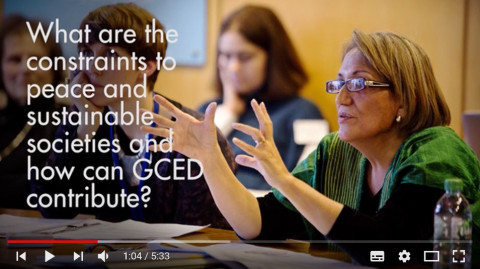 [Video] Second UNESCO Forum on Global Citizenship Education Year of publication: 2015 Corporate author: UNESCO Highlights of the Second UNESCO Forum on Global Citizenship Education (GCED) Building peaceful and sustainable societies: preparing for post-2015 (28-30 January 2015,UNESCO HQ, Paris). The Forum was organized by the Division for Teaching, Learning and Content, Education Sector, UNESCO, with the support of Austria, the Sultanate of Oman and the Republic of Korea, and the UN Secretary-General’s Global Education First Initiative (GEFI).
 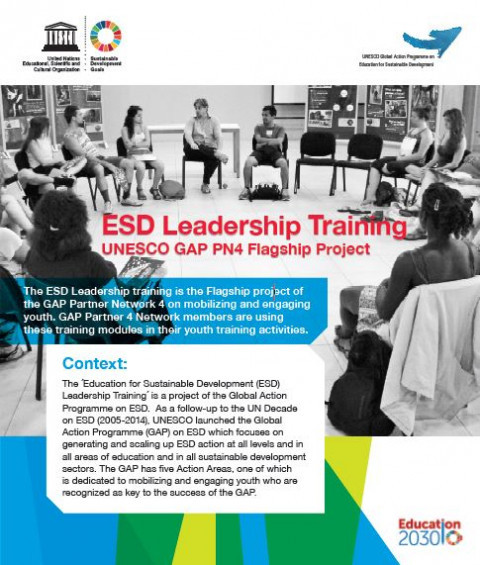 ESD Leadership Training: UNESCO GAP PN4 Flagship Project Year of publication: 2017 Corporate author: UNESCO The ESD Leadership training is the Flagship project of the GAP Partner Network 4 on mobilizing and engaging youth. GAP Partner 4 Network members are using these training modules in their youth training activities. Formation au Leadership pour l'EDD: Projet phare GAP PN4 de l'UNESCO Year of publication: 2017 Corporate author: Organisation des Nations Unies pour l'éducation, la science et la culture (UNESCO) La formation au leadership pour l’EDD est le projet phare du réseau de partenaires 4 (PN4) mis en place pour le Programme d’action global en vue d’autonomiser et de mobiliser les jeunes. Les membres de ce réseau utilisent ces modules pour leurs activités de formation des jeunes.