
Resources
Explore a wide range of valuable resources on GCED to deepen your understanding and enhance your research, advocacy, teaching, and learning.
883 Results found
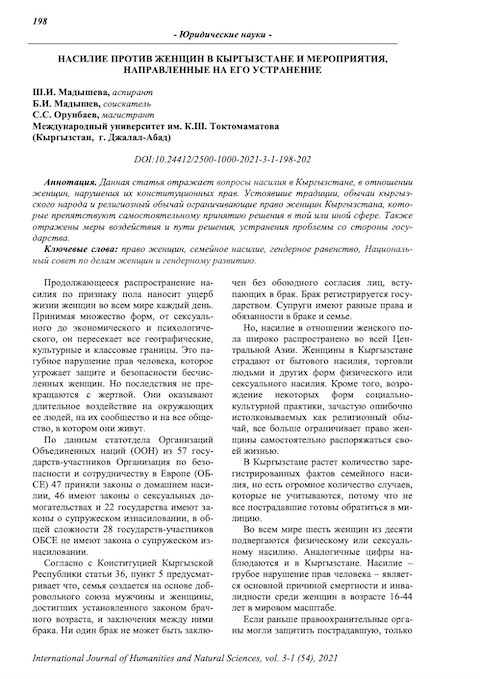 Violence Against Women in Kyrgyzstan and Activities Aimed at Its Elimination (International Journal of Humanities and Natural Sciences; vol. 3-1, no. 54) Year of publication: 2021 Author: Sh.I. Madisheva | B.I. Madyshev | S.S. Orunbaev This article reflects the issues of violence in Kyrgyzstan against women, violation of their constitutional rights. Persistent traditions, customs of the Kyrgyz people and religious custom that restrict the rights of women in Kyrgyzstan, which hinder independent decision-making in a particular area. Also reflects the measures of influence and ways of solving, eliminating the problem from the state. Насилие против женщин в Кыргызстане и мероприятия, направленные на его устранение (Международный журнал гуманитарных и естественных наук; vol. 3-1, no. 54) Year of publication: 2021 Author: Sh.I. Madisheva | B.I. Madyshev | S.S. Orunbaev Данная статья отражает вопросы насилия в Кыргызстане, в отношении женщин, нарушения их конституционных прав. Устоявшие традиции, обычаи кыргызского народа и религиозный обычай ограничивающие право женщин Кыргызстана, которые препятствуют самостоятельному принятию решения в той или иной сфере. Также отражены меры воздействия и пути решения, устранения проблемы со стороны государства.
  Women's Access to Justice in Kazakhstan: Identifying Barriers and Needs for Change Year of publication: 2013 Corporate author: International Commission of Jurists This report noted a number of problematic aspects of women's access to justice in Kazakhstan that were raised by participants, as well as how the government should address these problems in light of the requirements of Kazakhstan's international obligations. Доступ женщин к правосудию в Казахстане: Определение препятствий и потребности в Переменахх Year of publication: 2013 Corporate author: International Commission of Jurists В докладе отмечен ряд проблематичных аспектов доступа женщин к правосудию в Казахстане, на которые указывали участники, а также рассмотрен вопрос том, каким образом правительству необходимо разрешить обозначенные проблемы в свете требований международных обязательств Казахстана.
  Domestic Violence in Tajikistan: It’s Time to Restore Justice Year of publication: 2017 Corporate author: International Partnership for Human Rights (IPHR) On International Women's Day, Public Foundation Notabene (Tajikistan), International Partnership for Human Rights (IPHR, Belgium) and Helsinki Foundation for Human Rights (HFHR, Poland) publish a joint report that examines why many victims of domestic violence still remain without effective protection and support four years after the adoption of new legislation to prevent domestic violence in Tajikistan. Домашнее насилие в Таджикистане: Время восстановить справедливость Year of publication: 2017 Corporate author: International Partnership for Human Rights (IPHR) В Международный Женский День Общественный фонд «Нотабене» (Таджикистан), Международное партнерство по правам человека (МППЧ, Бельгия) и Хельсинкский фонд по правам человека (ХФПЧ, Польша), опубликовывают совместный доклад, в котором рассматриваются причины, по которым многие жертвы домашнего насилия до сих пор остаются без эффективной защиты и поддержки спустя четыре года после принятия нового законодательства о предупреждении домашнего насилия в Таджикистане.
  Jeunesse et extrémisme violent: Atelier de réflexion du Système des Nations unies et ses partenaires au Maroc Year of publication: 2017 Corporate author: UNESCO Rabat | United Nations (Morocco) Le thème proposé pour cet atelier de réflexion concerne un phénomène d’une actualité prenante qui représente un défi majeur pour les gouvernements de la région du Maghreb, comme pour ceux des autres régions du monde. Il s’agit du phénomène que la communauté internationale appelle « Extrémisme violent » dont les premières victimes sont les jeunes. Jeunesse et extrémisme violent: Atelier de réflexion du Système des Nations unies et ses partenaires au Maroc Year of publication: 2017 Corporate author: UNESCO Rabat | United Nations (Morocco) Jeunesse et extrémisme violent: Atelier de réflexion du Système des Nations unies et ses partenaires au Maroc Jeunesse et extrémisme violent: Atelier de réflexion du Système des Nations unies et ses partenaires au Maroc Year of publication: 2017 Corporate author: UNESCO Rabat | United Nations (Morocco) Jeunesse et extrémisme violent: Atelier de réflexion du Système des Nations unies et ses partenaires au Maroc
 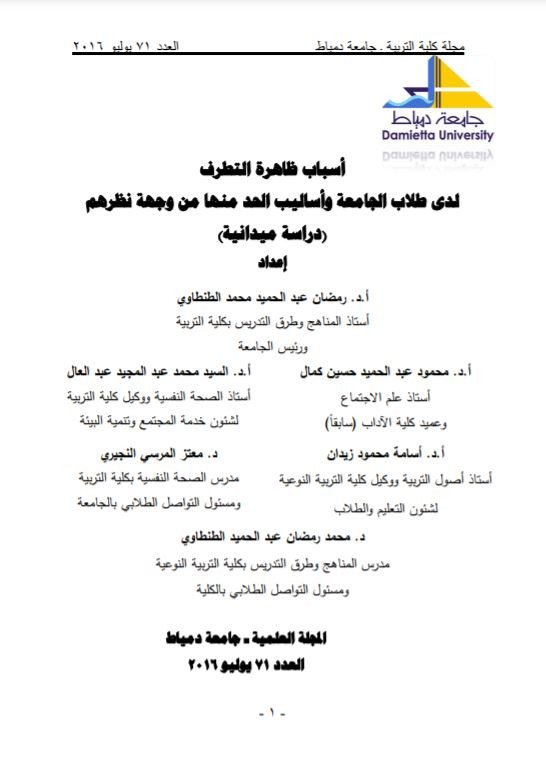 أسباب ظاهرة التطرف لدى طالب الجامعة وأساليب الحد منها من وجهة نظرهم) دراسة ميدانية ( Year of publication: 2016 Author: Ramadan Abdel-Hamid Mohamed El-Tantawi | Mahmoud Abdel-Hamid Hussein Kamal | El-Sayed Mohamed Abdel-Meguid Abdel-Aal | Osama Mahmoud Zidan | Moataz El-Morsi El-Nagari | Mohamed Ramadan Abdel-Hamid El-Tantawi Corporate author: Damietta University تسعى الدراسة الى التعرف على الأسباب التي تؤدي الى انتشار ظاهرة التطرف. وأيضا مناقشة الأساليب الأكثر جدوى ومناسبة في الحد من ظاهرة التطرف. وتنتهي الورقة بوضع توصيات وحلول للحد من هذه الظاهرة.