
Resources
Explore a wide range of valuable resources on GCED to deepen your understanding and enhance your research, advocacy, teaching, and learning.
2,775 Results found
 Multilingual education: Why is it important? How to implement it? Year of publication: 2014 Corporate author: UNESCO Mother tongue instruction is in the context of bilingual education / multilingual education (MLE) because it lays a solid foundation for learning, improves access to education (especially for girls), improves learning outcomes, raises the quality of education by emphasizing understanding and creativity rather than repetitive memorization. Furthermore, learners who are excluded from the education system are those who mosk likely benefit from multilingual education. There are several ways to implement MLE, such as by creating a favourable environment, using appropriate materials, training teachers and educators, and taking into account the learners' knowledge.
  Teacher Training for Multicultural Education in Favour of Democracy and Sustainable Development: the Territorial Approach Year of publication: 1995 Author: Raúl Galiardi | Paula Bernadini Mosconi Corporate author: UNESCO This publication is part of the book Teacher Training and Multiculturalism: National Studies. This book presents the outcomes concerning the initial training systems of teachers in eight countries at different levels of development in different regions of the world but who are faced with a common challenge to educate for cultural diversity. Both the conclusions of each particular study and the general outcomes demonstrate the complexity of the problems and the benefits of comparative analysis. Overcoming prejudices and stereotypes is not an easy task nor likely to be achieved in the short term. Mentalities change far more slowly than knowledge and, because of this, educational strategies need to be applied in the long term. This study also shows that it is necessary to improve the exchange of experiences as well as contacts between people and institutions who are confronted with the same problems in different contexts. The publication of the initial outcomes of this project is intended to enrich the quality of discussions between specialists and institutions who, in different parts of the world, are concerned by multicultural education as an instrument to promote understanding, respect and dialogue between cultures.
  문화정책의 (재)구성: 발전을 위한 창의성 증진; 문화다양성 협약 글로벌 리포트, 2018 Year of publication: 2018 Corporate author: 유네스코 '글로벌 리포트(Global Report)' 시리즈는 유네스코 「문화적 표현의 다양성 보호과 증진에 관한 협약(2005)」의 이행을 모니터링하기 위해 기획되었다. 본 시리즈는 이러한 이행 과정이 UN의 2030 지속가능발전목표 및 세부목표를 달성하는 데 어떻게 기여하는지 증거를 통해 보여주고 있다.2018년 글로벌 리포트는 2015년에 첫 번째 리포트가 출간된 이후 협약을 이행하면서 이루어진 진전 사항을 분석하고 있다.본 보고서는 협약 당사국들이 제출한 국가보고서에 대한 분석과 그와 관련된 새로운 연구 결과를 바탕으로 협약이 10개의 모니터링 분야에서 세계 및 국가 수준의 정책 변화에 어떻게 영향을 주었는지 검토하고 있다. 또한 본 보고서는 디지털 환경의 급속한 변화에 맞는 문화정책을 다루면서 인권과 기본적 자유를 기반으로 하는 향후 일련의 정책 권고안을 제시하고 있다.이 두 편의 글로벌 리포트는 문화정책을 수립하고 발전을 위한 창의성을 증진시킬 수 있는 새롭고 가치 있는 증거를 제시하기 시작하고 있다. Re|shaping Cultural Policies: Advancing Creativity for Development; 2005 Convention Global Report, 2018 Year of publication: 2018 Corporate author: UNESCO The Global Report series has been designed to monitor the implementation of the UNESCO Convention on the Protection and Promotion of the Diversity of Cultural Expressions (2005). It also provides evidence of how this implementation process contributes to attaining the United Nations 2030 Sustainable Development Goals and targets.The 2018 Global Report analyses progress achieved in implementing the 2005 Convention since the first Global Report was published in 2015.Grounded in the analysis of the Quadrennial Periodic Reports submitted by Parties to the Convention and relevant new findings, this report examines how the 2005 Convention has inspired policy change at the global and country level in ten areas of monitoring. It puts forward a set of policy recommendations for the future, addressing the adaptation of cultural policies to rapid change in the digital environment, based on human rights and fundamental freedoms.When deployed together, the two editions of the Global Report are beginning to produce new and valuable evidence to inform cultural policy making and advance creativity for development. Repenser les politiques culturelles: la créativité au coeur du développement; Rapport mondial Convention 2005, 2018 Year of publication: 2018 Corporate author: UNESCO La série des Rapports mondiaux a été conçue pour faire le suivi de la mise en oeuvre de la Convention de l’UNESCO sur la protection et la promotion de la diversité des expressions culturelles (2005). Elle sert également à montrer comment ce processus contribue à la réalisation des Objectifs de développement durable des Nations Unies à l’horizon 2030.Le Rapport mondial 2018 analyse les progrès accomplis dans la mise en oeuvre de la Convention de 2005 depuis la publication du premier Rapport mondial en 2015.A partir des rapports périodiques quadriennaux soumis par les Parties à la Convention et de nouvelles analyses, ce Rapport examine comment la Convention de 2005 a inspiré des changements politiques aux niveaux mondial et national dans dix domaines clés de l’action politique. Il propose un ensemble de recommandations politiques pour le futur et met l’accent sur l’adaptation des politiques culturelles, fondées sur les droits de l’homme et les libertés fondamentales, afin de faire face aux transformations rapides suscitées par l’environnement numérique.
 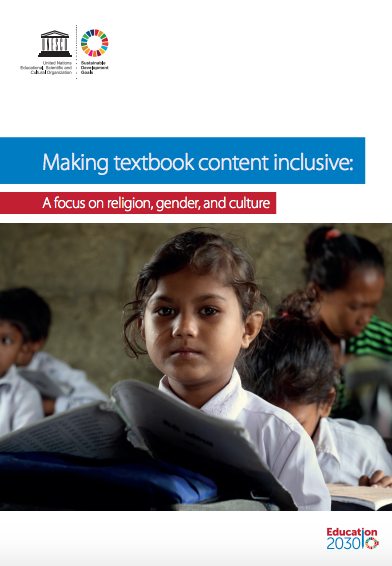 Making Textbook Content Inclusive: A Focus on Religion, Gender, and Culture Year of publication: 2017 Corporate author: UNESCO UNESCO has been working on textbook development issues since its inception in 1945 as part of its fundamental mandate to “build peace in the minds of men and women.” The present guide’s primary task is to enable its users to address and counter stereotypes in a variety of educational contexts, through teaching and learning materials. The three key issues – religion, gender and culture – were chosen for their common link to the concept of human diversity. These three potentially controversial topics are important aspects of inclusive education because they help shape the learning environment of a school as well as its educational practices.The guide was intentionally written in a simple, practical style so as to be immediately accessible to textbook developers, adopters, and users, even those who are working on their own. Although it is designed primarily for textbook authors, curriculum developers, and teachers, it might also be particularly useful for publishers, political stakeholders, and teacher educators. Pour des manuels scolaires au contenu inclusif Year of publication: 2017 Corporate author: UNESCO UNESCO has been working on textbook development issues since its inception in 1945 as part of its fundamental mandate to “build peace in the minds of men and women.” The present guide’s primary task is to enable its users to address and counter stereotypes in a variety of educational contexts, through teaching and learning materials. The three key issues – religion, gender and culture – were chosen for their common link to the concept of human diversity. These three potentially controversial topics are important aspects of inclusive education because they help shape the learning environment of a school as well as its educational practices.The guide was intentionally written in a simple, practical style so as to be immediately accessible to textbook developers, adopters, and users, even those who are working on their own. Although it is designed primarily for textbook authors, curriculum developers, and teachers, it might also be particularly useful for publishers, political stakeholders, and teacher educators.
  Consolidated Report on the Implementation of the 1974 Recommendation Concerning Education for International Understanding, Cooperation and Peace and Education Relating to Human Rights and Fundamental Freedoms Year of publication: 2013 Corporate author: UNESCO Background: In accordance with 34 C/Resolution 87, 177 EX/Decision 35 (I) and 184 EX/Decision 20, the Executive Board has monitored the implementation of the 1974 Recommendation concerning Education for International Understanding, Cooperation and Peace and Education relating to Human Rights and Fundamental Freedoms. Pursuant to 192 EX/Decision 20 (III), the Director-General hereby submits the consolidated report on the implementation by Member States of the Recommendation.Purpose: This document reports on the results of the Fifth Consultation on the Implementation of the Recommendation concerning Education for International Understanding, Cooperation and Peace and Education relating to Human Rights and Fundamental Freedoms (covering the period 2009-2012). The analysis was prepared on the basis of 55 national reports from Member States received by the Secretariat.
 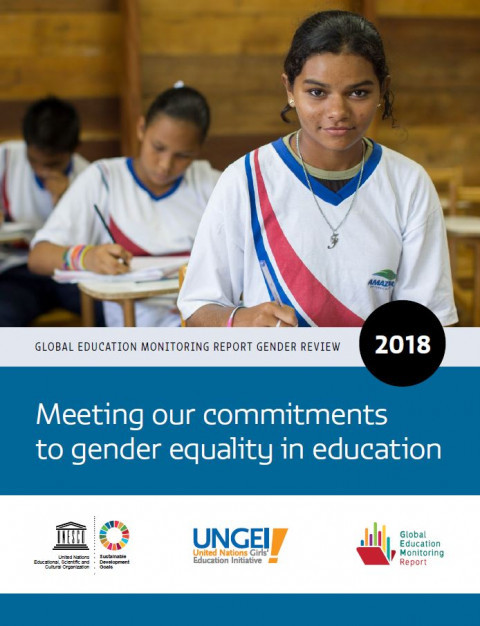 Meeting Our Commitments to Gender Equality in Education: Global Education Monitoring Report Gender Review 2018 Year of publication: 2018 Corporate author: UNESCO The Education 2030 Framework for Action, a tool aimed at helping the international community achieve SDG 4 on education, explicitly recognizes gender equality as a guiding principle linked to the realization of the right to education. It states clearly that girls and boys, women and men, must be equally empowered ‘in and through education’.In this sixth Gender Review, in a series that began in 2011, the Global Education Monitoring Report team maintains the focus on a broad conception of gender equality that extends beyond counting boys and girls in classrooms. The review’s first part examines disparities in participation and skills, in education and political leadership positions, and in selected aspects of infrastructure and curricula. It also examines gender issues in professional development by exploring the role of education in three other SDGs: those concerning agriculture, health, and water and sanitation.The second part of the review analyses institutions, laws and policies to explore ways to determine and enforce accountability for gender equality in education. Tenir nos engagements en faveur de l'égalité des genres dans l'éducation: Rapport mondial de suivi sur l'éducation, résumé sur l'égalité des genres 2018 Year of publication: 2018 Corporate author: Organisation des Nations Unies pour l'éducation, la science et la culture (UNESCO) Le Cadre d’action Éducation 2030, outil qui vise à aider la communauté internationale à atteindre l’ODD 4 sur l’éducation, reconnaît explicitement l’égalité des genres comme principe directeur lié à la réalisation du droit à l’éducation. Il stipule clairement que les filles et les garçons, les femmes et les hommes, doivent bénéficier des mêmes possibilités « dans et par l’éducation ».Dans ce sixième résumé sur l’égalité des genres, qui fait partie d’une série qui a commencé en 2011, l’équipe du Rapport mondial de suivi sur l’éducation reste concentrée sur une large conception de l’égalité des genres, qui va au-delà du simple comptage du nombre de filles et de garçons dans les classes. La première partie du résumé examine les disparités en matière de participation et de compétences, aux postes à responsabilité des secteurs éducatif et politique et dans certains aspects des infrastructures et des programmes scolaires. Elle examine également les questions liées au genre dans le cadre de la formation professionnelle, en explorant le rôle de l’éducation dans trois autres ODD concernant l’agriculture, la santé, et l’eau et l’assainissement.La deuxième partie du résumé analyse les institutions, les lois et les politiques afin d’explorer des manières de déterminer et de faire appliquer le principe de responsabilité pour l’égalité des genres dans l’éducation.